Lake Huron, second largest of the Great Lakes of North America, bounded on the west by Michigan (U.S.) and on the north and east by Ontario (Can.). The lake is 206 mi (331 km) long from northwest to southeast, and its maximum width is 183 mi. The total area of its drainage basin is 51,700 sq mi (133,900 sq km), exclusive of the lake surface area, which is 23,000 sq mi. Inflow into the lake is received from Lake Superior (via the St. Marys River), from Lake Michigan (via the Straits of Mackinac), and from numerous streams draining the adjacent lands. The lake discharges at its southern end into Lake Erie (via the St. Clair River, Lake St. Clair, and the Detroit River). With a mean surface height of 577 ft (176 m) above sea level, the lake reaches a maximum depth of 750 ft. Many islands lie in the northeastern part of the lake, notably Manitoulin Island and many others in Georgian Bay and the North Channel. Scenic Mackinac Island and several others are located near the Straits of Mackinac in the northwest part of the lake, and Saginaw Bay indents the Michigan coast.
Lumbering and fishing have been important economic activities in the Lake Huron region, and many resorts line the lake’s shores. As part of the St. Lawrence Seaway, the lake supports heavy commercial traffic in iron ore, grain, and limestone. The average navigation season extends from early April to late December. Large tonnages of limestone are loaded at Rockport and Rogers City, Mich. Other harbours important in local trade include Cheboygan, Alpena, Bay City, and Harbor Beach (in Michigan) and Collingwood, Midland, Tiffin, Port McNicoll, and Depot Harbor on Georgian Bay
Lake Huron was the first of the Great Lakes to be seen by Europeans. The French explorers Samuel de Champlain and Étienne Brûlé travelled up the Ottawa and Mattawa rivers and reached Georgian Bay in 1615. Brûlé traversed the North Channel to the St. Marys River in 1618. A Jesuit mission was established among the Huron Indians at the Wye River (southeastern corner of Georgian Bay) in 1638 and named Sainte-Marie; but it was destroyed by the Iroquois Indians in 1649. After that, the centre of French activities shifted northwestward to the settlement at Sault Ste. Marie on the St. Marys River. Jacques Marquette, the French missionary and explorer, founded a mission at St. Ignace on the Straits of Mackinac in 1671.
Meanwhile, Louis Jolliet, the French-Canadian explorer, canoed down Lake Huron in 1669 before discovering Lake Erie. The French explorer Robert Cavelier, sieur de La Salle, sailing westward from Niagara, traversed Lake Huron in 1679. British penetration of the lower lakes developed strongly in the mid-18th century, leading to the British capture of Fort-Pontchartrain-du-Détroit (Ft. Detroit) in 1760 and Michilimackinac on the Straits of Mackinac (1761). The current boundary between the U.S. and Canada was drawn after the Revolutionary War (1775–83) and was firmly established after the War of 1812. In the latter war, the fort on Mackinac Island (overlooking the Straits of Mackinac) was taken by the British, but U.S. troops reoccupied it at the close of the war. The lake was named by the French after the...
Read moreLake Huron /ˈhjʊrɒn, ˈhjʊrən/ (French: Lac Huron) is one of the five Great Lakes of North America. Hydrologically, it comprises the easterly portion of Lake Michigan–Huron, having the same surface elevation as its westerly counterpart, to which it is connected by the 5-mile-wide (8.0 km), 20-fathom-deep (120 ft; 37 m) Straits of Mackinac. It is shared on the north and east by the Canadian province of Ontario and on the south and west by the state of Michigan in the United States. The name of the lake is derived from early French explorers who named it for the Huron people inhabiting the region. The Huronian glaciation was named due to evidence collected from Lake Huron region. The northern parts of the lake include the North Channel and Georgian Bay. Across the lake to the southwest is Saginaw Bay. The main inlet is the St. Marys River, and the main outlet is the St. Clair River.
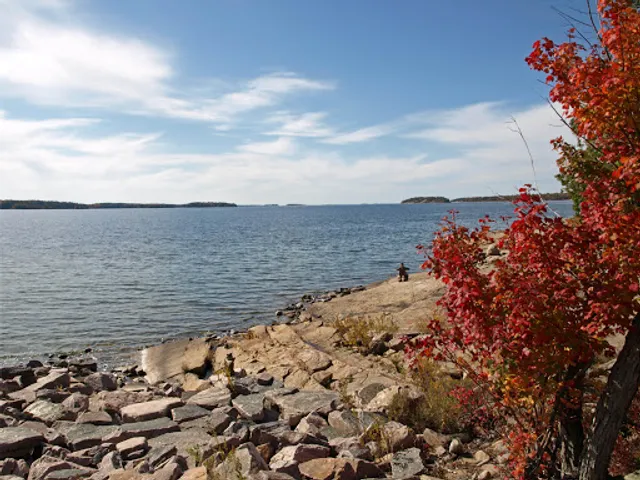
Lake HuronLake Huron has the largest shore line length of any of the Great Lakes, counting its 30,000 islands.[15]
Lake Huron is separated from Lake Michigan, which lies at the same level, by the 5-mile-wide (8.0 km), 20-fathom-deep (120 ft; 37 m) Straits of Mackinac, making them hydrologically the same body of water (sometimes called Lake Michigan-Huron and sometimes described as two 'lobes of the same lake').[15] Aggregated, Lake Huron-Michigan, at 45,300 square miles (117,000 km2), "is technically the world's largest freshwater lake."[15] When counted separately, Lake Superior is 8,700 square miles (23,000 km2) larger than Huron and higher. Lake Superior drains into the St. Marys River which then flows southward into Lake Huron. The water then flows south to the St. Clair River, at Port Huron, Michigan and Sarnia, Ontario.
The Great Lakes Waterway continues thence to Lake St. Clair; the Detroit River and Detroit, Michigan; into Lake Erie and thence – via Lake Ontario and the St. Lawrence River – to the...
Read moreLake Huron, one of the five Great Lakes of North America, is known for its expansive size and stunning shoreline. It is the second-largest Great Lake by surface area and features beautiful islands, sandy beaches, and charming coastal towns.
Activities:
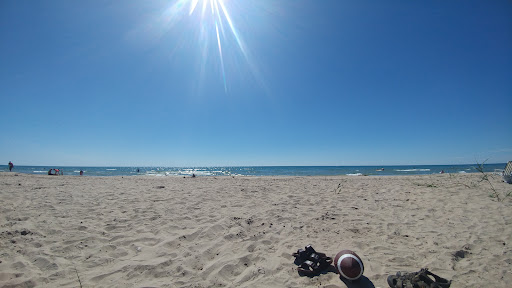
• Swimming and Sunbathing: • The lake’s beaches, such as those at Sauble Beach and Wasaga Beach, are perfect for swimming, sunbathing, and enjoying water sports during the summer. • Boating and Fishing: • Lake Huron offers excellent opportunities for boating, sailing, and fishing, with various species like salmon, trout, and perch attracting anglers. • Exploring Islands: • The lake is home to several islands, including Manitoulin Island—the largest freshwater island in the world—where visitors can hike, bike, and explore charming communities.
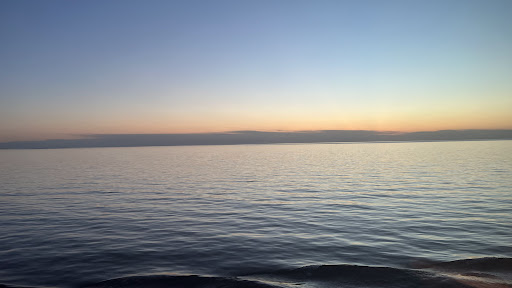
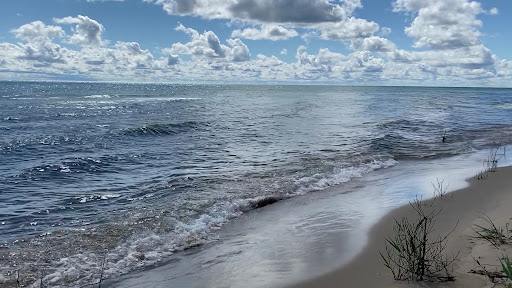
Scenery: Lake Huron is characterized by its stunning blue waters, sandy shores, and picturesque sunsets. The shoreline features diverse landscapes, including rugged cliffs, lush forests, and charming lighthouses.
Cultural Attractions:
• Historic Sites: Visitors can explore historic sites like Fort Mackinac on Mackinac Island and the Maritime Museum of the Great Lakes in Kingston. • Local Festivals: Coastal towns often host festivals celebrating local culture, food, and art, providing a glimpse into the region’s heritage.
Visitor Amenities: The towns around Lake Huron offer a wide range of accommodations, from hotels to cozy bed-and-breakfasts. Dining options abound, featuring fresh local seafood and regional cuisine.
Conclusion: Lake Huron is a beautiful destination that combines outdoor adventure, stunning scenery, and rich cultural experiences. Whether you’re swimming, boating, or exploring the charming towns, it offers a memorable experience in the heart of the Great...
Read more