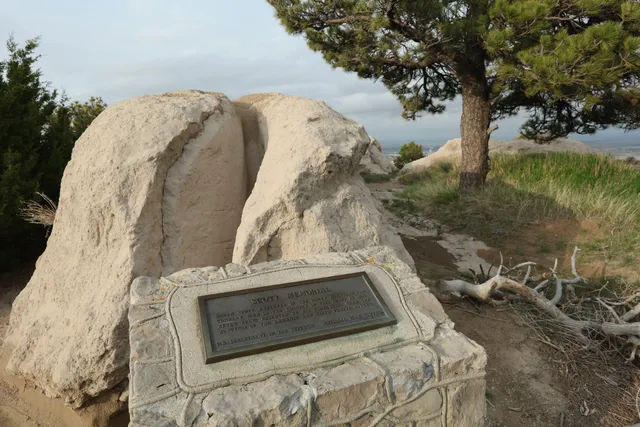
Great staff, free entry. The staff always have time for you. I have one thought about some of the information at the park. There is a post at the top of the hill, placed there around 1933. When it was placed, the top of the post was flush with the ground, according to the placard by the trail in front of the post. The post now extends around 12” or more from the ground. The placard says this is due to erosion. So it would seem as though the hill is eroding at a rate of 1 foot every 90 years, or 13 1/3 inches every 100 years. I mean according to the basic principles of uniformitarianism, we can look at current processes and typically assume that these current processes have been happening the same way for all of time.
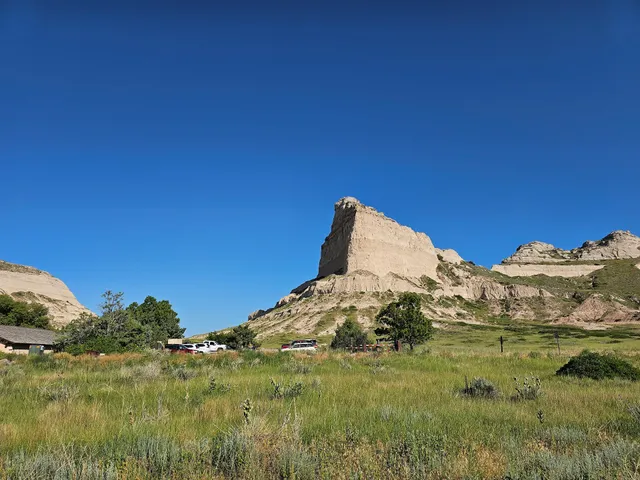
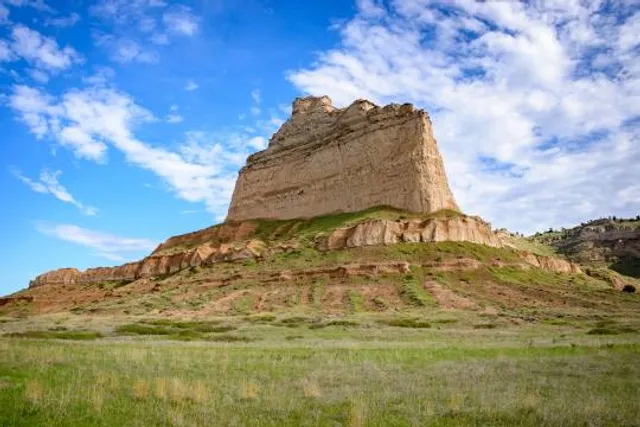
Another thing I noticed was that the bluff was formed when hardened volcanic ash was eroded by the drainage of an inland sea (according to the placards and exhibits at the park). This sea (according to Wikipedia) “…existed from the early Late Cretaceous (100 million years ago) to the earliest Paleocene (66 Ma)…” So this seems to indicate that the sea dried up by 66 million years ago.
So 1 foot of erosion every 90 years for 66 million years, according to uniformitarianism, is around 138 miles. That means that this bluff must have been 138 miles high, in addition to its current height above sea level.
If we say it only erodes 6 inches every 100 years for 10 million years, that makes Scott’s bluff 50,000 feet tall. Almost twice as tall as Mount Everest.
Even if we say it only erodes 6 inches every 100 years for 1 million years, it is still 5,000 feet taller than it is now.
So maybe there was a time with little rain and very little erosion due to that. Without rain, the bluff becomes much more susceptible to wind erosion, and in Nebraska… I mean I don’t know if a lack of rain would actually decrease erosion rates that much. Maybe there was a time where I’ve froze the bluff and kept it from eroding… but we don’t see that in reality. We see glaciers carving out massive valleys in mountains. Potentially even faster than a liquid water river.
So I don’t know… maybe I missed something, but something must be way off. Maybe our perception of how long the earth itself has existed is wrong, or maybe the change we observed on top of the bluff is an illusion. There could be many reasons the facts don’t seem to match up. But to me, it seems the bluff hasn’t existed for nearly as long as the current theories suggest.
Please fill me in on what I may have missed in...
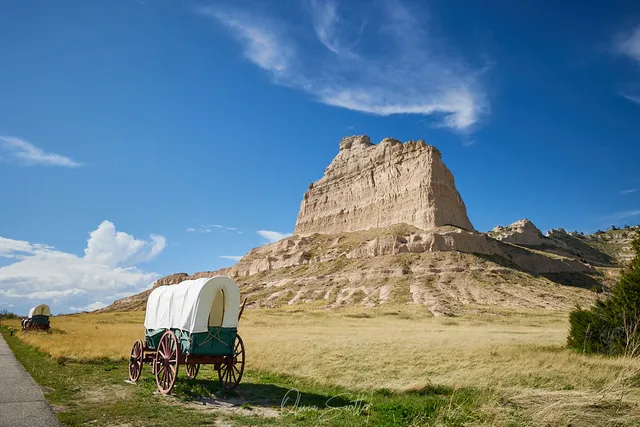
Read moreLove the Scottsbluff National Monument. Worked there as it was my 1st job when I was 16 years old. I gave living history performances dressed as a prairie wife waiting on my husband who went fishing nearby at the Platte River while outside I'm making pancakes, hardtack and very black coffee over an open fire. I also showed them the many things brought along with them. Little trinkets to set on their forever home mantle and wrapped with care for the rough terain. Showed them the clothes worn, hair brushes, food brought with them. I enjoyed that so much and met people from all over the world. The walking trail to the east of the museum winds a bit and is not long but watch for rattlesnakes on the trail. This walking path believe it or not goes all the way to the top of the bluff and you see a beautiful scenic view of the panhandle. If you don't feel like walking you can drive up to the top and take in the view. If you came on a bus just passing thru you can also go up the driving road. To the west of the museum there is another short trail but this one you can see the original wagon rutts by seeing the depth of the trail your walking in is actually the worn down trail as the pioneers passed through with their heavily loaded wagons. The museum has many artifacts and writings in the sandstone from pioneers that made their stop here. This was one of the landmarks the pioneers used as a visual map to get from Chimney Rock to the bluff. You won't be disappointed. Please stop in and take in the aerial...
Read moreScotts Bluff National Monument is a great place for a family adventure or as a personal get-away. There are several miles of paved trails near the museum at the base of the Bluff. The walking trail leading to the summit is 1.6 miles long (one way) and will take most steady walkers 35 to 40 minutes to accomplish; plus the quicker walk down. There is also a paved road for pedestrian vehicles to travel to the summit. At the time of this post a Day Pass (lasts 7 days) costs about $8.00. An Annual National Pass costs $80. A Lifetime Senior Pass is also $80. Inside the museum visitors have access to information about the Oregon Trail, it's travelers, the Native people of the land, local wild life and vegetation. There are public restrooms inside and out of the museum near the fire pit. From time to time educators will deliver informative seminars on various topics to visitors around the fire pits. Although pets are allowed on the trails if leashed, smoking is not; also the trail is rugged and includes stairs-thus it is not wheelchair accessible. Once at the summit, visitors are able to see all of Scottsbluff and Gering cities as well as the "Bad Lands" immediately to the north at the base of the bluff. Out to the east another National Monument and landmark is visible- Chimney Rock. On a clear day, a notable mountain in Wyoming can be spotted on the western horizon. I hope this information was informative, please stay safe on the trails, watch your step...
Read more