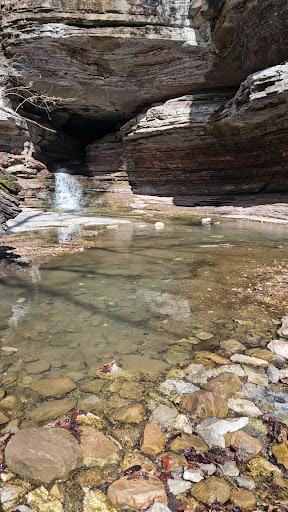
It seems so odd to see Lost Valley now that it so groomed and manicured. The numbers of people visiting also make me thoughtful. I first walked up the valley over 40 years ago, when it was known only to local people. As a clueless Yankee, I was lucky to have been taken under the wing of some of the best people I have ever had the honor of knowing--native Arkansans. And it WAS an honor--they took me to special places that were unbelievably beautiful. I don't want to be dramatic, but there was an otherworldly quality to the Ozarks then, no place more so than Lost Valley. Some places were dangerous to get to. We hiked and climbed and swam and balanced precariously. Getting up to the top cave (which is what we called it then) was truly a climb. It surprises me that nobody mentions some of the things that occurred to me the first time, and the subsequent times, I went to LV: It's important to sit in Cob Cave in the winter at sunset, when no one is really around (at least back then) and it's overcast and chilly and think of the neolithic people who lived there for a hundred generations thousands of years ago. And I wonder if whoever is in charge nowadays (and there wasn't anybody in charge back then) has shut off the other access through the top cave to the Great Room. It's very narrow, and I suppose there are many people (having eaten too many Whoppers) who can't make it through and might get stuck. It looks to me like the new owners of Lost Valley don't want stuck tourists on their watch--bad PR for the "natural state." Lost Valley really was "lost." Local people didn't talk about it much. It wasn't known at all as a tourist spot. There were several other places just as remarkable, just as literally unbelievable, like a chute cut down the side of a mountain that widened out into a series of deep pools, clear all the way to the bottom, with hundreds of tiny flowers, mosses and lichens growing down to water's edge. You could start at the top of the chute (worn smooth as glass by centuries of rushing water), and slide all the way to the river at the bottom, going over waterfalls into the pools, which all ended with a waterfall and another pool. I hesitate to call places "magic," but this place was: You knew just as soon as you came to the top of the downward creek and there were cactuses and pastel flowers and ancient cedars growing all around, plants that you just didn't see anywhere else--not only in Arkansas--but anywhere in the mid-South or Midwest. No waterpark ride ever equalled it. In a way, I'm glad (and angry) that the people on whose land the stream flowed down to the river closed off access to the public. But I suppose in a way they were right to do so. There were no water or restrooms (as the reviewers here sometimes note as being essential) and sliding down the stream could be very dangerous, something you wouldn't want your kid to do, unless you were one of those people who, like my dear friends, believed kids should take chances in the name of pure joy. Well, anyway, I think it's okay that Lost Valley sort of stands for all those places in the Ozarks that few people know of and should remain unknown. If you've been to Lost
Valley, try to imagine it like that--with no one else around. The sound of moving water and songbirds. And caves by candlelight where you didn't know where you'd end up. I'd travelled all over the world by the time I got to Lost Valley, but I never imagined I'd...
Read more
 Learn more insights from Wanderboat AI.