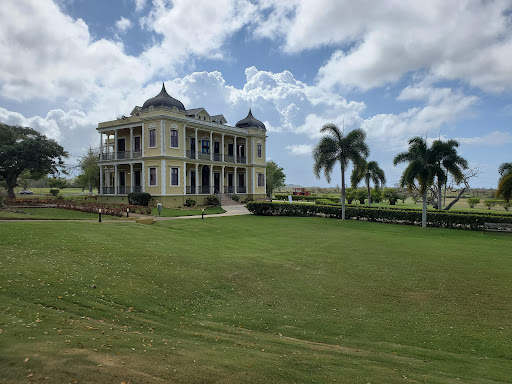
🇵🇷 This is a historic home as you can see it today designed in the Renaissance/French Chateau style I believe that the French Pallot family were the last to live here. The Pallot’s bought it in 1893. It is the only building still standing where both coffee and sugar were planted and processed.
🧡 It seems Juan Labadie, lived there with his family from 1860 until his death in 1893. His wife remained in the home until she apparently sold it that same year. I was able to tour the inside of this home when that was an option in the late 2000’s. At the time it was sparsely decorated. Today solely its’ grounds are available to visit on weekdays and they are beautifully landscaped. Well worth a visit.
🧡 Moca, in the 1930’s had become known as the “Capital of Mundillo”, an intricate lace craft to which a museum is designated to nearby. .It’s speculated by current Mundillo Master artisans (see the YouTube video featuring Artist Nellie Vela Sáchez) that wealthy European families who took residence in Moca, may have brought knowledge of this artistic craft to Moca from France 🇫🇷, initiating its enormous growth and positive impact on the local labor force.
🤓 At the time of my visit, my friend and I were the only visitors in attendance, this was in the late 2000’s. The gentleman who showed my friend and I around, and told us that it’s former residents had come to the island as a result of the encouragement for European families to come live in Puerto Rico. That concept seemed unusual to me and it stayed on my mind. I noticed what looked like an old freight container from a train on the grounds, I thought: What would make a wealthy family in the 1800’s (!) move thousands and thousands of miles away to establish a new life in Puerto Rico?
What this local man was referring way back then was a decree known as the “Royal Decree of Graces” of 1815, enacted by the Spanish Crown, it’s purpose served as a legal order to encourage Spaniards and Europeans of non-Spanish origin, to settle in and populate the colonies of Puerto Rico and Cuba. Both the Labadie and Pellot families benefited from this decree.
From Wikipedia -
“On 10 August 1815, King Ferdinand VII of Spain approved the Spanish Royal Decree of Graces, which granted Puerto Rico the right to have commercial ties with countries which were in good standing with Spain. It also granted free land to settlers, as well as incentives for investing money and providing technology for agricultural development to any Spaniard willing to relocate and settle in those territories.
Puerto Rico was largely undeveloped until 1830, when immigrants from the Spanish provinces of Catalonia, Majorca, and the Canary Islands began to arrive. They gradually developed the sugarcane, coffee, and tobacco plantations, based on the use of African slave labor. “
——————————
✏️ 🗞 📚 On the grounds of Castillo Labadie lies the burial site of Enrique Arturo Laguerre Vélez (July 15, 1905 – June 16, 2005) a noted teacher, novelist, playwright, critic, and newspaper columnist from Moca. He is the author of the 1935 novel La Llamarada, long considered an important work of Puerto Rican Literature. A granite tombstone marks this spot.
Laguerre Tombstone Inscription:
Enrique Arturo Laguerre Velez
1905 - 2005
A Man Conscious Of His Identity
Teacher, Novelists, Short Story Writer
Essay, Playwright, Poet and Journalist
————————————-
I encourage you to visit this historic site.If you call their office number, they will gladly answer your questions. If you do not speak Spanish please enlist the help of a friend to...
Read more
 Learn more insights from Wanderboat AI.