The first time I visited the “official“ Minidoka Historic Site, it was located within the visitor center at Hagermann Fossil Beds National Monument. On display were many photographs, detailing the life and struggles of the Japanese internments and what they were forced to endure.
Since then, Minidoka NHS has recently established itself on the original site, near Hunt Idaho, where thousands of Japanese were sent during WWII to collectively reside in a US government relocation camp. Minidoka (1942-1945) was one of these many relocation centers, ten in total.
Two months after the invasion at Pearl Harbor. President Roosevelt signed Executive Order #9066. In it, all persons of Japanese ancestry (whether citizens or aliens) were forced to move away from the Pacific Ocean. It was deemed necessary at the time to prevent espionage. All Japanese American citizens or those of Japanese ancestry were forced into “camps” east of the Cascade Mountain Range or east of the Sierra Nevada Mountains.
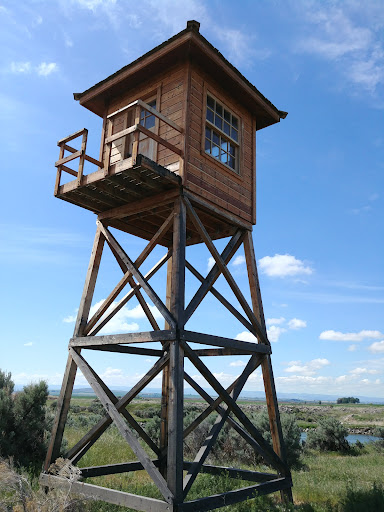
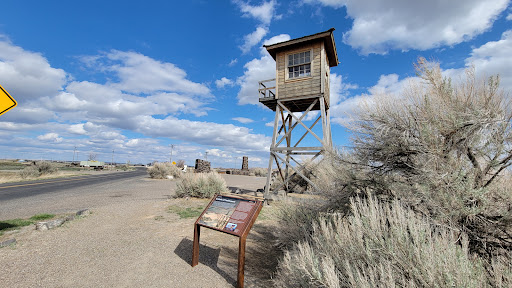
The US government also claimed that relocation into isolated camps was necessary to protect those of Japanese descent. But many residents wondered why the guns were pointed towards them, and not defensively aimed away from the barbed wire.
It wasn’t until 1988 that Congress passed Public Law 100-383 where the United States government acknowledged the stunning injustice of Japanese Internment Camps, including Minidoka (Hunt Relocation Center). With an apology, $20,000 was given to each of those interned. Unfortunately, most of those that were sent to relocation camps lost everything they owned (except the clothes on their backs plus the contents of one suitcase), including homes, cars and businesses. It negatively changed their lives forever.
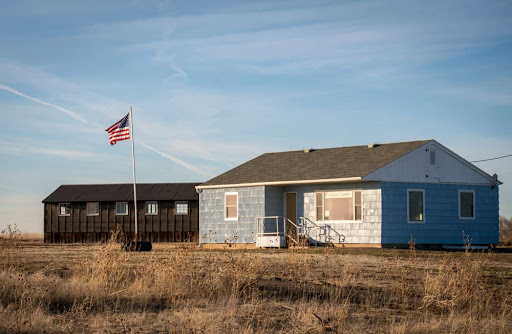
If visiting Minidoka, it is good to understand that construction of this National Historic Site is just beginning. There is currently a temporary visitor center located in the “Herrmann House.” The Herrmann family lived here for many years, establishing a farm within the camp’s boundaries after the closure of the Hunt Relocation Center (Minidoka).
Located hundreds of miles away, near Bishop CA, east of the Sierra Nevada Mountains, is Manzanar National Historic Site. It, too, was established in 1942 as a Japanese Relocation Center. Manzanar NHS is exceptional in its site re-creation and the stories of the extreme hardships that those of Japanese ancestry were forced to endure. If one had to chose between these two historical sites to visit, (now) go to Manzanar. I truly hope that the eventual completed site at Minidoka will also bring its visitors to tears. And if Minidoka becomes as powerful in its message as Manzanar, it will truly deserve five stars.
Be careful. Winter hours and open days (visitor center) are...
Read moreExtremely interesting! I'm very glad I took my children so they could learn about this and make sure and their lifetime that it doesn't happen again. I wouldn't say that it's for a little little kids but my 5-year-old was okay. They have a fun booklet for kids to do activities in and turn in to get a cool wood pin-on badge. My kids really enjoyed that. And they were really interested in the movie shown at the center. The workers were wonderful. Very knowledgeable, very understanding, friendly and ready to answer the barrage of questions we threw at them. The building is actually brand new, only dedicated February, so it's really nice and clean. Was a peaceful walk around part of the property. I just wish there were a lot more of the old buildings to see as it's kind of difficult to imagine the breadth of what it was like back then. Was very enriching and I am very...
Read moreFor something totally different, there’s an important piece of 20th-century history preserved about 20 minutes northeast of Twin Falls.
This is the Minidoka National Historic Site, a former internment camp that held some 10,000 Japanese American citizens.
In the wake of the Pearl Harbor attack in 1941 120,000 ordinary people were forced to leave their homes, jobs and lives and spend the rest of WWII in camps like this one. It was the largest forced relocation in American history.
Minidoka was one of 10 similar camps, and stands as a memorial to a chapter that continues to be controversial.
The site is open all year and can be discovered on a 1.6-mile self-guided trail. There’s also a visitor center presenting exhibits and a film about the site, but this was closed at the...
Read more