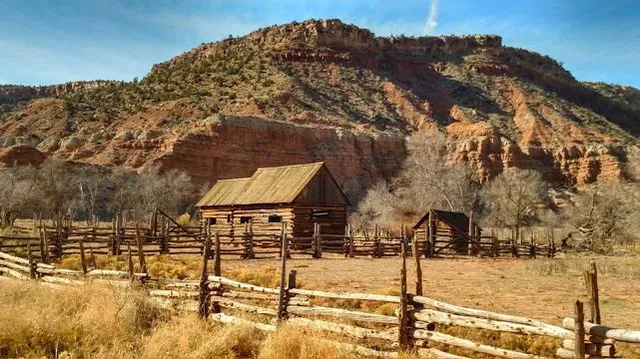
The site was first settled in December 1859 as part of a southern Utah cotton-growing project ordered by Brigham Young. A group from Virgin led by Nathan Tenney established a new settlement they called Wheeler. Wheeler didn't last long, it was largely destroyed on the night of January 8, 1862 by a weeks-long flood of the Virgin River, part of the Great Flood of 1862. The rebuilt town, about a mile upriver, was named New Grafton, after Grafton, Massachusetts. The town grew quickly in its first few years. There were some 28 families by 1864, each farming about an acre of land. The community also dug irrigation canals and planted orchards, some of which still exist. Grafton was briefly the county seat of Kane County, from January 1866 to January 12, 1867, but changes to county boundaries in 1882 placed it in Washington County. Flooding was not the only major problem. One particular challenge to farming was the large amounts of silt in Grafton's section of the Virgin River. Residents had to dredge out clogged irrigation ditches at least weekly, much more often than in most other settlements. Grafton was also relatively isolated from neighboring towns, being the only community in the area located on the south bank of the river. In 1866, when the outbreak of the Black Hawk War caused widespread fear of Indian attacks, the town was completely evacuated to Rockville. Severe flooding discouraged resettlement, and most of the population moved permanently to more accessible locations on the other side of the river. By 1890 only four families remained. The end of the town is usually traced to 1921, when the local branch of the Church of Jesus Christ of Latter-day Saints was discontinued. The last residents left Grafton in 1944. A United Press news item dated May 23, 1946, stated that the town was purchased by movie producer Harry Sherman as a film location site. He bought it from William Russell, 80, a descendant of the co-founder, and one the town's three current inhabitants. A great experience for me. I'm glad I was able to stop and explore this part of local history. Jeff Mullins Photography Adventures. Get Your Hike On! Please consider liking my...
Read moreSpooky? No but its an amazing look at frontier life. The buildings have been restored so you can go in them. The largest house was too dilapidated to safely enter when I was a kid. People complain that the walls look freshly painted. That's because they have been recently painted to cover up the vast amount of horrible graffiti that was there. People also complain about new grave markers and headstones on the cemetery. Well some of these deceased people still have relatives in the area that care about their loved ones and preserving their memories, its important to them. The only thing I found sad was that you couldn't go into the school house anymore. That building was always in remarkably good condition and I remember walking around in it on several different visits to the town when I was a kid. I took my kids here and I can tell you we all enjoyed ourselves immensely. ...
Read moreWe love finding historical buildings, and it's a bonus when it's a ghost town! Grafton is an abandoned town right before you go into Zions. We drove through dirt roads and crossed a suspension bridge before getting to our destination. It's a bit up on the mountains but no 4x4 cars needed. When we got there, it looked like others were doing a tour with a tour guide, so that is an option if you want to learn more about the history behind the buildings. We opted for our own self guide tour. We peeped inside the church building. Went inside a couple of houses as well as basements and ended our tour at the cemetery, which is where most of the family from the homes we visited were laid to rest. Each area had signs with an explanation on the building and history. PSA: Watch out for the fire aunts! They are all over, and you will he walking through fields going from one...
Read more