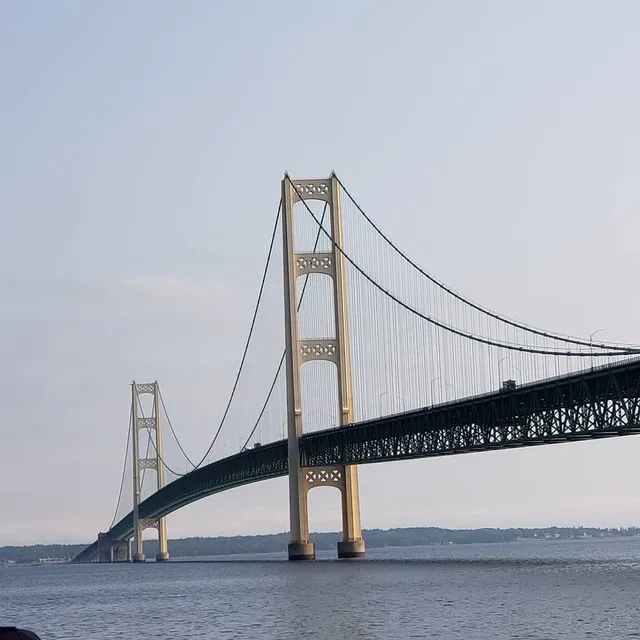
Length from cable bent pier to cable bent pier: 7,400 feet (2,256 m).
Total width of da roadway: 54 feet (16.5 m)
2 outside lanez: 12 feet (3.7 m) wide each
2 inside lanez: 11 feet (3.4 m) wide each
Center mall: 2 feet (0.61 m)
Catwalk, curb & rail width: 3 feet (0.91 m) on each side
Width of stiffening truzz in da suspended span: 68 feet (20.7 m).
Depth of stiffening truzz: 38.1 feet (11.6 m)
Height of da roadway @ mid-span: approximately 200 feet (61 m) above water level.
Vertical clearance @ normal temperature:
155 feet (47 m) @ da center of da main suspension span.
135 feet (41 m) @da boundariez of da 3,000 feet (914 m) wide navigation channel.
Construction cost: $99.8 million (equivalent to $669 million in 2016
Height of towerz above water: 552 feet (168 m)
Max. depth of towerz below water: 210 feet (64 m)
Depth of water beneath da center of da bridge, 250 feet (76 m)
Total length of wire in main cablez: 42,000 milez (68,000 km).
Total vehicle crossingz, 2005: 4,236,491 (average 11,608 per day)
Speed limit: 45 milez per hour (72 km/h) for passenger carz, 20 milez per hour (32 km/h) for heavy truckz. Heavy truckz are also required to leave 500 feet (150 m) spacin ahead.
KNOWN Major Accident Fatalitiez 5 workerz died durin da construction of da bridge. Diver Frank Pepper ascended too quickly from a depth of 140 feet (43 m) on September 16, 1954. Despite being rushed to a decompression chamber, da 46 year-old died from da bendz. 26 yr old Jamez LeSarge lost hiz balance on October 10, 1954, & fell into a caisson. He fell 40 feet (12 m) & likely died of head injuriez caused by impact wit da crizz-crossin steel beamz inside da caisson. Albert Abbott died on October 25, 1954. da 40 yr old fell 4 feet (1.2 m) into da water while workin on an 18-inch (46 cm) wide beam. Witnessez speculate he suffered a heart attack. 28 yr old Jack Baker & Robert Koppen died in a catwalk collapse near da north tower on June 6, 1956. Koppen's body waz never recovered. For both it waz der 1st day on da job. All 5 men R memorialized on a plaque near da bridge'z northern end (Bridge View Park)
One worker haz died since da bridge waz completed. Daniel Doyle fell 60 to 70 feet (18 to 21 m) from scaffoldin on August 7, 1997. He survived da fall but fell victim 2 da 50 °F (10 °C) water temperature. Hiz body waz recovered da next day in 95 feet (29 m) of water. also 2 vehiclez hav fallen off da bridge. On September 22, 1989, Leslie Ann Pluhar died wen her 1987 Yugo plunged over da 36-inch-high (91 cm) railin. A combination of high windz & excessive speed waz initially blamed. Later investigation showed da driver had stopped her car over da open steel gratin on da bridgez span & dat a gust of wind through da gratin blew her vehicle off da bridge, although diz iz not supported by recorded wind speed measurementz taken on & around da bridge @da time of da accident. On March 2, 1997, Richard Alan Daraban drove a 1996 Ford Bronco over da edge. It waz l8r determined 2 b a suicide. On September 10, 1978, a small private plane carryin United Statez Marine Corpz Reserve officerz Maj. Virgil Osborne, Capt. Jamez Robbinz, & Capt. Wayne W. Wisbrock smashed into 1 of da bridgez suspension cablez while flyin in a heavy fog. Da impact tore da wingz off da plane, which den plunged into da Straitz of Mackinac. All 3...
Read moreUseful information from someone who crosses twice a day every day: Please please please when you approach the toll booths, put down your phone, look up and ahead to see what lanes are open. Mac Pass is NOT EZ Pass. You will have to reverse out of your lane and look like an idiot trying to merge back into an open cash lane. Same goes to the people who rush both lanes when there's only 1 lane open, play it smart and get in line like good little boys and girls. Also cutting off semi trucks isn't smart either, they may be doing 20 but if you jump in front of one and get rear ended, don't say I didn't warn you. Also to the "super truckers" who ignore the "Trucks/Buses no passing" there are cameras every 5th light pole and the DOT are watching. Also 500 feet is 1 and 3/4 light pole lengths. The DOT patrol the bridge and WILL stop you if you're following too close, sometimes even driving up next to you and count the light pole distance too. Trucks loaded under 60,000lbs gross weight (lightly loaded) can do 45, as long as it's clear. But again you can't pass or tailgate. When in doubt, do 20. Vehicles requiring escort heading north, there's a nice little pulloff to the side immediately past the last exit on the right, that's where you will go to call the bridge and wait for the escort. If the bridge scares you, they offer a service to drive your vehicle across for you. Bicyclists and snowmobilers can get a ride across too (but they don't meet on the ramp). To people pulling boats, campers, toy haulers, and the bridge is in high wind warning and to do 20, this includes you too. Again the cameras are watching. People flip their toys all the time on here during a high wind warning, it's there for a reason. The center grates are slippery when wet, and depending on your tire tread pattern and speed, you may lose control. This is especially true for motorcyclists. Speed limit is 45. Not 55, not 65. You are being watched. If we all work together and follow the rules, the bridge will be a more enjoyable and safer place to be. Enjoy your time in...
Read moreA Marvel of Engineering: The Mackinac Bridge ⭐⭐⭐⭐⭐
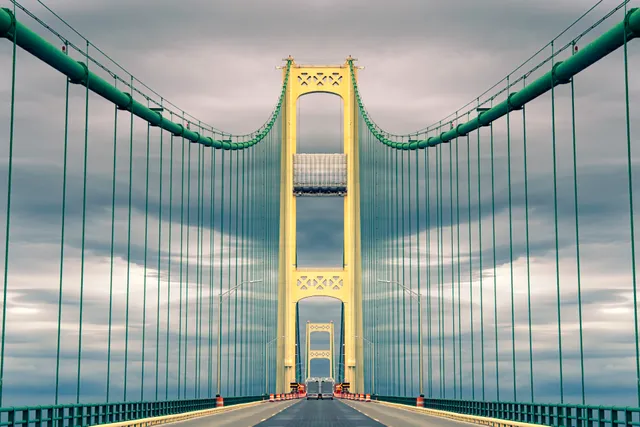
The Mackinac Bridge, affectionately known as "The Mighty Mac," stands as a testament to human ingenuity and determination. Spanning the Straits of Mackinac, it connects Michigan's Upper and Lower Peninsulas, a feat that was once deemed impossible.
Historical Significance
Opened on November 1, 1957, the bridge was designed by the renowned engineer David B. Steinman. At the time of its completion, it was the world's longest suspension bridge between anchorages, stretching 26,372 feet (8,029 meters) from shore to shore. This monumental structure not only bridged a physical gap but also united communities that had relied on ferries for decades.
Engineering Excellence
Constructed over turbulent waters, the bridge's design had to withstand fierce winds and the potential for ice floes. Its two towers rise 555 feet above the water, and the main span measures 3,800 feet, allowing ships to pass beneath with a clearance of 155 feet. The bridge's resilience and longevity are a direct result of meticulous planning and innovative engineering solutions.
Cultural Impact
Beyond its engineering feats, the Mackinac Bridge has become an iconic symbol of Michigan. It has been featured in numerous films, documentaries, and photographs, often serving as a backdrop that highlights the state's natural beauty and industrial prowess.
Visitor Experience
Driving across the bridge offers breathtaking views of the Great Lakes and the surrounding landscape. The experience is both humbling and exhilarating, providing a unique perspective on the vastness of the region. For those interested in learning more, the Mackinac Bridge Authority offers educational resources and guided tours that delve into the bridge's history and significance.
The Mackinac Bridge is more than just a structure; it is a monument to human achievement, connecting people and places while standing as a proud symbol of Michigan's spirit...
Read more