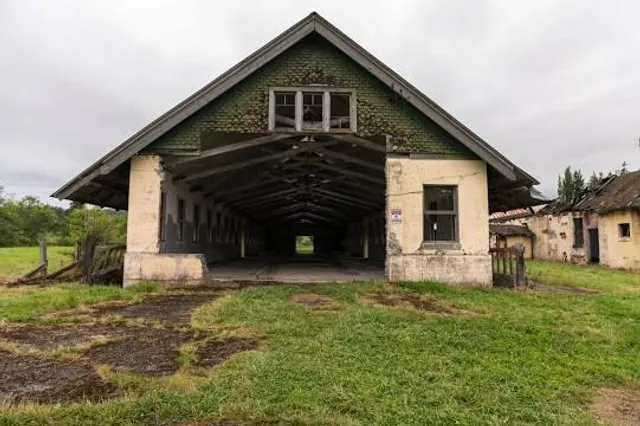
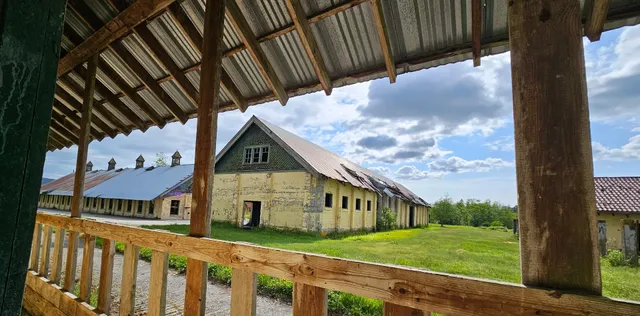
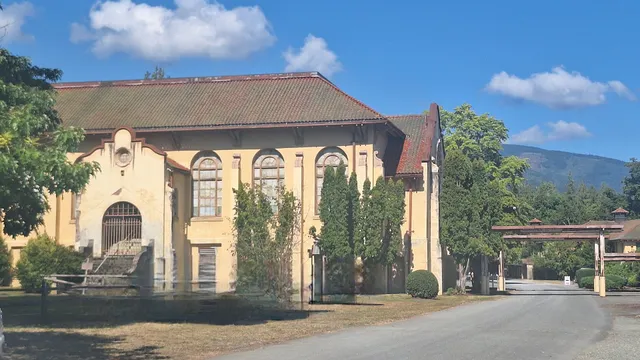
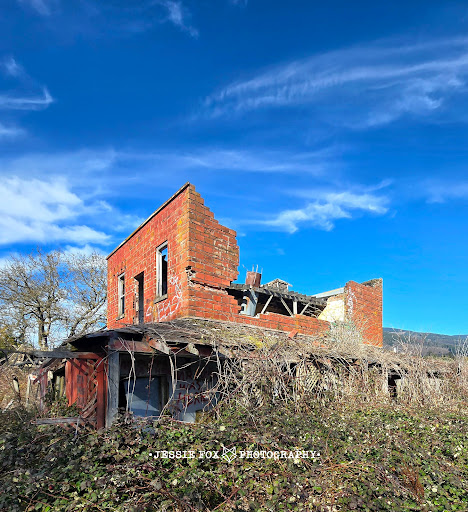
Let me first state that I think many people believe these buildings are of the old hospital, which they are not. They are part of the property, but these buildings are of the large farm that was a part of the Northern State Hospital grounds.
Beautiful buildings in various states of decay. Like with all old and crumbling buildings, there's a solemness about this vast piece of property. I couldn't help but wonder about the people who lived and worked here. And, hoped the patients at the hospital on the adjoining property were well cared for as is too often not the case of marginalized people like those with psychological problems that make it difficult, if not impossible, to live lives as most people are able to enjoy.
There is unfortunately a lot of evidence of people who litter and spray graffiti. Other than that, some of the buildings offer unique architecture which makes for great photography subjects.
I was absolutely thrilled that the buildings, although posted with signs that tell visitors to not enter, are open and available to appreciate. If you are careful of what is below and over head, you can easily peek into the past and imagine the animals in the various buildings back in their day.
One thing that just really got to me was the cemetery. Over 150 people buried, and not one grave marker. Not even a list of names. It's absolutely shameful that these people were obviously discarded without any respect once they perished. Just despicable. I do wish they would research who is buried there and at least put up a plaque with names. There could be family members who may not know they have loved ones lying there.
Over where the SWIFT center is, formerly the Northern State Hospital, you can drive the historic route, as they have named it. You can see that they are keeping buildings well maintained. You can also see those folks who are part of this community, who live behind barbed wire fences and gates.
It's not easy to see the reality of mental illness and hard sometimes to come to terms that some people may never live freely on their own for a myriad of reasons. I like to think these people are well taken care of. I hope. The grounds and functioning buildings are quite lovely. Some of the trees are enormous and grand. There are still many old buildings that still stand yet are boarded up. Damaged by time and those who seem to get a kick out of breaking windows and such.
Check out the plans for how the facility is working on trying to restore parts of the property. It is hundreds of acres large. It's a glimpse into the past as well as the future of the care of our country's most vulnerable. Other than the awfulness of the unnamed dead, I was glad to walk around this massive property on a sunny,...
Read moreI had so much yesterday exploring the Northern State Rec Area. What a cool experience. It's so cool that they made the old mental hospital site into a series of trails. The main buildings themselves are off limits, but I was able to get some cool pictures by looking through the broken windows. There is a lot of graffiti, although most of it is offensive language, which is unfortunate since I love the creativity graffiti showcases. I hope to get to explore these ruins again sometime. 😍
A little history about Northern State
Once the largest facility for mentally ill people in Washington State, Northern State Mental Hospital was a town unto itself. The hospital was established in 1909 after the over-crowded conditions at Western State Hospital came under public criticism. Northern State’s grand opening happened in 1912. The Olmstead Brothers, whose father was famous for having designed New York City’s Central Park, designed the landscape at Northern State. Renowned architects Saunders and Lawton designed the hospital’s buildings. They worked in close collaboration with Northern State’s farm superintendent to create a self-sustaining and therapeutic colony for the mentally ill. The hospital site included patient and staff housing, a water reservoir, sewage system, lumber mill, quarry, steam plant, greenhouse, canning facilities, gymnasium, library, laundry, dining room, bakery, dairy, and 700-acre farm for growing vegetables and raising livestock. A cemetery was also included in the site plan. At one time in the 1950s, about 2,700 patients lived at Northern State. This was the full capacity of the hospital, according to the superintendent at the time, but he was still being pressured to take on more patients. The public perception of mental hospitals began to change in the 1970s, and Northern State Mental Hospital closed its doors in 1976 after the State Legislature cut off funding. Some of the buildings, including the farm’s housing ward, have since been torn down. A few of the remaining buildings are currently being used for job corps projects and drug...
Read moreNot very wheelchair accessible. They need to remove any mention of accessibility for the google maps and the park website. The main loop path is flat compacted dirt, but unfortunately they ruined accessibility by using fine loose gravel and medium loose and sometimes deep gravel. This is not accessible to most manual wheelchair users. Some power chairs and some types of power mobility scooters may be able to use the trail. Benches are in grass sometimes with no way for a wheelchair to access them. Bathrooms are all gender and I didn't have my measuring tape to determine of it's ADA compliant. Two accessible parking spots on concrete slabs - both are van accessible. If you don't use a wheelchair maybe don't use those spots if you can walk just a few feet from the parking spots right next to them.
The picnic shelter area has not one single picnic bench that is accessible to wheelchairs! There are so many benches they could have at least 4 minimum that are accessible to all users
It's approximately one mile for just the loop. Oh, lots of dog poop right on the trail, also along the sides. Weird that dog owners don't have poop bags. Irresponsible.
There was someone mowing the tall grass and fields in the middle of bird nesting season - June 6th 2025. It's a federal crime to disturb nesting birds, and to kill birds. The big field is obviously a great nesting and breeding area for Savannha Sparrows, which have a population decline due to loss of habitat. All they need to do is put up signs that say the field is untouched to protect wildlife. Better yet they could remove the invasive grass and plants, and cultivate a true prairie field with native plants. That would support pollinators, birds, mammals, and all sorts of wildlife.
Overall very disappointed with the lack of accessibility. It's clear that no disabled folks were consulted about how to properly create and maintain...
Read more