SIZE, DEPTH, WATERSHED, WATER QUALITY, etc
Lake Superior is, by surface area, the world's largest freshwater lake.
The surface area of Lake Superior (31,700 square miles or 82,170 square kilometers) is greater than the combined areas of Vermont, Massachusetts, Rhode Island, Connecticut, and New Hampshire.
Lake Superior contains as much water as all the other Great Lakes combined, even throwing in two extra Lake Eries. Its volume is second only to Russia's Lake Baikal.
Lake Superior contains 10% of all the earth's fresh surface water.
There is enough water in Lake Superior (3,000,000,000,000,000--or 3 quadrillion-- gallons) to flood all of North and South America to a depth of one foot.
The deepest point in Lake Superior (about 40 miles north of Munising, Michigan) is 1,300 feet (400 meters) below the surface.
Over 300 streams and rivers empty into Lake Superior.
8, The average elevation of Lake Superior is about 602 feet above sea level.
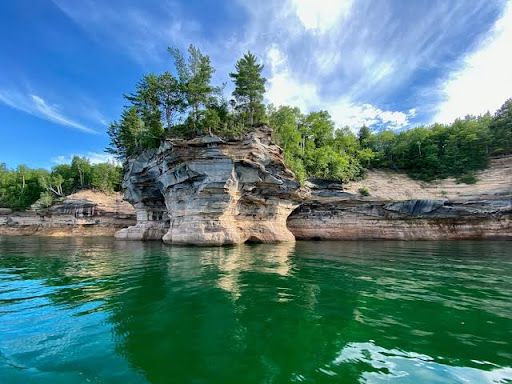
The Lake Superior watershed region ranges in size from 160 miles inland near Wabakimi Provincial Park to only 5 miles inland from Pictured Rocks National Seashore.
The Lake Superior shoreline, if straightened out, could connect Duluth and the Bahama Islands.
The average underwater visibility of Lake Superior is 27 feet, making it easily the cleanest and clearest of the Great Lakes. Underwater visibility in places reaches 100 feet. Lake Superior has been described as "the most oligotrophic lake in the world."
The lake is about 350 miles (563 km) in length and 160 miles (257 km) in width.
In the summer, the sun sets more than 35 minutes later on the western shore of Lake Superior than at its southeastern edge.
Lake Superior has over 400 islands, the largest of which is Isle Royale, with a size of 207 square miles.
Waves of over 40 feet in height have been recorded on Lake Superior.
Travel by car around Lake Superior covers a distance of about 1,300 miles.
The largest underwater formation in Lake Superior is the Superior Shoal, which rises from a depth of over 1,000 feet to within 20 feet of the water surface over a distance of just three miles.
Sudden changes in winds or barometric pressure around Lake Superior can produce seiches, a phenomenon which results in water levels rising or falling as much as six feet along a coast in a short period of time.
Water in Lake Superior is retained, on average, 191 years.
GEOLOGY, FLORA AND FAUNA, CLIMATE, etc.
Lake Superior is one of the earth's youngest major features, at only about 10,000 years of age--dating to the last glacial retreat. By comparison, the earth's second largest lake (by surface area, and largest by volume), Lake Baikal in Russia, is 25 million years old.
Fifty-eight orchid species are native to the Lake Superior basin. In North America, only Florida has more native orchid species.
Lake Superior produces the greatest lake effect snows on earth. (Significant lake effect snows are a rare phenomenon, occurring--besides on the Great Lakes--only on the east shore of Hudson Bay and the west coasts of two Japanese islands.) Lake effect snows extend 20 to 30 miles inland, primarily on the Ontario shore southeast of Marathon, and from Sault Ste. Marie to the Wisconsin-Michigan border. Average annual snowfall in Michigan's Keweenaw exceeds 200 inches in places.
Lake Superior has been at its modern elevation for only about 2,000 years, when elevations of Lake Michigan and Lake Huron dropped, creating a rapids at Sault Ste. Marie.
Lake Superior has its origins in the North American Mid-Continent Rift of 1.1 to 1.2 billion years ago, which produced a huge plume of hot mantle where the present lake sits. The crust tore apart, leaving an arc-shaped scar stretching form Kansas through Minnesota, then down...
Read more
 Learn more insights from Wanderboat AI.