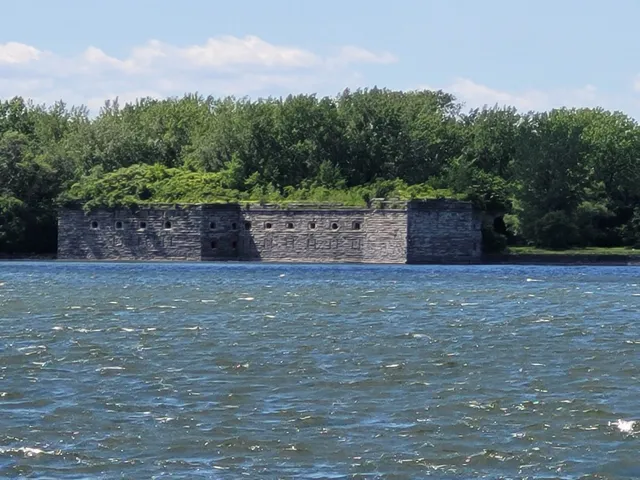
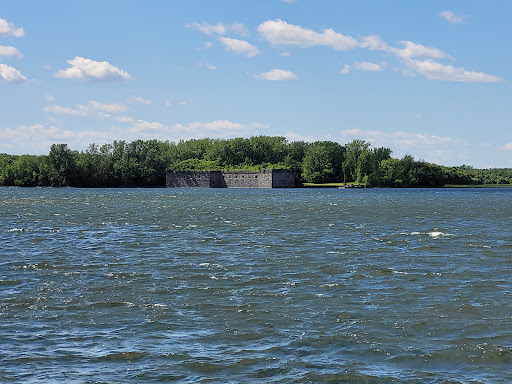
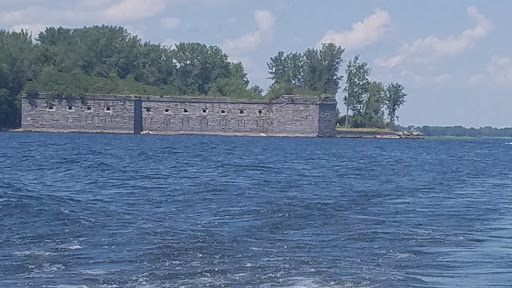
La construction a commencé en 1816 et a duré 2 ans avant que les États-Unis et la Grande-Bretagne n'arpentent conjointement le territoire et ne découvrent des erreurs embarrassantes. Le fort a été construit du mauvais côté, à environ 1,6 km au sud de la frontière américaine actuelle. Car selon le Traité de Paris de 1783, frontière originelle entre New York, l'Amérique et le Québec, le Canada longeait le 45e parallèle, ce qui signifie que le fort était en sol canadien.
La construction a ensuite été rapidement arrêtée. La structure inachevée a été surnommée « Fort Blunder ». La forteresse fut abandonnée pendant les 20 années suivantes, avant que les habitants ne viennent récupérer la pierre et les matériaux nécessaires à la construction de maisons et de travaux publics.
En 1842, les diplomates britanniques et américains discutèrent des questions frontalières, notamment de ce fort. Cependant, les États-Unis ont insisté pour que la nouvelle frontière soit repoussée vers le nord, juste assez pour que la forteresse inachevée tombe sous sa souveraineté. Cela fut accepté et devint l'un des articles négociés dans le traité...
Read moreIt is nice to see the construction and the history behind it. Americans build this fort on Canadian land to fight the Canadian, when they discover the mistake, they stopped...now the Fort is for sale and it is a landmark. The Fort can only be seen from land. There is a entry by the side of the bridge connecting Vermont and NY where you can stop your car and...
Read moreCông trình khởi công vào năm 1816 và kéo dài 2 năm trước khi Mỹ và Anh cùng tiến hành khảo sát lãnh thổ, phát hiện sai lầm đáng xấu hổ. Pháo đài bị xây nhầm bên, nằm ngoài biên giới thực của Mỹ một dặm (khoảng 1,6 km) về phía nam. Bởi theo Hiệp ước Paris năm 1783, biên giới gốc giữa New York, Mỹ và Quebec, Canada đi dọc theo vĩ tuyến 45, tức pháo đài nằm trên đất Canada.
Việc xây dựng nhanh chóng bị dừng lại sau đó. Công trình chưa hoàn thành được đặt biệt danh là “Pháo đài Blunder” (Pháo đài ngớ ngẩn). Pháo đài bị bỏ hoang trong 20 năm tiếp theo, trước khi dân địa phương đến lấy đá và vật liệu đem đi xây nhà cùng các công trình công cộng.
Năm 1842, các nhà ngoại giao Anh và Mỹ thảo luận về vấn đề biên giới, trong đó có pháo đài này. Tuy nhiên, Mỹ khăng khăng biên giới mới được đẩy lên phía bắc, vừa đủ để pháo đài đang xây dở thuộc chủ quyền của mình. Điều này được chấp thuận, trở thành một trong những điều thương lượng trong Hiệp ước...
Read more