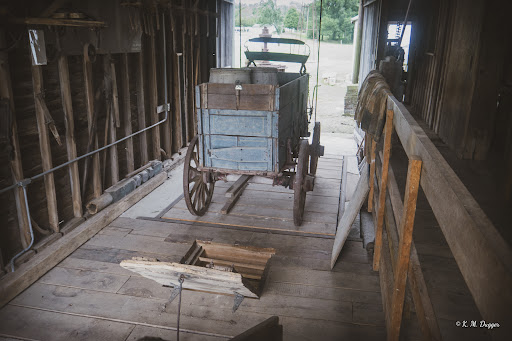
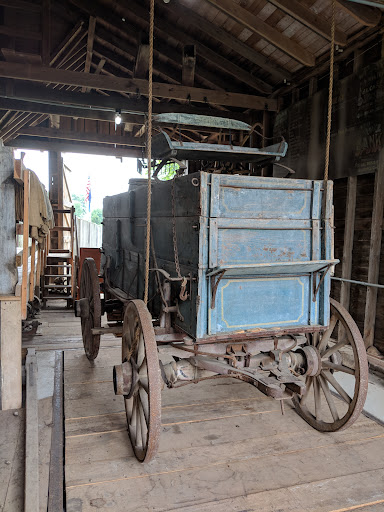
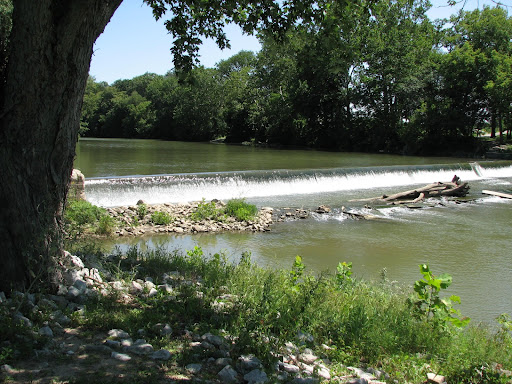
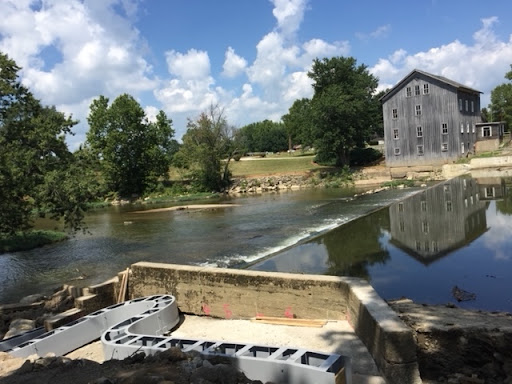
One of the few remaining original water-powered flour mills is on Eel River, at the Wabash – Miami County line, in the old village of Stockdale Indiana. In 1836 John Anderson cut a trail through the wilderness and located just off Eel River. He was soon followed by other settlers and it was probably in 1839 that Thomas Goudy started a sawmill on Eel River and sawed the lumber with which he built a new flour mill and a flour run of buhrs. Standing at the mill today, one cannot but feel wonder and admiration for the courage, foresight and judgment of those pioneers. What insight told them where to build a dam? Surveyors were few and far between. Yet the Stockdale dam is at one of the best power sites on Eel River. Oddly enough, Goudy never owned the mill site. That section of land had been granted to Aubenaube, a Fulton County Indian chief, at the Treaty of Tippecanoe, in 1832. In 1838, this grant was annulled and turned to Topenowkong (wife of Peter Longlois). Apparently the owners leased the mill site to Goudy.
In 1856 the mill built by Goudy was undermined and washed away by high waters roaring over the dam. Baker and Ranck, apparently partners, rebuilt, settling the new structure on the north bank and building a short mill race to operate the waterwheels. Huge timbers support the floors. Sixty foot beams were hand-hewn by broad-axe from oak, walnut and poplar, and one is of hickory elm. It is a marvel how the builders ever managed to raise those timbers to all floors without a hoist. No nails were used; rather the timbers are tightly fitted together by notches. During the Civil War, this mill, under lease to Holt & Son, supplied flour and meal to the Union Armies.
In 1881 James M. Deck came to Stockdale from Hamburg, Berks County, Pennsylvania. It seemed that he first worked for the owners and then entered into contract to purchase interest in the mill as he was able to do so. That year also, the old buhr mill was changed to a roller mill, and Mr. Deck named the flour “White Loaf Flour” with a picture and this was never changed. In 1886 Deck acquired his first interest in the mill and in 1902 became sole owner. He operated the mill until 1916. At that time a new dam was needed. He died before the new one was completed, and his son took over. James H. Deck operated the business for 35 years and at the time of this death in 1952, his daughter and son-in-law assumed management until 1964. At the present time, the fifth generation of the Deck family has an active interest in the old mill.
The mill had a capacity of fifty barrels of flour a day; in addition commercial feed grinding was done by a hammer mill. The superb engineering kept the flour grinding evenly though the machinery on all floors by a belting system from a line shaft powered by three vertical turbines located in the water of the mill race in the basement. They developed about 75 horsepower. The wooden bevel gears were installed in 1856. (The cogs in one had to be replaced in 1934.) This simple, yet complex, system ran the machinery which converted the wheat into flour. Starting in the first brake, the wheat was rolled a little finer in each subsequent operation through a series of eight brakes. The flour was constantly sifted through pure silk which was made on hand looms in Switzerland. This sifting is called bolting. All in all, the flour went through 64 silks before being bagged from the finished sifter.
Water power from Indiana’s rivers once operated over 2000 grist mills. There were 13 on Eel River alone, one about every six or seven miles. The Stockdale Mill operated commercially until 1964 when it was not longer profitable to operate; however, the machinery is intact and could be operated with a minimum of preparation. written by Mrs. Addison P....
Read more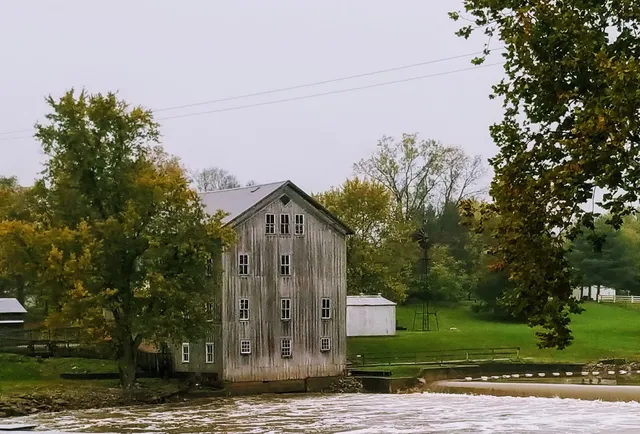
 Learn more insights from Wanderboat AI.