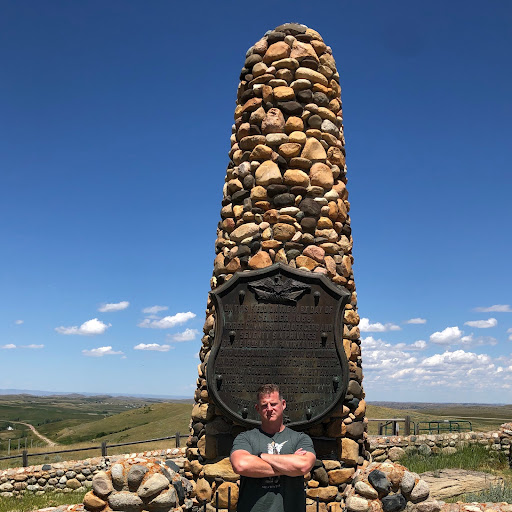
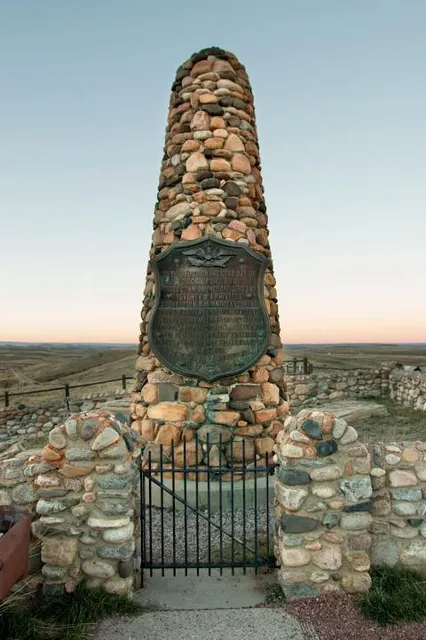
I participated in a historical discussion of the Fetterman Fight and a hiking tour of the battlefield, where the stone obelisk stands, on the 158th anniversary of the battle, in which the combined force of Lakota, Northern Cheyenne, and some Arapaho inflicted the worst defeat for the U.S. military in the Indian Wars until the Battle of the Little Bighorn ten years later. The monument at the trailhead of Lodge Trail Ridge essentially marks the end of the line for Captain Fetterman and eighty troopers. The soldiers formed a last-ditch skirmish line within a few yards of this spot before being overwhelmed by hundreds of Indian warriors.
The Indians had ridden roughly sixty-five miles in three days from the Wolf Mountains of southeastern Montana in order to lay their trap. Captain Fetterman had been expressly ordered not to crest Lodge Trail Ridge, where the garrison at Fort Phil Kearny would lose sight of his unit. But the Oglala Lakota, including Crazy Horse, and their allies lured Fetterman and his men, approximately fifty infantry and thirty cavalry, beyond the point of contact and help. The cavalry fell first. The infantry, desperately running back the way they came, maintained discipline until the final two volleys. Armed with muzzle-loading rifles, which they couldn't reload fast enough, the troopers were then at the mercy of eight-hundred braves with bows and arrows and some firearms. The Indians then stripped and mutilated the bodies of the slain.
It was, coincidentally, the winter solstice, the shortest day of the year. For the fallen soldiers, the shortest of the shortest days of their lives, yet at the same time the longest.
Around 1,500 Lakota, Northern Cheyenne (with whom the Lakota frequently intermarried), and Arapaho lay concealed in the gulleys on either side of Lodge Trail Ridge until Captain Fetterman's company had been lured past the point of no return. Then the Indians sprang the trap. Fetterman's detachment was annihilated.
In my opinion, which fortunately lacks the benefit of a college education in the past philistine and sordid forty-five years, the answer to the question "How do we account for the disaster of the Fetterman Massacre?" is really quite simple: too many hostile Indians.
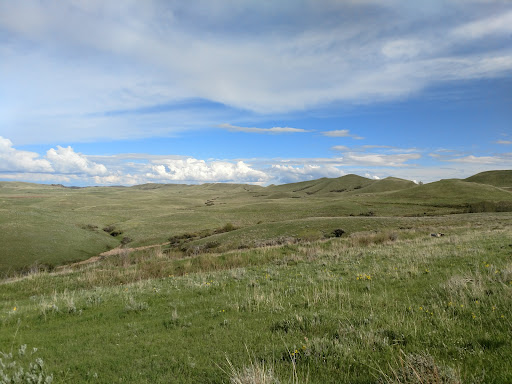
A beautiful yet eerie site (or is it "an eerie yet beautiful site"), in that respect much like the Little Bighorn Battlefield, about a hundred miles north. We amateur historians of the group enjoyed a bright and unseasonably warm solstice, under blue skies and wispy clouds, in that central historic corridor along the Bighorn front. The concentration of major historical activity within a few miles of the Fetterman Monument is extraordinary: the Bozeman Trail, Fort Phil Kearny, and the Wagon Box Fight, principally. The Connor Battlefield, which lies forty miles north in Ranchester, is another important site in the history of the Indian Wars. So all along the Bighorn front, you're in the...
Read moreThe Sioux won a decisive battle here in December of 1866. Captain Fetterman famously exclaimed "Give me 80 men and I can ride through the Sioux Nation", or words to that effect. Well, Fetterman and 80 soldiers and cavalry, proved that they were not up to the fight on this day. They were taunted and lured into an ambush, and Crazy Horse was up to bat against the United States military, and under the overall leadership of Red Cloud, and the Sioux's Cheyenne allies, a victory was achieved that day for the indigenous peoples, defending themselves against the incursions of the Americans on the Bozeman Trail. Lessons were learned on both sides, and this battle was instrumental in the overall victory of Red Cloud in the Great Sioux War, resulting in the Fort Laramie Treaty of 1868.
I visited this battlefield in late August, 2018. It is somewhat isolated and remote, but not difficult to find. Unlike the more famous LIttle Bighorn National Battlefield to the north, there are no crowds here. In fact, when I visited, I was the only one there.
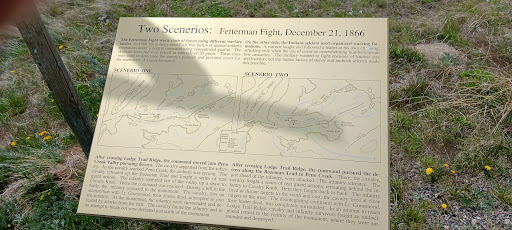
There is a monument with a visitor's parking lot, and a trail with some great interpretive signs leading you into the past, and into the fight. The interpretive signs complement and compliment both sides of the battle, and give the respective perspective.
You find that the soldiers occupied the high ground here, and that even the high ground did not win the day. The bravery shown by both sides, with Sioux and Cheyenne decoys being shot and killed, and soldiers, inexperienced at best, fighting for their lives in a battle in which they were vastly outnumbered. One is humbled by the sense that this is a sacred place, and we may honor both sides.
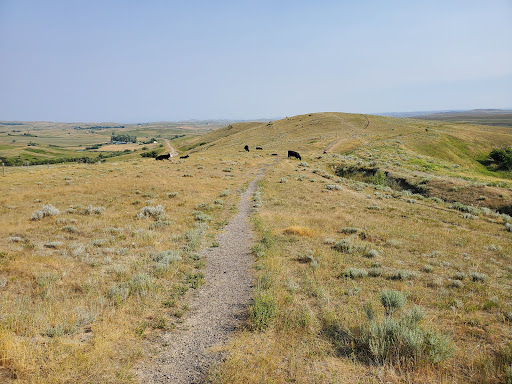
It was windy on the morning I visited, and cold. The Big Horn Mountains are nearby, and clouds shrouded them from view. The entire battlefield was in view, and hiking the battlefield trail is important. There is a tree there which was probably alive during the battle.
One can contemplate and ponder upon the site as one walks under the big sky of northern Wyoming. The black angus cattle are there to keep you company, as are the newly hatched eggs of snakes (likely western racers), litter the ground en route to the top of the ridge. The wind whistles half heard shrieks from the past, illusory audibles or perhaps real ghosts, yelling in agony, victory, and desperation.
The Fetterman Monument is not far from Fort Phil Kearney, from which these soldiers issued. It is also not far from the Wagon Box Fight, fought perhaps a year later.
It is one of many sites where one may learn and appreciate the shared history of the United States and its expansion to the west, and its campaign of dispossession of the lands of the indigenous inhabitants. It is a shared memory which makes one ponder about how we human beings treat each other. It is a good...
Read moreFascinating to finally visit the site of the Fetterman defeat after reading Dee Brown's memorable book many years ago. Good walk that has many explanatory signs and some good descriptions of the events as well as some informed conjecture about what happened to Fetterman's command. The rather ugly monument is a suitable memorial to military hubris but the site is well worth a visit to mark the biggest defeat of Settler Colonialism before the Little Big Horn. Tragic that it only slowed the genocide. Plenty of interesting biodiversity for them that...
Read more