Buddhist Stupa of Zurmala Historical landmark in Uzbekistan.
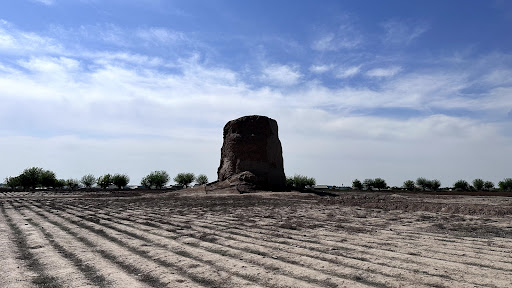
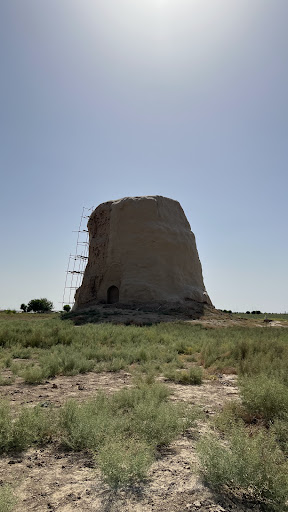
Zurmala stupa is a remnant of the largest Buddhist stupa located in Termez district in Uzbekistan. It is considered to be the oldest construction still standing in Uzbekistan. It was built in the first or second century CE.
The stupa is 13.5m tall and has a diameter of about 14 m. It is made up of square bricks. Each of the bricks has a stamp which is similar to one used in Bactria during the Kushan Empire in the 3rd century AD. The fragment of klined bricks can also be found around the stupa. It is believed that the exterior facade of the stupa was painted a bright red colour. Currently, the stupa has huge cracks around it.
The early information about the stupa can be found in the diaries Xuan Jian, a Chinese buddhist priest who visited Termez in 629- 630. According to him, there were more than 10 monasteries in Termez and more than 1000 monks. He mentioned that there were many stupas in the area.
The study by A.S. Strelkov in 1926–1928 in the expedition by the Oriental Museum of Moscow and the Hermitage Museum of St. Petersburg, noted the similarity with the description of Xuan Jian. Later, M.E. Masson organized an expedition to understand the general features of...
Read moreThe Buddhist Stupa of Zurmala is an ancient historical monument located near Termez, Uzbekistan.
Dating back to the 3rd-2nd centuries BCE, it is one of the oldest stupas in Central Asia. This site reflects the spread of Buddhism along the Silk Road and showcases the region’s rich cultural and religious history. The stupa served as a religious shrine and a place for meditation and worship. Made of bricks, it has a distinctive dome shape typical of Buddhist architecture.
Today, the Zurmala Stupa is an important archaeological site attracting historians, tourists, and researchers interested in Central Asian history and...
Read moreСтупа Зурмала — остатки крупнейшей буддийской ступы, расположенной в районе Старого Термеза, примерно в 10–12 км к западу от современного города . Это, вероятно, самое старое сохранившееся здание Узбекистана, датируемое I–II веками н. э. .
🧱 Архитектура и конструкция
Ступа состоит из цилиндрической башни диаметром около 14–14,5 м, высота — около 13–13,5 м, включая платформу первоначальная высота могла достигать около 16 м .
Построена из около 1,2 миллиона квадратных кирпичей (33 × 33 см), каждый с характерным штампом: линия и две впадины — типичной для Бактрии времен империи Кушанов .
Платформа (22 × 16 м) была облицована белым известняком, а фасад — ярко-красным обожжённым кирпичом и, возможно, каменными плитами с религиозной символикой .
Верхняя часть содержала реликварий — камеру для хранения священных текстов, миниатюр и реликвий Будды, над которой находился стержень с «зонтиками почёта» (символ защиты и просветления) — эти элементы сегодня не сохранились .
📜 История и значение
Первое упоминание датируется VIII веком китайским монахом Сюань Цзяном, который наблюдал множество монастырей и ступ в окрестностях Термеза .
Археолог А. Стрелков впервые предположил в 1927 году, что башня — буддийская ступа; заключения подтвердились только спустя несколько десятилетий при раскопках Г. Пугаченковой .
Зурмала — первый обнаруженный буддийский памятник в Центральной Азии XX века; всего изучено около 40 буддийских памятников этой эпохи, большая половина на территории...
Read more