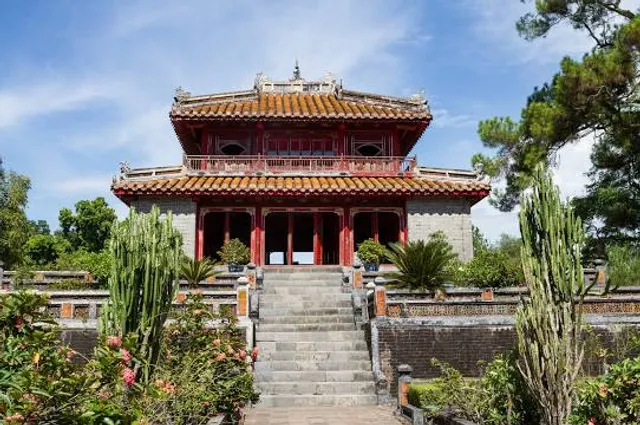
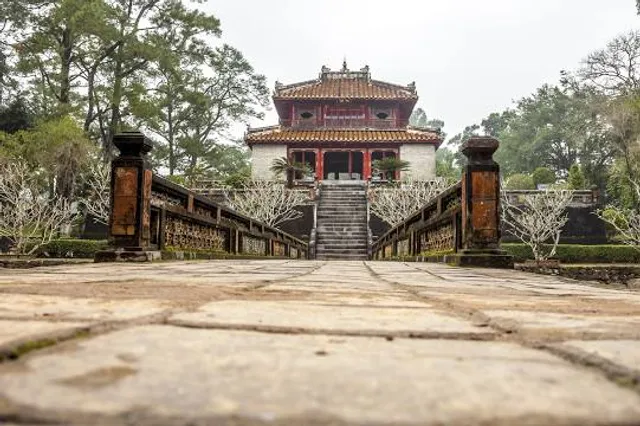
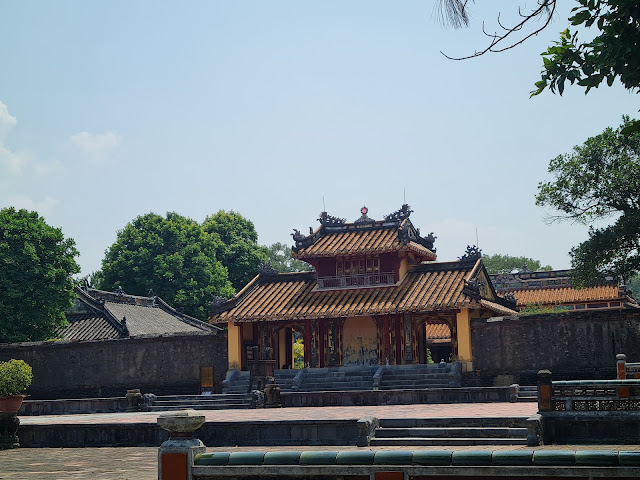
Lăng Vua Minh Mạng - the tomb of Vietnam Emperor Minh Mạng. Built from 1840 to 1843. The area has of 18 hectares and has been surrounded by a wall enclosing inside 40 monuments, temples, pavilions and lakes. Area is designated as a symmetric axis. There are two fantastic flower gardens inside which are designated as the Chinese character.
Mystical atmosphere and visit to Lăng Vua Minh Mạng starts from Great Red Wall. Running to the foot of Surrounding Wall behind the Emperor’s Tomb.
Visitor can see: Dai Hong Gate, Ta Hong Gate, Huu Hong Gate, Stele House, Salutation Court, Hien Duc Gate, Sung An Temple, Minh Lau Pavilion, Trung Minh Lake, Tan Nguyet Lake, Truy Tu Pavilion, Quan Lan Building, Linh Phuong Pavilion, Tuan Loc Garden, Left House, Right House, Hu Hoai Pavilion, Nghenh Luong Pavilion, Dieu Ngu Pavilion, Trong Dao Bridge, Left House for Accessory Sacrificies, Right House for Accessory Sacrificies, Left Loading for Royal Followers and Right Loading for Royal Followers.
At the end of walk there is Huyen Cung - the place where the Emperor is laid to rest.
Huyen Cung has benn souranded by Buu Than which is a round wall that protects the Emperor’s Tomb. The wall is 285 metres long and 3 metres high.
Huyen Cung is an underground palace where the Emperor’s corpse was placed. When Minh Mạng Emperor passed away, his coffin was brought to this palace through and underground chanel. Then chanel was closed permanently.
The Gate of Burial Area was opened once a year when Emperor’s death anniversary is on the stage.
Lăng Vua Minh Mạng is worth to visit!!!
I was there in...
Read moreThe Mausoleum of Emperor Minh Mang is a stunning architectural masterpiece located in Hue, Vietnam. Built in the 19th century, it is one of the most well-preserved mausoleums in the country and is a testament to the grandeur of the Nguyen Dynasty.
The complex is situated on a vast area of land, surrounded by lush greenery and beautiful gardens. As you enter the grounds, you are immediately struck by the serenity and tranquility of the place. The mausoleum is designed in a traditional Vietnamese style, with intricate details and ornate decorations.
The main feature of the complex is the tomb of Emperor Minh Mang, which is located at the center of the complex. The tomb is a large structure made of solid stone, adorned with beautiful carvings and statues. It is a truly impressive sight and a testament to the power and wealth of the Nguyen Dynasty.
The surrounding gardens and lakes add to the beauty of the place, and it is a pleasure to walk around and explore. There are also several pavilions and temples within the complex, each with its own unique design and significance.
One of the highlights of visiting the Mausoleum of Emperor Minh Mang is the peaceful atmosphere. The complex is not as crowded as some of the other tourist attractions in the area, allowing visitors to fully appreciate the beauty and tranquility...
Read moreThis majestic tomb is renowned for its architecture and sublime forest setting. The tomb was planned during Minh Mang’s reign (1820–40) but built by his successor, Thieu Tri.
Minh Mang's tomb is in An Bang village, on the west bank of the Perfume River, 12km from Hue.
The Honour Courtyard is reached via three gates on the eastern side of the wall. Three granite staircases lead from the courtyard to the square Stele Pavilion (Dinh Vuong).
Sung An Temple, which is dedicated to Minh Mang and his empress, is reached via three terraces and the rebuilt Hien Duc Gate. On the other side of the temple, three stone bridges span Trung Minh Ho (Lake of Impeccable Clarity). The central bridge was for the emperor’s use only. Minh Lau Pavilion (Pavilion of Light) stands on the top of three superimposed terraces that represent the ‘three powers’: the heavens, the earth and water. To the left is the Fresh Air Pavilion, to the right, the Angling Pavilion.
From a stone bridge across crescent-shaped Tan Nguyet Lake (Lake of the New Moon), a monumental staircase with dragon banisters leads to Minh Mang’s sepulchre. The gate to the tomb is opened only once a year on the anniversary of the...
Read more