HTML SitemapExplore
logo
Find Things to DoFind The Best Restaurants

Stone house (Dar Alhajar) — Attraction in Sana'a Governorate

Name
Stone house (Dar Alhajar)
Description
Nearby attractions
Nearby restaurants
Nearby hotels
Related posts
Keywords
Stone house (Dar Alhajar) tourism.Stone house (Dar Alhajar) hotels.Stone house (Dar Alhajar) bed and breakfast. flights to Stone house (Dar Alhajar).Stone house (Dar Alhajar) attractions.Stone house (Dar Alhajar) restaurants.Stone house (Dar Alhajar) travel.Stone house (Dar Alhajar) travel guide.Stone house (Dar Alhajar) travel blog.Stone house (Dar Alhajar) pictures.Stone house (Dar Alhajar) photos.Stone house (Dar Alhajar) travel tips.Stone house (Dar Alhajar) maps.Stone house (Dar Alhajar) things to do.
Stone house (Dar Alhajar) things to do, attractions, restaurants, events info and trip planning
Stone house (Dar Alhajar)
YemenSana'a GovernorateStone house (Dar Alhajar)

Basic Info

Stone house (Dar Alhajar)

دارالحجر شارع وادي ظهر, Sanaa, Yemen
4.5(1.3K)
Open 24 hours
Save
spot

Ratings & Description

Info

Cultural
Outdoor
Family friendly
attractions: , restaurants:
logoLearn more insights from Wanderboat AI.

Plan your stay

hotel
Pet-friendly Hotels in Sana'a Governorate
Find a cozy hotel nearby and make it a full experience.
hotel
Affordable Hotels in Sana'a Governorate
Find a cozy hotel nearby and make it a full experience.
hotel
The Coolest Hotels You Haven't Heard Of (Yet)
Find a cozy hotel nearby and make it a full experience.
hotel
Trending Stays Worth the Hype in Sana'a Governorate
Find a cozy hotel nearby and make it a full experience.

Reviews

Get the Appoverlay
Get the AppOne tap to find yournext favorite spots!
Wanderboat LogoWanderboat

Your everyday Al companion for getaway ideas

CompanyAbout Us
InformationAI Trip PlannerSitemap
SocialXInstagramTiktokLinkedin
LegalTerms of ServicePrivacy Policy

Get the app

© 2025 Wanderboat. All rights reserved.
logo

Posts

Hisham MohamedHisham Mohamed
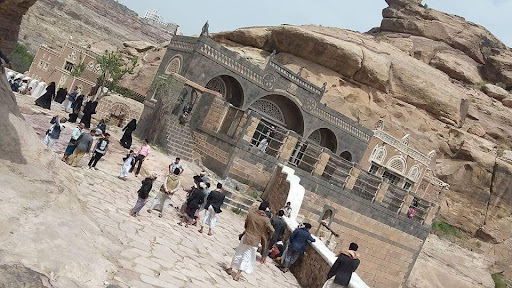
House of stone in the valley of noon. Dar Al-Hajar is one of the historical buildings in Yemen. It is located in Sana'a - Wadi Dhahr. It was built during the 18th century by Ali bin Saleh Al-Ammari and was named after the granite rock on which this house was built. The palace dates back to the late 18th century when the king of Yemen, Imam Al-Mansur Ali bin Abbas, and his minister, Ali bin Saleh al-Amari (1736-1798), who was famous for architecture, astronomy, poetry and literature, ordered him to build a palace in Wadi Zahr to be his summer palace. Historians say that it was built on the ruins of an ancient palace known as the fortress of the sedan built by the donkeys in 3000 BC. The fortress was destroyed by the Turks four hundred years ago, and was restored at the beginning of the twentieth century by the Imam Yahya Hamid religion after being inherited by a number of kings Yemenis. He is currently a tourist destination for thousands of people around the world. [2] The construction was in its primary way for years, until Imam Yahya bin Humaiduddin added the upper floor (the freed). [1] The stories associated with the beginning of the foundation and the construction of Dar Al-Hajar vary, and some stories indicate that the house was demolished dozens of times but was once again rebuilt. It is said that the Turks in the first invasion of Yemen preferred to live in this house for its unique architecture and the valley which, together with the rest of the sites and views surrounding it as a garden and orchard for the inhabitants and visitors of this historic palace due to the characteristic of these beautiful places of evergreen vegetation, Squash and squash, as well as giant dum trees, which have begun to fade as a result of the expansion of qat cultivation. It is also said that the country during the reign of the Turks saw heavy rains led to the demolition of the house and did not have any impact, then came to the region Imam Abdullah al-Mansur, who reconstructed the three roles with a black stone Habash, which is currently, and then settled and after the death of Imam Abdul Allah al-Mansur Imam al-Nasser It is said that during his reign, some wars and disagreements between him and the people of Hamdan, who killed him sleeping on his bed and took him and buried him and the guard that was with him in an area south of the valley of noon and say the people of the region that his grave is still known to everyone. After the death of Imam al-Nasser, the imams were afraid of the residence of this house until Imam Yahya built some other palaces in the valley but soon changed his mind after a period and renovated the house of stone and building some additional roles of the material of the Iagor and added some other facilities such as the porter, People. The Imam also built a mosque adjacent to the house and wrote on his door "built to God Almtawakil God" is still present.
Fahmi AbbasFahmi Abbas
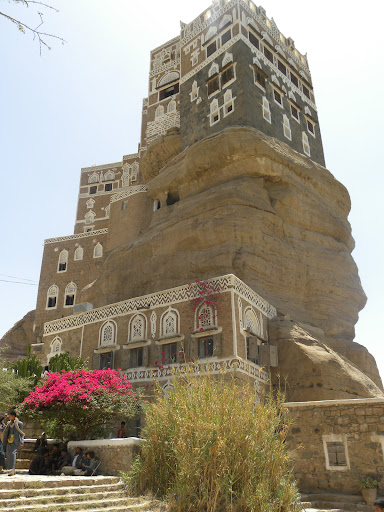
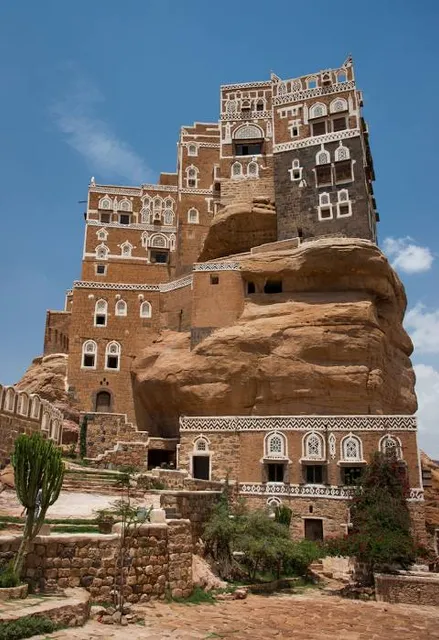
Yemen’s Dar al-Hajar – or ‘stone house’ is a rock column behold one of the world’s most spectacular constructions. The former royal residence grows out of the rock pinnacle upon which it’s perched. The Dar al-Hajar or “Rock Palace” is located in Wadi Dhar, around 15 km (9 miles) from the capital city of Sana, Yemen. It seems to grow out of the rocks on which it is constructed and it has the characteristic painting of its windows and edges. Yemen’s architecture Dar al-Hajar palace, built atop a tall natural rock spire is nevertheless fantastical. The five-storey building looks incredible from every angle. So, it won’t be surprised to see Dar al-Hajar on a Yemeni currency note (the 500 rials one). In the 1920’s Islamic spiritual leader named Yahya Muhammad Hamiddin (ruler of Yemen from 1904 to 1948) stayed here as a summer residence. This place didn’t leave good memories for Imam Muhammad Yahya as his grandson assassinated him during a coup in Yemen in 1948. Nevertheless, the palace did remain in the ownership of the Yemeni royal family until the Yemen 1962. However, Islamic scholar Imam Mansoor Ali Bin Mehdi Abbas constructed atop the structure on the rock column. This beautiful building has multiple facilities of kitchen, storage area, guest rooms, and sedate courtyard leading through the five-story structure. The main feature of this building is to look like a fortress with shooting emplacements to defend the place from attackers. Therefore, it’s indeed easy on the eye, though designed to withstand attack and its own water supply from deep below the rock’, meaning it could ‘easily have withstood a siege’. Now it’s a popular example of Yemeni architecture for tourists, who can see the rooms and explore the labyrinth of staircases. Now Dar al-Hajar has a museum, and tourists who paid a visit to the palace have sung its praises on the internet. It’s a fantastic place and one of the best things you will see in Yemen. You will have a wonderful experience to see this old Yemeni palace and understand more about the local life and culture.’ It is nothing like you have ever seen before to pay a must-visit and relish the exquisite view. The majestic five floors offer enough to relish, but walking around at its base is equally impressive and heightens your admiration.
Abdullah Faiz SalehAbdullah Faiz Saleh
The Middle-Eastern-styled palace as it stands today was actually built relatively recently, in the 1930s by an Islamic spiritual leader named Yahya Muhammad Hamiddin, but it seems that he was building atop a preexisting structure that was built in the 1700s by an Islamic scholar. The tall castle was intended to be the leader’s summer home, and featured a number of facilities including appointment rooms for his highly appointed guests and separate spaces for cooling water in earthen jars. The rooms are built up the side of a tall rock spire, culminating in a grand tower at its pinnacle. The Imam Yahya was assassinated in 1948, but his iconic palace still stands and it has become a popular example of Yemeni architecture. While it is no longer used as a royal residence, the palace has been refitted as a museum and can be toured for a fee. Visitors can range about through the kitchens, storage rooms, and appointment rooms connected by a small labyrinth of stairways leading through the five-story structure. But as impressive as it is to explore inside, it is the view from the exterior that really makes the palace one of a kind. Combined with the natural rock on which it is built, it truly looks like a monumental work straight out of a fantasy novel.
See more posts
See more posts
hotel
Find your stay

Pet-friendly Hotels in Sana'a Governorate

Find a cozy hotel nearby and make it a full experience.

House of stone in the valley of noon. Dar Al-Hajar is one of the historical buildings in Yemen. It is located in Sana'a - Wadi Dhahr. It was built during the 18th century by Ali bin Saleh Al-Ammari and was named after the granite rock on which this house was built. The palace dates back to the late 18th century when the king of Yemen, Imam Al-Mansur Ali bin Abbas, and his minister, Ali bin Saleh al-Amari (1736-1798), who was famous for architecture, astronomy, poetry and literature, ordered him to build a palace in Wadi Zahr to be his summer palace. Historians say that it was built on the ruins of an ancient palace known as the fortress of the sedan built by the donkeys in 3000 BC. The fortress was destroyed by the Turks four hundred years ago, and was restored at the beginning of the twentieth century by the Imam Yahya Hamid religion after being inherited by a number of kings Yemenis. He is currently a tourist destination for thousands of people around the world. [2] The construction was in its primary way for years, until Imam Yahya bin Humaiduddin added the upper floor (the freed). [1] The stories associated with the beginning of the foundation and the construction of Dar Al-Hajar vary, and some stories indicate that the house was demolished dozens of times but was once again rebuilt. It is said that the Turks in the first invasion of Yemen preferred to live in this house for its unique architecture and the valley which, together with the rest of the sites and views surrounding it as a garden and orchard for the inhabitants and visitors of this historic palace due to the characteristic of these beautiful places of evergreen vegetation, Squash and squash, as well as giant dum trees, which have begun to fade as a result of the expansion of qat cultivation. It is also said that the country during the reign of the Turks saw heavy rains led to the demolition of the house and did not have any impact, then came to the region Imam Abdullah al-Mansur, who reconstructed the three roles with a black stone Habash, which is currently, and then settled and after the death of Imam Abdul Allah al-Mansur Imam al-Nasser It is said that during his reign, some wars and disagreements between him and the people of Hamdan, who killed him sleeping on his bed and took him and buried him and the guard that was with him in an area south of the valley of noon and say the people of the region that his grave is still known to everyone. After the death of Imam al-Nasser, the imams were afraid of the residence of this house until Imam Yahya built some other palaces in the valley but soon changed his mind after a period and renovated the house of stone and building some additional roles of the material of the Iagor and added some other facilities such as the porter, People. The Imam also built a mosque adjacent to the house and wrote on his door "built to God Almtawakil God" is still present.
Hisham Mohamed

Hisham Mohamed

hotel
Find your stay

Affordable Hotels in Sana'a Governorate

Find a cozy hotel nearby and make it a full experience.

Get the Appoverlay
Get the AppOne tap to find yournext favorite spots!
Yemen’s Dar al-Hajar – or ‘stone house’ is a rock column behold one of the world’s most spectacular constructions. The former royal residence grows out of the rock pinnacle upon which it’s perched. The Dar al-Hajar or “Rock Palace” is located in Wadi Dhar, around 15 km (9 miles) from the capital city of Sana, Yemen. It seems to grow out of the rocks on which it is constructed and it has the characteristic painting of its windows and edges. Yemen’s architecture Dar al-Hajar palace, built atop a tall natural rock spire is nevertheless fantastical. The five-storey building looks incredible from every angle. So, it won’t be surprised to see Dar al-Hajar on a Yemeni currency note (the 500 rials one). In the 1920’s Islamic spiritual leader named Yahya Muhammad Hamiddin (ruler of Yemen from 1904 to 1948) stayed here as a summer residence. This place didn’t leave good memories for Imam Muhammad Yahya as his grandson assassinated him during a coup in Yemen in 1948. Nevertheless, the palace did remain in the ownership of the Yemeni royal family until the Yemen 1962. However, Islamic scholar Imam Mansoor Ali Bin Mehdi Abbas constructed atop the structure on the rock column. This beautiful building has multiple facilities of kitchen, storage area, guest rooms, and sedate courtyard leading through the five-story structure. The main feature of this building is to look like a fortress with shooting emplacements to defend the place from attackers. Therefore, it’s indeed easy on the eye, though designed to withstand attack and its own water supply from deep below the rock’, meaning it could ‘easily have withstood a siege’. Now it’s a popular example of Yemeni architecture for tourists, who can see the rooms and explore the labyrinth of staircases. Now Dar al-Hajar has a museum, and tourists who paid a visit to the palace have sung its praises on the internet. It’s a fantastic place and one of the best things you will see in Yemen. You will have a wonderful experience to see this old Yemeni palace and understand more about the local life and culture.’ It is nothing like you have ever seen before to pay a must-visit and relish the exquisite view. The majestic five floors offer enough to relish, but walking around at its base is equally impressive and heightens your admiration.
Fahmi Abbas

Fahmi Abbas

hotel
Find your stay

The Coolest Hotels You Haven't Heard Of (Yet)

Find a cozy hotel nearby and make it a full experience.

hotel
Find your stay

Trending Stays Worth the Hype in Sana'a Governorate

Find a cozy hotel nearby and make it a full experience.

The Middle-Eastern-styled palace as it stands today was actually built relatively recently, in the 1930s by an Islamic spiritual leader named Yahya Muhammad Hamiddin, but it seems that he was building atop a preexisting structure that was built in the 1700s by an Islamic scholar. The tall castle was intended to be the leader’s summer home, and featured a number of facilities including appointment rooms for his highly appointed guests and separate spaces for cooling water in earthen jars. The rooms are built up the side of a tall rock spire, culminating in a grand tower at its pinnacle. The Imam Yahya was assassinated in 1948, but his iconic palace still stands and it has become a popular example of Yemeni architecture. While it is no longer used as a royal residence, the palace has been refitted as a museum and can be toured for a fee. Visitors can range about through the kitchens, storage rooms, and appointment rooms connected by a small labyrinth of stairways leading through the five-story structure. But as impressive as it is to explore inside, it is the view from the exterior that really makes the palace one of a kind. Combined with the natural rock on which it is built, it truly looks like a monumental work straight out of a fantasy novel.
Abdullah Faiz Saleh

Abdullah Faiz Saleh

See more posts
See more posts

Reviews of Stone house (Dar Alhajar)

4.5
(1,281)
avatar
5.0
8y

House of stone in the valley of noon. Dar Al-Hajar is one of the historical buildings in Yemen. It is located in Sana'a - Wadi Dhahr. It was built during the 18th century by Ali bin Saleh Al-Ammari and was named after the granite rock on which this house was built.

The palace dates back to the late 18th century when the king of Yemen, Imam Al-Mansur Ali bin Abbas, and his minister, Ali bin Saleh al-Amari (1736-1798), who was famous for architecture, astronomy, poetry and literature, ordered him to build a palace in Wadi Zahr to be his summer palace. Historians say that it was built on the ruins of an ancient palace known as the fortress of the sedan built by the donkeys in 3000 BC. The fortress was destroyed by the Turks four hundred years ago, and was restored at the beginning of the twentieth century by the Imam Yahya Hamid religion after being inherited by a number of kings Yemenis. He is currently a tourist destination for thousands of people around the world. [2] The construction was in its primary way for years, until Imam Yahya bin Humaiduddin added the upper floor (the freed). [1]

The stories associated with the beginning of the foundation and the construction of Dar Al-Hajar vary, and some stories indicate that the house was demolished dozens of times but was once again rebuilt.

It is said that the Turks in the first invasion of Yemen preferred to live in this house for its unique architecture and the valley which, together with the rest of the sites and views surrounding it as a garden and orchard for the inhabitants and visitors of this historic palace due to the characteristic of these beautiful places of evergreen vegetation, Squash and squash, as well as giant dum trees, which have begun to fade as a result of the expansion of qat cultivation. It is also said that the country during the reign of the Turks saw heavy rains led to the demolition of the house and did not have any impact, then came to the region Imam Abdullah al-Mansur, who reconstructed the three roles with a black stone Habash, which is currently, and then settled and after the death of Imam Abdul Allah al-Mansur Imam al-Nasser It is said that during his reign, some wars and disagreements between him and the people of Hamdan, who killed him sleeping on his bed and took him and buried him and the guard that was with him in an area south of the valley of noon and say the people of the region that his grave is still known to everyone.

After the death of Imam al-Nasser, the imams were afraid of the residence of this house until Imam Yahya built some other palaces in the valley but soon changed his mind after a period and renovated the house of stone and building some additional roles of the material of the Iagor and added some other facilities such as the porter, People. The Imam also built a mosque adjacent to the house and wrote on his door "built to God Almtawakil God" is...

   Read more

avatar
5.0
3y

Yemen’s Dar al-Hajar – or ‘stone house’ is a rock column behold one of the world’s most spectacular constructions. The former royal residence grows out of the rock pinnacle upon which it’s perched. The Dar al-Hajar or “Rock Palace” is located in Wadi Dhar, around 15 km (9 miles) from the capital city of Sana, Yemen. It seems to grow out of the rocks on which it is constructed and it has the characteristic painting of its windows and edges. Yemen’s architecture Dar al-Hajar palace, built atop a tall natural rock spire is nevertheless fantastical. The five-storey building looks incredible from every angle. So, it won’t be surprised to see Dar al-Hajar on a Yemeni currency note (the 500 rials one). In the 1920’s Islamic spiritual leader named Yahya Muhammad Hamiddin (ruler of Yemen from 1904 to 1948) stayed here as a summer residence. This place didn’t leave good memories for Imam Muhammad Yahya as his grandson assassinated him during a coup in Yemen in 1948. Nevertheless, the palace did remain in the ownership of the Yemeni royal family until the Yemen 1962. However, Islamic scholar Imam Mansoor Ali Bin Mehdi Abbas constructed atop the structure on the rock column. This beautiful building has multiple facilities of kitchen, storage area, guest rooms, and sedate courtyard leading through the five-story structure. The main feature of this building is to look like a fortress with shooting emplacements to defend the place from attackers. Therefore, it’s indeed easy on the eye, though designed to withstand attack and its own water supply from deep below the rock’, meaning it could ‘easily have withstood a siege’. Now it’s a popular example of Yemeni architecture for tourists, who can see the rooms and explore the labyrinth of staircases. Now Dar al-Hajar has a museum, and tourists who paid a visit to the palace have sung its praises on the internet. It’s a fantastic place and one of the best things you will see in Yemen. You will have a wonderful experience to see this old Yemeni palace and understand more about the local life and culture.’ It is nothing like you have ever seen before to pay a must-visit and relish the exquisite view. The majestic five floors offer enough to relish, but walking around at its base is equally impressive and heightens...

   Read more
avatar
5.0
3y

The Middle-Eastern-styled palace as it stands today was actually built relatively recently, in the 1930s by an Islamic spiritual leader named Yahya Muhammad Hamiddin, but it seems that he was building atop a preexisting structure that was built in the 1700s by an Islamic scholar. The tall castle was intended to be the leader’s summer home, and featured a number of facilities including appointment rooms for his highly appointed guests and separate spaces for cooling water in earthen jars. The rooms are built up the side of a tall rock spire, culminating in a grand tower at its pinnacle. The Imam Yahya was assassinated in 1948, but his iconic palace still stands and it has become a popular example of Yemeni architecture. While it is no longer used as a royal residence, the palace has been refitted as a museum and can be toured for a fee. Visitors can range about through the kitchens, storage rooms, and appointment rooms connected by a small labyrinth of stairways leading through the five-story structure.

But as impressive as it is to explore inside, it is the view from the exterior that really makes the palace one of a kind. Combined with the natural rock on which it is built, it truly looks like a monumental work straight out of a...

   Read more
Page 1 of 7
Previous
Next