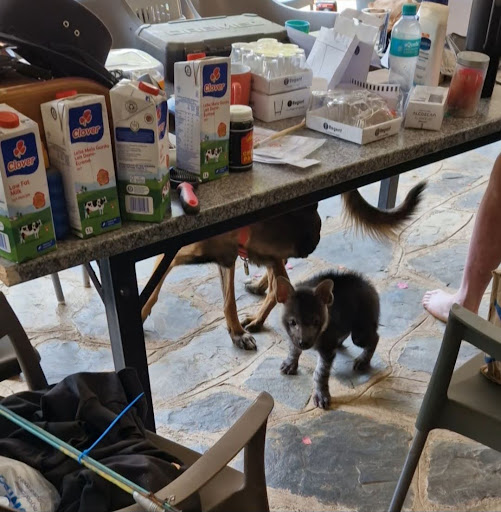
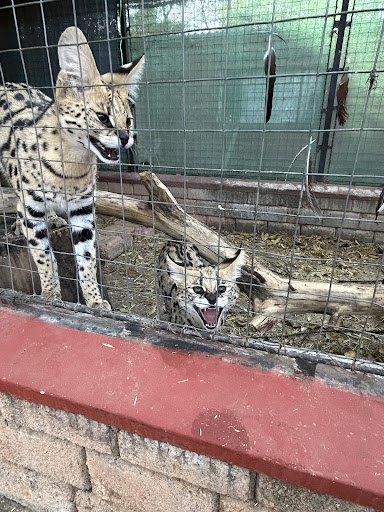
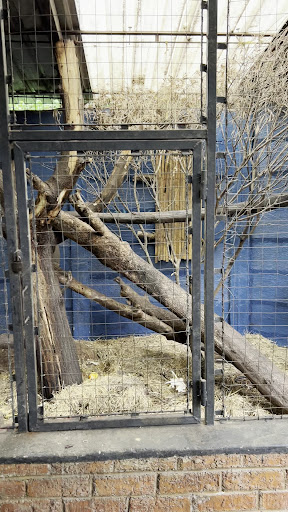
I was really looking forward to volunteering at a Wildlife Sanctuary in Africa, but what I experienced at Chipangali was really sad and frustrating. The entire facility is messy and in a bad condition, enclosures are old and fences are falling apart. For being a sanctuary, I found the cages to be very small, especially for the big cats. Animals often did not have any water, which is unacceptable as they have nowhere else to go. Some enclosures, like those of snakes, fish and a small bush pig smelled really bad, because they had not been cleaned for months. Overall, they don't clean enclosures regularly and they smell bad, scat and bones are laying around for weeks and old, dirty hay was put into the kudu enclosure. Some animals are in a bad condition; the claws of kudus and sheep are too long so they struggle to walk, the bunnies' nails have not been trimmed for months and a vervet monkey had a skin condition, which could have been treated, but was not, many animals have mites and fleas. Even though it is being advertised, Chipangali does not commit to any research and state that they keep their Brown Hyenas for research purposes, but that is not true. Unfortunately, no one at Chipangali is educated in veterinary medicine, wildlife conservation or management and it shows, because the knowledge about wildlife is limited and wrong vet procedures were taught during the Pre-Vet-Program (e.g. wrong teachings of how to inject an animal, wrong facts about their animals, e.g. hyenas are related to dogs, which is not true). There are several cases of incest among the captive animals, which is justified by Chipangali stating, this is natural, which is also not true. The management and organization here is very poor and there is rarely any volunteer coordination. Healthy animals have been taken from the wild, undocumented, for no reason, which could be seen as illegal poaching. Chipangali says they use their animals for educational purposes, but many of these animals are behind the scenes and the quality of education is very low. All lions have been born at Chipangali, but they did not document, when they have been born etc. There is also no record of when animals have been given medicine and it was often forgotten to give (e.g. deworming animals on time, one cat had worms for a long time and was not treated even though it is highly contagious.) Many animals at the facility could be released, but it is sadly not happening. When animals die, the cause of death is not being checked. During my time there, a chameleon had died because volunteers had sprayed it with too much water as no one showed them how to take care of these sensitive reptiles. When wild animals are being caught on farms, they stay in a tiny trap cage at Chipangali for 2 weeks before they can be released. During that time, a leopard had bitten of the tip of her tail and broken off her canine tooth, a jackal completely scarred his face. Then these animals are being released into unknown areas, very far away and are not being monitored. Is this how conservation works? There are several baboons living in isolation for years, which is very cruel for such social beings and when other sanctuaries offered to integrate these primates into their own troops, Chipangali declined the offer. Unfortunately, Chipangali often talked very badly about other ethical sanctuaries and accused them of horrible things, like killing animals to get babies, which is serious defamation. It seems they don't deal well with competition. Chipangali does not have any relevant collaborations with conservation organizations and seems to bash on everyone, who does not agree with the way they are doing things. I have complained many times about the conditions there, but it was always blocked and ignored. To me it seems like they don't deal well with criticism, which is sad, because I wish the conditions for animals would become better. Lastly, Chipangali gave me the impression they are more of a run-down, messy, private zoo and not a...
Read more

 Learn more insights from Wanderboat AI.