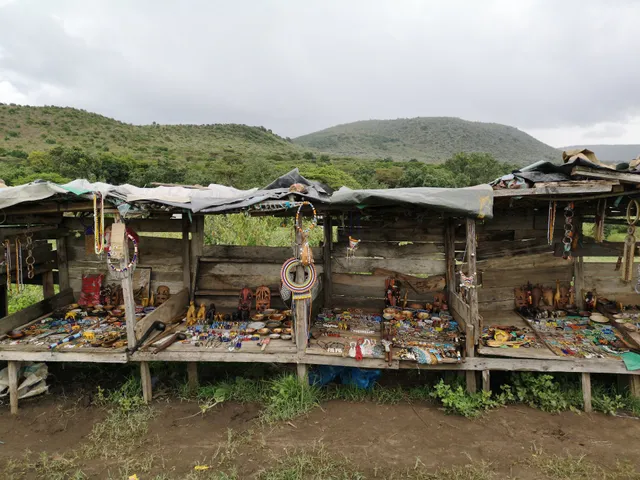
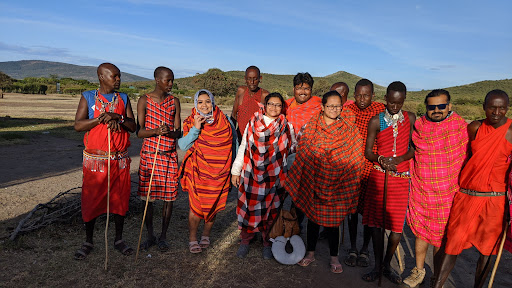
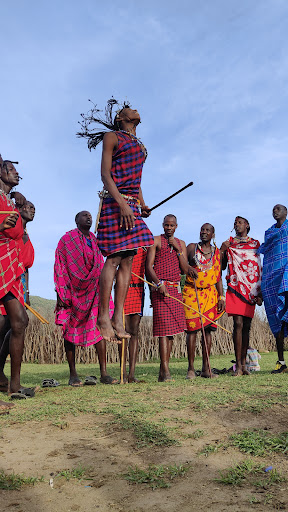
I debated not visiting the village because I was concerned that it would be a tourist trap. I didn’t read any reviews prior, my assumption was based on previous experiences in other countries. I’m so grateful we went. It was great to learn about the people who have protected and preserved the land and its inhabitants way before any of us showed up to start taking pictures. ||Our guide reviewed the traditional practices and why some are no longer practiced. My husband had chance to jump, all be it nothing compared to the Masai men 😅. We entered the traditional style home. I sang with the women. We were educated on how animals were housed and maintained. Actually, when you fly out and look out your window you will see the same circle branch construction for housing the animals on other masai properties. ||We don’t typically buy souvenirs because of their manufactured nature. But the quality and uniqueness of the pieces compelled me to purchase. I don’t have one piece that looks exactly alike, maybe similar colors and styles but not the same. One of the necklaces I plan to frame and hang. I negotiated every item. Got some great acacia wood serving spoons that would easily run me $50 from William Sonoma. The men held my items as I shopped mostly because they wanted to get an idea of what style or type of items I chose so that they could understand what another tourist maybe interested in. They trying to appeal to you just like any other business. If you willing to buy an “I Love NY” shot glass or shirt made in another county, why wouldn’t you buy the woodwork or beaded work from the people whose land you are on?||Pretty ignorant to make it a point to not support people because they have a cellphone and don’t live in a dirt hut or dress in rags. Bill Gates is doing pretty good because of you. ||If you like people and culture you will enjoy this. You don’t have to buy but I’m sure they really appreciate it. I’m pretty sure that the reason park fees went up is because there is not enough support from visits to...
Read moreI was recently on Safari in Tanzania and we stopped in a Village as part of our tour. I am writing this review to warn people to use your sense when visiting the villages as I believe they are a scam and way to get money off gullible tourist. Firstly we were taken to the most rustic looking village that had barely anything and the smallest possible houses. The chiefs son went on and on about how he has 7 wives and multiple children. The house we went in barely fit myself and my boyfriend. lol there is no way he sleeps in there with all 7 wives and that many kids. There was also no supplies or cooking utensils inside the house so I don’t believe he lived there. Also we had driven by many villages with much larger huts and had good fenced in areas for the animals. (Looked like they were actually inhabited) Most even had a car and we saw many Masai walking holding cell phones. I read up on things because I had a bad feeling and there is such thing as “fake show villages” for tourists where they don’t actually live there and they do this to make themselves look poorer to get more money off you. |I just felt a negative energy about our entire visit to the village and how they harassed us and pressured us to buy these cheap trinkets and bracelets for an insane amount of money. Things you can get for a better quality in the markets in the towns. The school house seemed fake to me lol and the way the kids sang a song and yelled out numbers seemed rehearsed and like a show. When we didn’t buy as much as they wanted us to, the one side man of the chiefs son got really rude and aggressive with us and wanted us to hurry up and leave the village. Also I witnessed them giving our safari guide a cut of the money for taking us to the village. It’s all about money and everyone is in on it for a cut. don’t be quick to fall for this. I left with a very bad taste in my mouth not a pleasant or good experience just felt taken...
Read moreOur visit to this Maasai Village in Narok (very near our Mara Elatia Camp) was an interesting one.||We had a free morning, so our guide asked us to check this place out. On the way, we saw dozens of cows belonging to this village. As soon as we entered, we were greeted very pleasantly by a group of six men carrying a long wooden stick. Al of them were draped in their traditional brightly colored “Shukas” – One of was introduced to us as “The Elder”. They took $20 per person – to help out in their schools.||The tour allowed us a glimpse of the lives of the Maasai. All of them were kind and friendly, and happy to answer all our questions. They showed us how they make fire by rubbing a special stone and a stick together while intermittently blowing on it. Then, they put some small logs of wood in a pile, and created a fire large enough for a large pot to sit on it. That is how they cook their food. ||After the demonstration, they walked us around the village and showed us a few houses. One of them belonged to their original ancestors, and still had the fur blankets on the beds. Every item is preserved, and is maintained in pristine condition – as a sign of respect for the departed relatives.||We could not help, but notice how tall and lean everybody was – they explained that it was because of their diet consisting of beef, lamb (Mutton), healthy garden vegetable, nuts, seeds and milk. Apparently, they also drink blood (yes, fresh blood) using a hollow animal horn as the utensil.||Since we did not have any more questions, they taught us their dances, and made us participate. They are all trained warriors and hunters, and some of the dance steps mimic the actions of spearing the animals during a hunt, and then celebrating.||We watched the ladies making some intricate jewelry from tiny beads, and were amazed at their skills.||All-in-all, it was a learning...
Read more