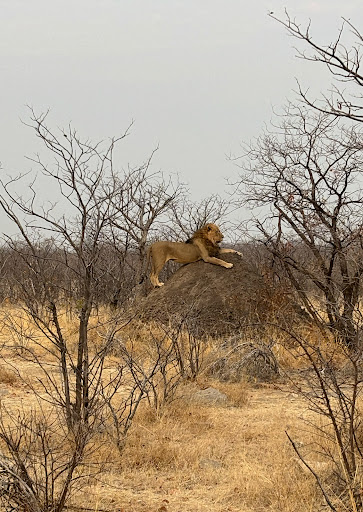
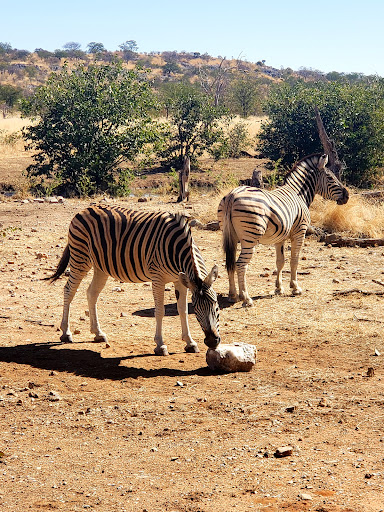
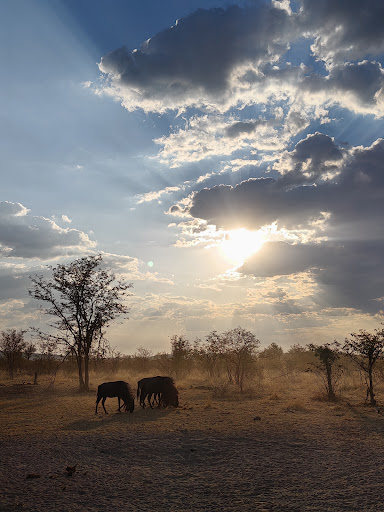
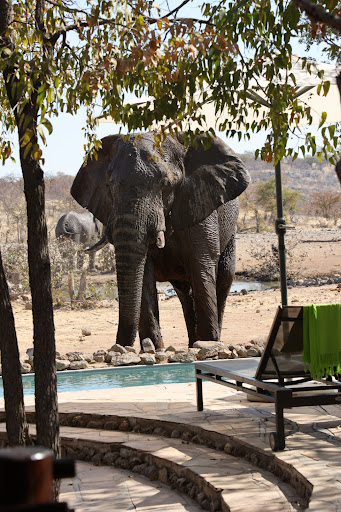
We landed at the Ongava airstrip to be welcomed by Binius, our guide for the next few days, replete with tea and biscuits in the shaded waiting room. ||After enjoying morning tea, we headed off to our accommodation at the Ongava Tented Camp (OTC), which is within the Ongava Game Reserve adjacent to the Etosha National Park. Some of the many wild animals who call this area home heralded our arrival, including oryx, zebras, and vultures, and as our 4WD vehicle made its way along the dusty road we knew we were in for a treat.||Upon arrival we were met by the camp manager Orlando, who provided cool towels and drinks as refreshment after our short drive. ||After check-in and a camp safety briefing we visited the dining area for lunch, which we enjoyed along with our pilot Romeo, who stayed at the camp in a separate guide's quarters. The reception and dining areas are adjacent to a watering hole, and as we ate lunch we were treated to zebra, giraffe, impala, waterbuck, and helmeted guinea fowl, popping in to quench their collective thirsts.||It was a warm winter's day, and this brought out the hyraces, small mammals whose comical behaviour whilst bouncing over the rocky slopes was a delight to watch. Those we saw were about the size of an Australian possum, and they seemed friendly enough.||When moving between buildings we were advised to stay on the paths because the camp is unfenced, and if moving after dark or before sunrise were told to contact reception to organise an armed escort. Following a guide armed with a rifle and an ammunition belt studded with large bullets was an unusual but necessary aspect of our stay.||Our evening game drive with Binius was joined by fellow travellers Mauricio and Katarina from Milan. We were treated to black-faced impala, waterbuck, warthog, and helmeted guinea fowl. The highlight, however, was seeing two male lions enjoying the afternoon sun. These guys have two prides which they service, and from all appearances they were quite comfortable with their lot in life.||Back at camp we were treated to the ubiquitous (but VERY enjoyable) sundowners, followed by a buffet barbecue dinner, complete with steak and chicken and assorted salads. Our drinks were included, so we sampled some of the large variety available, including lovely scotch whiskies and some beautiful African wines. Nice!||Time for bed, and under armed escort we made our way back to our tent. When I say tent I really mean a luxury timber cabin, complete with indoor and outdoor showers, stylish bathroom and large twin beds surrounded by mosquito netting. Surprisingly there were no mossies to be seen as the area had had very little rain, so deployment of the netting was not required.||Around 3am I awoke to the sound of a roaring lion who seemed to be just outside the tent, and as the hairs on the back of my neck stood up I remembered the emergency air horn that was provided to alert people should a dangerous animal approach too closely. Happily, I didn't need to resort to sounding the alarm as the roaring stopped as quickly as it started, but it did take a short while before I was able to get back to sleep.||Up early, and as we were being escorted to the dining room our guide pointed out leopard footprints in the sand near our tent. He told us there was a leopard that frequented the waterhole, but it rarely entered the camp while ever there were people visible. I recounted my story about the previous night's lion encounter, and he said he had also heard it, but he considered it to be a long way from the camp. Their sound travels far in the cool, dense, night air!||We left early for our drive to the Etosha National Park and saw many native animals, including zebra, white rhino (square-lipped grazers), black rhino (hook-lipped solitary tree browsers), giraffe, lion, Kori Bustard (the heaviest flying bird in Africa, up to 20kg), southern pale chanting goshawk, kudu, oryx, springbok, impala, honey badgers digging and foraging, and White Elephants, the largest elephants in the world.||We learned that a group of zebras is called a "dazzle", a group of rhinos is a "crush", and a group of giraffes is a "tower", or "journey" if they're on the move. What would you call a group of totally gobsmacked tourists in a 4WD vehicle? ||The Etosha Pan, meaning "great white place", is the third largest pan in the world, after Utah and Alaska, and can be seen from space. It is 4760 square kilometres in area and was once filled by two rivers – the Okavango and the Kunene, that now flow to the Delta and the Atlantic Ocean respectively. It is empty 99% of the time and is a saline desert without vegetation. Animals come to the edge to lick the salt only, and people are not allowed to walk on it, nor cross it. It is very dusty and in summer can reach 55 degrees Celsius, and down to around 1 degree C in winter.||On the way back to camp we saw many helmeted guinea fowl in the reserve, plus two dark elephants, then as we sipped our sundowners on the lounge deck we watched as first giraffes, then a rhino mother and calf arrived to drink from the waterhole.||The next morning's game drive saw us come across an ex-zebra. All that remained of this once glorious beast was a rib cage, neck vertebrae, and skull, proof positive that these animals, whilst in a game reserve, are indeed wild.||We saw the white rhinos again, some steenbok (second smallest antelope after dik-dik), baby giraffe and mum (giraffe mate for life, and the young stay with mum until 1-2 years, then join the male herd, or stay with mum if female), a zebra with its two-week-old foal, red hartebeest, kudu, and waterbuck.||After lunch we treated ourselves to manicures because our skin was so dry, during which two elephants walked right past our tent! ||The afternoon game drive was the best ever! We continued our search for the lion pride and found them resting in the sand with their huge, full bellies. After they got up to leave we followed them to the old airstrip, where they head-boofed each other and flopped down to rest - just like domestic cats, with the exception that these guys, given the chance, will eat you.||We stopped for sundowners on the savannah and watched helmeted guinea fowl (walking tea pots), wildebeest and rhino. We also noticed some huge elephant tracks right next to the 4WD. The sunset was again superb, and as we enjoyed our G&Ts we stood transfixed as the Namibian sky turned from yellow to red.||Tonight would be our last at OTC, so we savoured our final dinner and then sat watching the water hole as the evening's animal parade continued. Just sitting there, admiring magnificent wild animals only metres away was quite surreal, and its own way, thought-provoking. What would their future hold? With our support these game reserves should guarantee their prosperity.||After a lazy breakfast we bade farewell to our hosts and the wonderful management team. Their attention to detail in such a magnificent setting made our time in OTC so very enjoyable, and as we drove to the airstrip we talked of one day returning to this magnificent place.||A final bear-hug from our new friend Binius (was there a slight teardrop in his eye?) and we were off, spirited away by Romeo to our next stop.||If you're ever interested in a Namibian wildlife encounter you must definitely consider staying at the Ongava Tented Camp. The accommodation is exquisite, the people and management strive to make your stay as carefree as possible, the food and wines are top shelf, and the spectacular landscape and wildlife will fill you with memories you'll never lose. ||See you soon...||Terry and...
Read more
 Learn more insights from Wanderboat AI.