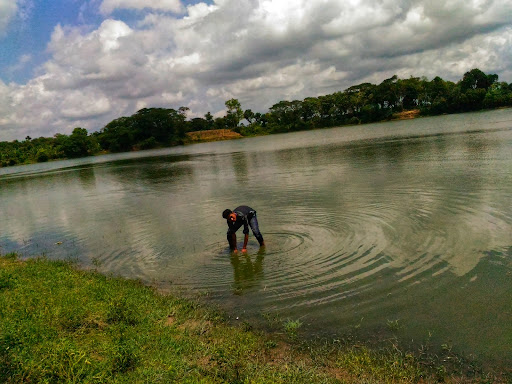
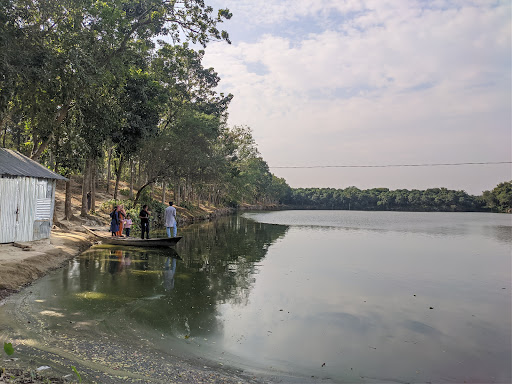
Dhol Somudur is a huge artificial pond called a Dighi by Bengali colloquy. It is supposedly the most conspicuous historical relic of the glorious and benevolent public works done by the then local dynastic landlord called Raja (king) Mukut Roy of Jhenaidah. There are also two more local dynastic landlords or kings in the olden Jessore region by the same name- one from Joydiah and the other from Brahmin Nagar.
The Dighi is situated 4 kilometers from the Jhenaida district on its south-western side in the village named Bari Bathan under the Pagla Kanai Union of the Sadar Upazilla. Popular lore suggests that the pond truly has a long legendary background with no authentic roots in history. It is privately owned by one of the veterans, well versed, reputed and respectable families of the locality since January 1935. Though various sources cite the pond to be situated on a land of 52 bighas, land documents record 10.34 acres of water pool with 10.60 acres on the banks around. Gossip rumbles loud that king Mukut Roy devoted to digging this pond in resolving the severe water crisis that existed in the area during his tenure. The water crisis is claimed to have caused many deaths at that time and had obliged the king to undertake this act of public good.
The enormity of the pond and its remarkable depth are ascribed to the low water levels that had led to the calamity of the water crisis. The rolling myth states that the king's men continued digging both across and in-depth to tap the water level that had receded during the draught but quite in vain. Failing a huge manual task of digging, the queen decided to make an offering to the deity water. The myth continues that, in response to her offerings stream enthused out of the bottom of the waterless excavation. The long tattered peasants and tenants similarly elated with joy vigorously played drums as the pond continued to fill up to the brinks. The huge body of water (sea) believed to be imbibed by the beats of the drums (Dhol) earned this body of water the name of Dhol Somudor (sea created by the beating of drums) from the captivated folk so long deprived of even the sight of water. The queen is said to have drowned as the water rapidly gushed from the bottoms. There is no historical evidence to support this myth except the being of a local ruler named Mukut Roy. [1] The timeline is also unknown.
Later the property was owned by the Zamindars of Narail. [2] The land office records (Record No 48 of 11 January 1935 and 211 of 30 January 1935) describe that the pond was purchased by a renowned and revered lawyer of that time Moulovi (Muslim Scholar) Toajuddin Ahmed, also a pioneering social worker of Jhenaidah from its following owners: 1. Babu Bon Bihari Roy son of Babu Bijon Bihari Roy, 2. Roy Kiran Chandra Roy Bahadur son of Babu Umel Chandra Roy 3. Babu Dhirendra Chandra Roy the son of Babu Jogendra Roy and Executor of Babu Jogendra Roy Estate Roy, 4. Babu Bhabendra Chandra Roy son of Babu Upendra Chandra Roy, Executor of Babu Khagendra Bhushan Roy Estate, 5. Babu Shamindra Bhushan Roy, 6. Babu Jitendra Bhushan Roy, 7. Babu Girindra Nath Roy son of Babu Jogendra Nath Roy, Executor of Babu Shama Prasad Roy Estate and five other Executors of Babu Shama Prasad Roy Estate namely Indumati Dashi, Babu Proddut Kumar Roy, Babu Surendra Kumar Roy, Babu Arun Kumar Roy and Babu Prafulla Kumar Roy, the dissidents of the Jamindar in Narail sub-District of Jessore in January 1935. [3] In 1937 Moulovi Toajuddin Ahmed was elected to the position of Vice Chairman of Jessore Zilla Board.[4] The descendants of Moulovi Toajuddin Ahmed, the contemporary owners of the property have maintained the estate as a natural reservoir and conservatory without having affected its natural glamour. Over the years a naturally decorative look has been imparted to it by huge plantation. The water body is also being exploited carefully for fish culture and meeting the protein needs of the area. The entire area has been a sanctuary for diverse species of wild birds.
The naturally beautified...
Read more
 Learn more insights from Wanderboat AI.