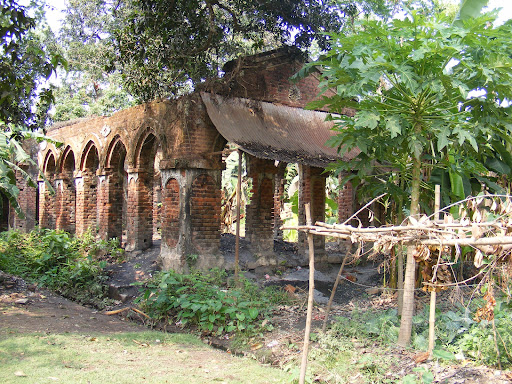
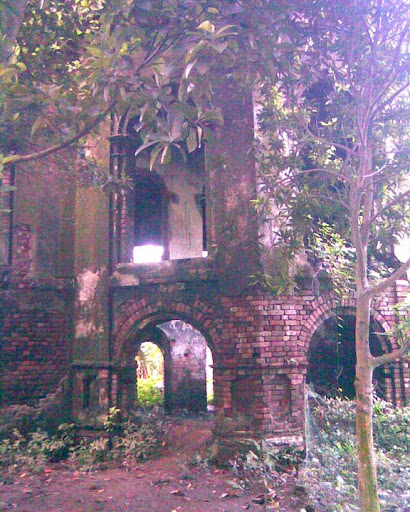
Dinajpur Rajbari now in ruins, is situated on the north-east outskirts of the present town. Originally enclosed within defensive moats and high rampart, the derelict remains of the Dinajpur Rajbari, can now be approached through a tall arched gate facing west. Inside the palace precinct near the gateway on left is a painted Krsna temple and on right, some ruined outhouses and another inner gateway that provides access to an inner square court. Facing the courtyard on the east is a flat-roofed temple, the front verandah of which is supported on four semi-Corinthian pillars and another set of columns carry the roof of the main hall.
Pitiable wreckage of the palace is now a collection of abandoned brick- buildings in an advanced stage of disintegration. The palace remains consist mainly of three groups of Mahals (blocks), known as Aina Mahal, Rani Mahal and Thakurbadi Mahal, besides other accessory buildings, erected by various Rajas and Zamindars at different times. A number of temples, rest houses, charitable dispensaries, tanks and sundry residential quarters of employees and retainers were also built within the palace area. All these building occupy an area of 16.41 acres of land including two large tanks on the east and south, the moat, garden, a defunct zoo, a tennis court, Katchary and the Kumar House. The main mahals and the enclosing moats seem to have been constructed by Maharaja Prannath and his adopted son Ramnath in the 18th century. It was built in the strange mixture of European, Muslim and Hindu styles and did not depict a very good taste. Two parallel moats called Ramdanga, which surrounded the palace on all sides, were probably dug by Ramnath after the invasion of his palace by sayed ahmed khan, the Faujdar of Rangpur under alivardi khan.
The imposing two-storeyed main palace facing east, now largely pulled down, was known as the Aina Mahal (Mirror Place) though now no trace of any glass mosaic remains on any part of the survived edifice or in its crumbling rubble. The eastern facade, about 45.72m wide has a 3.05m wide verandah above, projected prominently.
On either side of the balcony a broad spiral staircase leads up to the upper storey. The front projection of the upper floor has a series of elegant Ionic columns in pairs with round shafts. The parapet on top is plain except a short rectangular panel, rising slightly above the parapet level containing within an insignia of royalty depicting two confronting elephants holding a crown in relief. The floors of this block were flagged with black and white marble stones while ceiling gilded with stucco patterns noticeable especially in its Durbar Hall, Jalsa Hall, Toshakhana and the library.
Behind the main palace block on the west are the two-storeyed square block of Rani Mahal and the Thakurbadi Mahal. These once beautiful edifices, have now been thoroughly stripped off their costly relies, fitting fixtures and other belongings....
Read moreLocation of Dinajpur Rajbari Dinajpur Rajbari or Palace is situated on the north-east outskirts of the Dinajpur town. The name of the spot well-known as "Raj Batika", near to the village Rajarampur. You don't need to remember the names, just ask any people about the "Rajbari" and they will guide you
Dinajpur Rajbari : The Lion Gate
History of Dinagpur Rajbari or Palace History says that Raja Dinaj or Dinaraj is the establisher of the Dinajpur Rajbari. But others say that after usurping the Ilyas Shahi rule, the familiar "Raja Ganesh" of the early fifteenth century was the true founder of this Rajbari . At the end of the seventeenth century Srimanta Dutta Chaudhury became the zamindar of Dinajpur and after him, his sister's son Sukhdeva Ghosh hereditary the property as Srimanta's son had a premature death.
Dinajpur Rajbari : Gate of the Krishna Temple Structure of Dinajpur Rajbari In fact the Dinajpur Rajbari is all in its remnant. Most of the palace are tumbledown. Only few structures are alive. While entering the rajbari, you have to pass a tall arched gate facing west. Inside the palace precinct near the gateway on left is a colored Krisna temple and on right, some ruined outhouses and another inner gateway that provides access to an inner square court. Facing the courtyard on the east is a flat-roofed temple You will watch several statue of the Hindu gods inside the Temple.
The Rajbari consist principally of three groups of Mahals (blocks), named as Aina Mahal, Rani Mahal and Thakurbadi Mahal, sides other minor buildings, established by different Rajas and Zamindars at tomes to times. A few number of temples, rest houses, charitable dispensaries, tanks and building of employees and retainers were also made within the Rajbari area. The total area of Rajbari is16.41 acres of land including 2 big tanks on the east and south, the moat, garden, zoo, a tennis court, Katchary and the House of Kumar.
Conclusion With all this rajbari or palace is a beautiful historical ancient heritage. This Rajbari is not acquired by Bangladesh Govt. For that there is no care is taken. Inside the remnant of the old Dinajpur rajbari, people used to leave the wastes and caused damage day by day of this Palace. So government should take earlier stapes to protect this...
Read more13 years back this day, I went to Dinajpur Rajbari with my cousin Amit and Boro khalu. Photos are from that time. It was really a memorable day for me. It is a historic palace in Dinajpur, Bangladesh. It was once the home of the Dinajpur Rajas, a powerful Hindu dynasty that ruled the region for centuries. However, the palace was abandoned after the partition of India and Pakistan in 1947, and it has since fallen into ruins.
Today, the Dinajpur Rajbari is a popular tourist destination, but it is important to keep in mind that it is not a well-maintained site. The palace is in a state of disrepair, and many of the buildings are collapsing. However, the ruins are still impressive, and they offer a glimpse into the region's rich history.
One of the most interesting things about the Dinajpur Rajbari is its mix of architectural styles. The palace is a blend of Mughal, Hindu, and European influences, which reflects the diverse cultural heritage of the region. Visitors can see the Mughal influence in the palace's arched doorways and intricate carvings. The Hindu influence is evident in the palace's many temples and shrines. And the European influence can be seen in the palace's symmetry and classical proportions.
Despite its dilapidated condition, the Dinajpur Rajbari is still a worthwhile place to visit. The palace is a reminder of the region's rich history and culture. It is also a beautiful place to take photos and wander around.
Here are some tips for visiting the Dinajpur Rajbari:
Be aware that the palace is in a state of disrepair. Many of the buildings are collapsing, and there are hazards such as loose bricks and uneven surfaces. Wear comfortable shoes, as you will be doing a lot of walking. Bring a hat and sunscreen, as there is little shade at the palace. Be respectful of the local people and culture.
Overall, the Dinajpur Rajbari is a fascinating place to visit, but it is important to be aware of its limitations. The palace is in a state of disrepair, and it is not well-maintained. However, the ruins are still impressive, and they offer a glimpse into the region's...
Read more