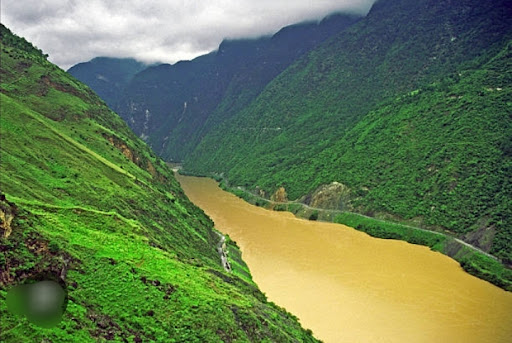
The Yellow River which sometimes called the "River of Sorrow," is one of the world's most dangerous and destructive rivers. Since historians began keeping records in 602 B.C., the river has changed course 26 times and produced 1,500 floods that have killed millions of people. The root of these disasters is the large amount of silt generated by soil erosion. From time to time the Yellow River overflows its banks and fills huge plains with large amounts of water. Floods sometimes occur when blocks of ice block the Yellow River. About once a century these floods reach catastrophic levels. When the levees of the Yellow River break, which happens with some regularity, the countryside is devastated. This is the second longest river in China and the cradle of Chinese civilization as the Nile is cradle of Egyptian civilization. It originates in Tibet---like the Yangtze, China's largest river, and the Mekong River---and gets nearly 45 percent of its water from glaciers and vast underground springs of the Qinghai-Tibet plateau. From Tibet it flows for 5,464 kilometers (about 3,400 miles) through Qinghai, Gansu, Ningxia, Inner Mongolia, the border of Shaanxi and Shanxi, Henan and Shandong before it empties into Bo Hai Gulf in the Yellow Sea. The Yellow River is known as the Huang in China. It is slow and sluggish along most of its course and some regard it as the world's muddiest major river, discharging three times the sediment of the Mississippi River. It gets its name and color from the yellow silt it picks up in the Shaanxi Loess Plateau. Dragon's Gate is the most spectacular of a series of gorges that squeeze the languid Yellow River into a raging torrent downriver from the Shaanxi Loess Plateau . Inside this 12-mile-long gorge, the Yellow River is compressed to a width, in some places, of only 50 feet by steep cliffs that rise up on both sides of the river. In my view, this is the best point for experiencing the Yellow River. Keep remember, Google is blocked in China, so you'll need to download a VPN app before you arrive. Just don't forget to enable international roaming also...
Read moreThe Yellow River is one of several rivers that are essential for China's existence. At the same time, however, it has been responsible for several deadly floods, including the only natural disasters in recorded history to have killed more than a million people. Among the deadliest were the 1332–33 flood during the Yuan dynasty, the 1887 flood during the Qing dynasty which killed anywhere from 900,000 to 2 million people, and a Republic of China era 1931 flood (part of a massive number of floods that year) that killed 1–4 million people. The cause of the floods is the large amount of fine-grained loess carried by the river from the Loess Plateau, which is continuously deposited along the bottom of its channel. The sedimentation causes natural dams to slowly accumulate. These subaqueous dams were unpredictable and generally undetectable. Eventually, the enormous amount of water has to find a new way to the sea, forcing it to take the path of least resistance. When this happens, it bursts out across the flat North China Plain, sometimes taking a new channel and inundating any farmland, cities or towns in its path. The traditional Chinese response of building higher and higher levees along the banks sometimes also contributed to the severity of the floods: When flood water did break through the levees, it could no longer drain back into the river bed as it would after a normal flood as the river bed was sometimes now higher than the surrounding countryside. These changes could cause the river's mouth to shift as much as 480 km (300 mi), sometimes reaching the ocean to the north of Shandong Peninsula and sometimes...
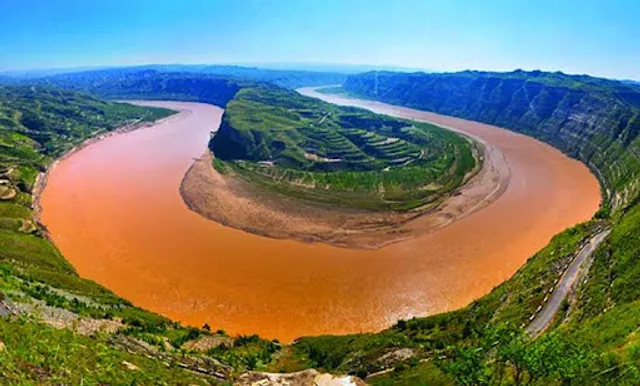
Read moreThe Yellow River gets its name because of the yellow windborne clay dust called loess that is blown across the north of China from the steppes of Central Asia. The loess is blown into the river and gives it a yellow appearance. Thanks. _ The Yellow River gets its name from the wind-borne yellow clay dust called loess that is blown across northern China from the steppes of Central Asia. The loess is thrown into the river and gives it a yellow appearance. Thank you. (Original) The Yellow River gets its name because of the yellow windborne clay dust called loess that is blown across the north of China from the steppes of Central Asia. The loess is blown into the river and gives it a yellow appearance. Thanks. _ El río Amarillo recibe su nombre debido al polvo de arcilla amarillo transportado por el viento llamado loess que se sopla a través del norte de China desde las estepas de Asia Central. El loess es arrojado al río y le da una apariencia...
Read more