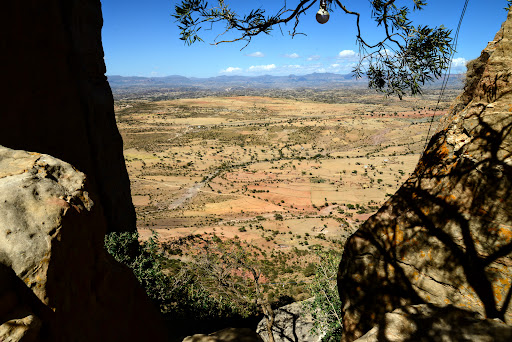
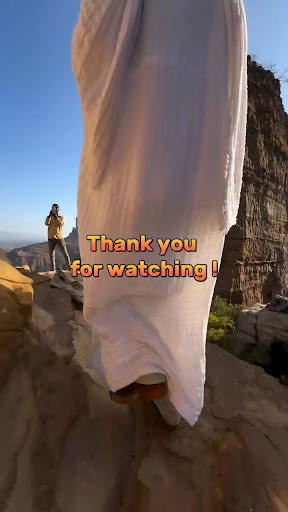
Abuna Yemata Goh must be the most stunning location of a church anywhere. It is placed in the upper part of a 300 metre vertical cliff, and to get there, you must walk around the corner of the cliff and continue some 20 metres along a 1-metre wide ledge 200 m above the ground (the ledge tilts downwards). This is not for everyone.
It is just as frightening as it seems like on pictures. I still believe that most people who consider visiting Abuna Yemata Goh will be able to make it. The climbing is not particularly difficult, it is more about courage. At one place you have to climb a 10-15 metre vertical wall, but you get a rope and a harness, and the grips are good.
From the parking you walk 30 minutes before the climbing begins. The path is easy to find, you don’t need a guide. Local ‘scouts’ wait for you with a harness when you come to the climb (150 birr). Shoes off! (Holy ground.) This is the last you will see of ropes and harnesses.
Continue for another five minutes with easy climbing (passing some interesting church chimes), until reaching the ridge and realizing that if it was steep where you came from, it is much steeper on the other side.
You are now only two minutes (and an abyss) from the church. You continue along an easy edge, until standing on a platform with heavy drops on each side. This is where the ledge begins. Luckily, the priests have placed some timber on the first part so you easily get around the corner. The ledge tilts slightly downwards to the opening of the church 15-20 metres away. Local guides walk the ledge as if on a Sunday stroll, but I preferred to keep my hands on the wall. There are a few grips on the way, but don’t trust them, they are not good enough for a solid handhold. The one rule that matters here, is: Don’t look down. Just keep walking steadily until you reach the opening of the cave.
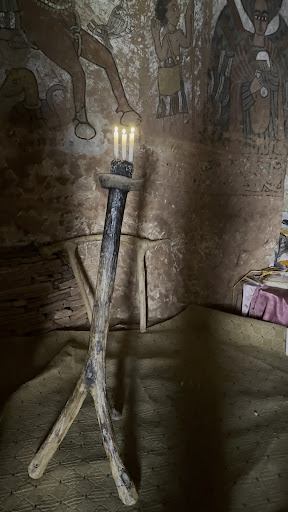
The best is the church itself. What a wonder. The decorations are absolutely fantastic. The walls and ceiling are full of Biblical figures and saints. The priest will tell you who they all are. I gave him a 100 birr tip, he was very grateful.
And of course, you need to sit down and wonder what they were made of, the people who carved this church some 500 years ago. The room itself was bigger than I had expected, with two large pillars inside and 3-4 metres to the ceiling. There is space for a small congregation here.
The location of Abuna Yemata Goh is more easily accessible than one might think. It is possible to travel back and forth from Mekelle in one day, but better to stay overnight at Hawzen for at least one night. The first thing you need to do is to get to Hawzen. From Mekelle, you can take a local bus for 40 birr (the bus station is located in the northern part of Mekelle). It takes 2.5 hours. If coming from Adigrat, you can do the trip to Hawzen in 1.5 hours (the bus station in Adigrat is in the centre of the city). Many tourists book the trip via a tour company and use a private driver. I don’t see why. They pay 10-100 times more than going by local transport. The local minibus or bus is frequent (just show up and get a ticket on board) and almost as fast as a private car.
When arriving in Hawzen, simply hire a bajaj (tuk-tuk), who will take you to the footpath at the Gheralta mountains in 30 minutes. I paid my bajaj driver 500 birr, for which he took me back and forth, plus waited for more than two hours while I climbed the mountain.
I didn’t use a guide. When I came to the climbing, one of the scouts followed me all the way up and down; extremely helpful. I tipped him 100 birr.
The church ticket is 150 birr. This is a general fee which you pay to get into all historical Tigrayan churches, collected at the start of the hike.
To sum up, for travel Adigrat via Hawzen to Gheralta mountains and return route to Mekelle, plus all tipping, church fee, harness and ropes, I paid less than 1100 birr (USD 40). I definitely think it is worth it.
Would I do it again? Never. It would be such a personal loss if I came to the ledge again and didn’t have the...
Read more
 Learn more insights from Wanderboat AI.