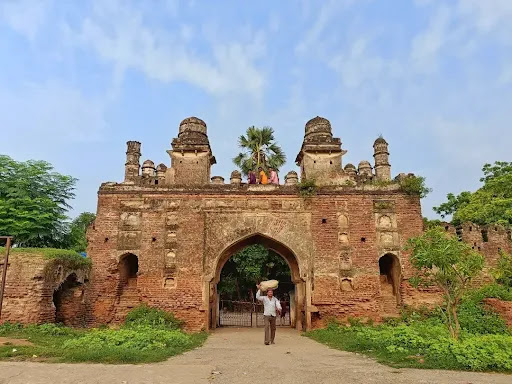
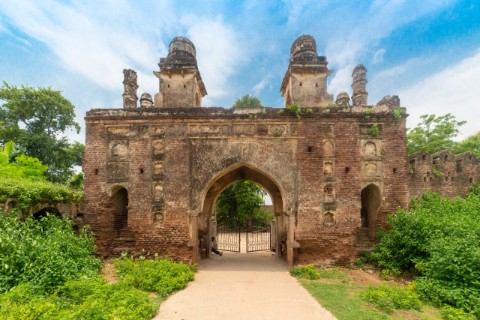
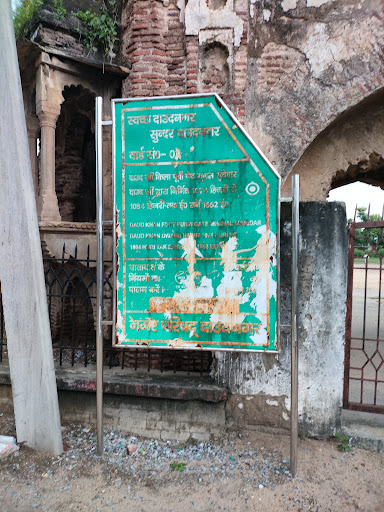
After conquering the fort of Palamu in 1659, Daud Khan established a town in Aurangabad district and named it after him, Daud Nagar. He was the first governor of Bihar during the rain of Aurangzeb. Later he built a Sarai known as Daud khan's fort, situated on the eastern bank of the Sone river in Daudnagar, Aurangabad, Bihar.
It was mainly built with bricks. There's a 3-domed mosque in ramshackle condition inside the fort. The fort has 2 entrances on the western and eastern sides. Each gate has 4 large minarets with 2 domes in the centre, surrounded by turrets. The gates are beautifully carved which can still be seen today. 2 rooms can be seen in the southern and the northern part of the fort which have 3-arched gates, and 4 domes on each corner of the fort.
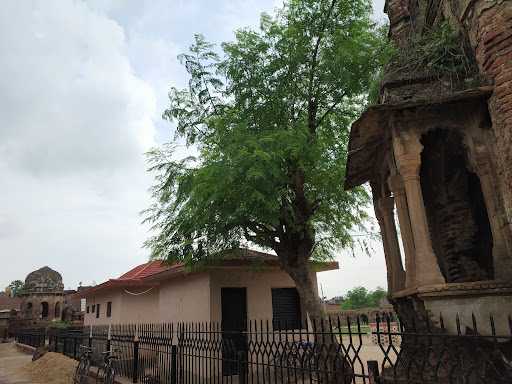
The government has taken some initiatives and built roads inside the fort for morning walks and some benches on the lawn for tourists and some rooms on the eastern side. But the condition of the fort is getting worse every day and the government is not paying any attention to saving it.
For some people the fort is just a pathway to go to the other side of the colonies, some use it as a garbage dump and open urinal and others for getting intoxicated.
Despite being in a dilapidated state this place is still a gem for architecture lovers. Which needs to...
Read moreThis fort is situated on the eastern bank of the Sone River and was founded by Dhaud Khan, a Governor of Bihar under Aurangzeb in the 17th of Palamu fort from the Cheros; and it is said that while back from this conquest he camped here and founded the town known after him. The surrounding area was also granted to him as a Jagir by the emperor. Early in the 18th century Buchanan saw it as a flourishing town with cloth and opium factories. The sarai built by Daud Khan was, perhaps really meant to be a stronghold; for it was well fortified with a battlemented wall, two large gates and a moat all around. It was called as a sarai probably to avoid jealousy of the Government. The sarai was in good condition till a few years before 1896; for the Bengal list says that the gates were regularly shut every night. Ahmad Khan, grandson of Dhaud Khan, fortified the town which was then named as Ghausipur. The town also contains an old mosque and another sarai built by Ahmad Khan, which had mud gates. In the outlying part of the town called Ahmadganj is the tomb...
Read more