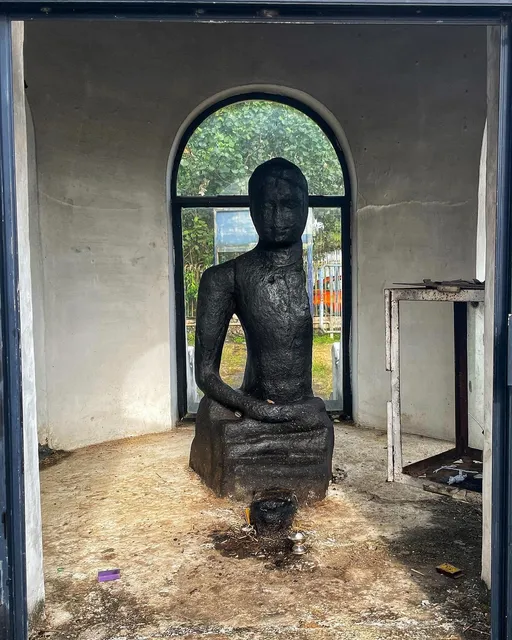
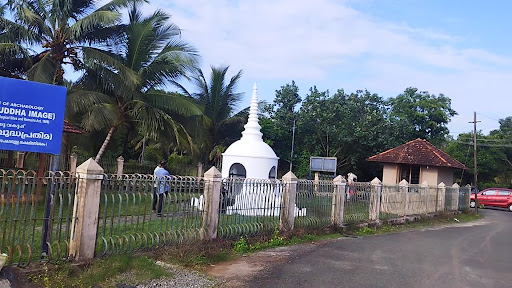
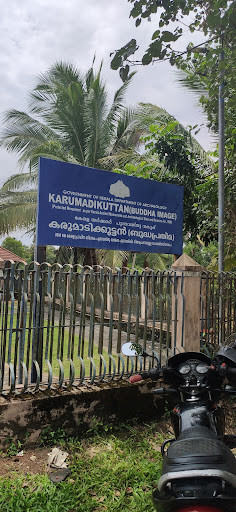
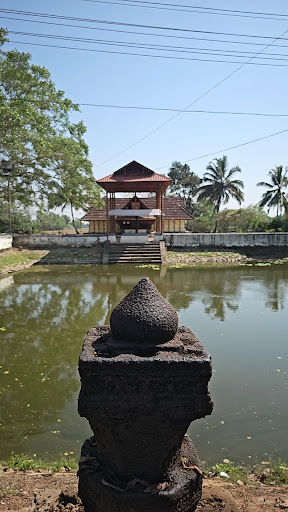
Tucked away in the small village of Karumadi, 17 kms away from Ambalapuzha is Karumadikuttan, famous for its three-feet-tall statue of lord Buddhaโthe lone silent reminder of the fact that Buddhism once flourished in Kerala between 3rd century BC and 13th century AD. Karumadikuttan, literally means the little black boy or the boy from Karumadi. Let's give you a bit of history. This statue is said to date back to somewhere between 9th and 14th century AD. History tells us that the statue remained abandoned for many years in a nearby stream named Karumady thodu until it was discovered by Sir Robert Bristov, a British engineer in 1930, who built the shrine to preserve the relic. What grabs your attention when you see the statue for the first time is that, it is entirely broken on its left side. And yes, there are lores that explain this phenomenon. Ironically enough, though the statue of Buddha is in a meditative and peaceful stance, it was rather violently destroyed by a Mughal emperor. This was done in order to put a stop to the slow and steady creeping in of Buddhism in Kerala at the time. Another famous lore among the locals is that the statue was broken apart after an angry elephant went surging in, demolishing it. This is a paradox to the frequently eulogized story about Buddha's birth. Buddha's mother, Maya, dreamt of an elephant before giving birth to her son. She, however, considered it to be a good sign as elephant is a symbol of greatness. Whatever be the story, Karumadikuttan is a mute testimony of a violent past. It faces the Punnamada lake and is protected by a pagoda that is believed to have been built by Dalai Lama during his visit to Karumadi. Though it was declared as a protected monument by the Archaeology Department under the Kerala Ancient Monuments and Archaeological Sites and Remains Act, 1968, the site remained neglected till last year. But now, due to the efforts of Karumadikuttansโa forum set up to look after the shrineโthe Archeology Department has sanctioned Rs 15.67 lakhs for the renovation of its premises. The renovation works that included the construction of a resting shed for visitors, granite footpath, security cabin, compound wall, lighting facility and information counter, were all completed within a span of time that would have made Sir Robert Bistrov very proud. By Boat: You can reach Karumadikuttan in half an hour by a boat from Alappuzha. This journey comes along with the added benefit of exploring the charm of Alappuzha backwaters. By Road: It will take the same half an hour through NH 47 via Ambalappuzha. The shrine remains closed on Mondays and on national holidays. Visiting time is between 09:30 am...
ย ย ย Read moreKarumadikkuttanย (ย เดเดฐเตเดฎเดพเดเดฟเดเตเดเตเดเตเดเตป )
Karumadikuttan is popular for the large black granite statue of Lord Buddha in sitting position.This 3 feet tall, black granite statue.
Dalai Lamaย has visited Karumadi in 1965.
It is a well-known Buddhist center in Alleppey. Built during 9th and 10th century, the statue of Lord Buddha serves as a reminder of remnants of Buddhist culture.Nearby stream named "Karumady thodu".
As per travancore state manual the idol of Karumadikkuttan is of Jain Theerthankara .
It is broken into half and kept under the protection of Archeological Survey of India. As legend says, the left part of the statue was destroyed by an elephant.
In 1930s, Sirย Robert Bristow, a colonial British engineer found the statue.
Buddhism came to Kerala in the 3rd century BCE and flourished during the reign of the Ay King, Varaguna. The Hindu renaissance in 8th century CE heralded the decline of Buddhism. Even though Buddhism did not flourish greatly in Kerala, ruined or neglected Buddha statues and images have been unearthed in the coastal districts, especially Alappuzha (Allepey) and Kollam (Quilon). Amongst Buddhist stupas and statues found in various spots of the state, Karumadikuttan is an important one.
The granite statue of Karumadikuttan Buddha is believed to have been built by Buddhist monks who visited Kerala between the 9th and 11th centuries through the port of Alappuzha, carrying the message of love and non-violence. Keralites who followed Buddhism gradually became Hindus.
Left side of the statue is missing. The statue is a subject of historical debate as the reason for its partial destruction is...
ย ย ย Read moreKarumadikkuttan, also known as the "boy from Karumady," is a Buddha statue here. This 3-foot-tall black granite statue is believed to be from the 9th to 14th century. It was discovered by Sir Robert Bristow, a colonial British engineer, in the 1930s. The left side of the statue is missing, and the reason for its partial destruction remains unknown, sparking historical debates. The statue is currently protected by the Kerala state government and is situated near the Karumady Thodu. Visiting Karumadikkuttan offers a captivating experience, where visitors can appreciate its historical significance and marvel at its artistic craftsmanship. For history enthusiasts, visiting Karumadikkuttan is an absolute must. The statue's serene location, coupled with its historical significance, creates an enchanting experience that transports you back in time. I highly recommend taking the time to explore the nearby areas and the beauty of the village. I prefer monsoon season to visit but be careful as they are water-logging areas and the chances of accidents will be high. Liked the ambience and...
ย ย ย Read more