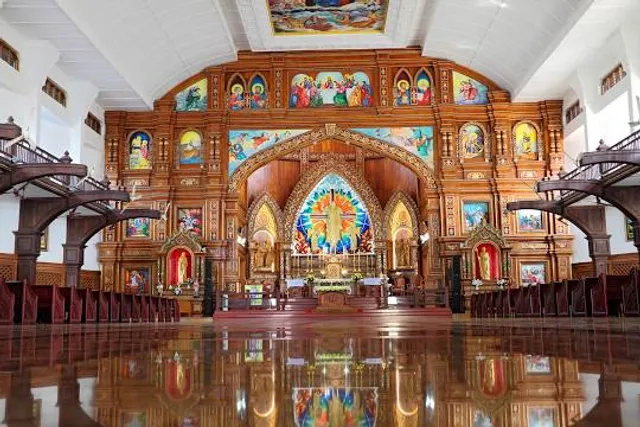
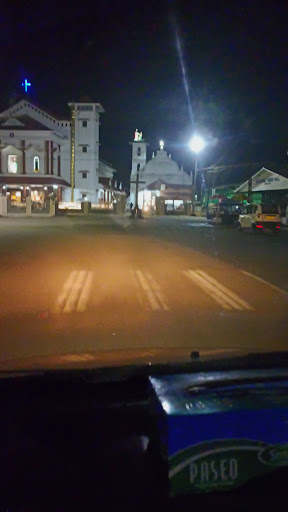
Kurishumudi (Hill of the holy cross) is a mountain at Malayattoor, has its fame as a place visited by St. Thomas, one of the Apostles of Jesus Christ. Jesus gave a mandate to his Apostles to go out to the whole world and to proclaim the Good News. Thomas set out to India and landed at Kodungalloor in AD 52. A hostile reception was given and his life was in danger. He was forced to flee to the top of the mountain and had spent days in the abode of God. In deep anguish and agony, St. Thomas prayed to the Lord and he made a sign of the cross on the rock. The Mother of Our Lord, Blessed Mary, appeared to console and strengthens him. He descended from the top hill and continued his journey to Mylapoore in Tamil Nadu. Later on the hunters went to the mountain for hunting. While they stayed in the night they saw a glittering sign of cross on the rock. Out of curiosity they struck there with their rude weapons. To their surprise blood gushed out. They ran to the valley and told the locals. They went to the mountain and while they prayed there they got many miracles. This is the humble beginning of Pilgrimage to Kurishumudi.
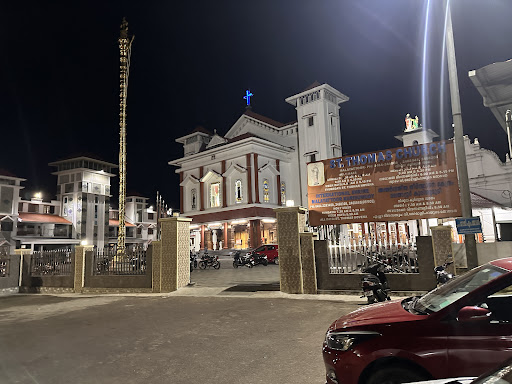
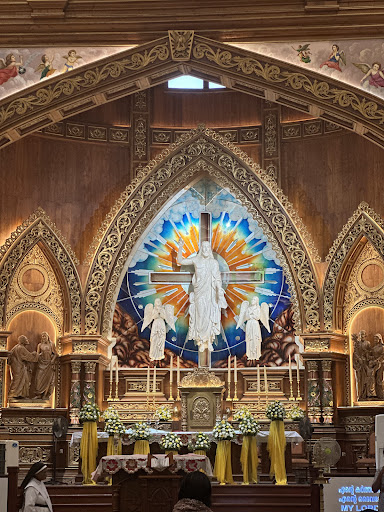
ST. Thomas Church, Kurishumudi Golden Cross Kurishumudi is where one can find the Golden Cross believed to have formed when St. Thomas knelt on a rock and signed a cross with his finger. He remained there praying for a long time, and ultimately a golden cross appeared on the spot.
Footprints of St Thomas One of the most curious sights at the mountain was the permanent footprint and the marks of knees of St. Thomas imprinted on the rock. At present, the natural footprint is not there but instead there is a man-made footprint (A replica) made by the Church.
The ancient chapel struck by the elephants An ancient chapel at Kurishumudi, was attacked by tuskers in the past when it used to be surrounded by thick jungle. Deep tusk marks can still be found on the back wall...
Read more[09/06, 10:45 pm] Meta AI: Malayattor Kurishumudi, a revered Christian pilgrimage site in Kerala, India, has a rich history dating back to 52 AD. St. Thomas the Apostle, one of Jesus' twelve apostles, arrived in Kerala and established a Christian community in Maliamkara. When faced with danger from hostile natives, St. Thomas fled to a hilltop, made the Sign of the Cross on a rock, and prayed. According to tradition, a golden cross appeared on the rock, and pilgrims still climb the hill, calling out in reverence. The Portuguese discovered the church in 1501, and in 1998, it was elevated to Archdiocesan status. Today, Malayattor Kurishumudi is one of eight international shrines, attracting devotees from Kerala, Tamil Nadu, and worldwide [09/06, 10:45 pm] Meta AI: Malayattor Kurishumudi, a revered Christian pilgrimage site in Kerala, India, has a rich history dating back to 52 AD. St. Thomas the Apostle, one of Jesus' twelve apostles, arrived in Kerala and established a Christian community in Maliamkara. When faced with danger from hostile natives, St. Thomas fled to a hilltop, made the Sign of the Cross on a rock, and prayed. According to tradition, a golden cross appeared on the rock, and pilgrims still climb the hill, calling out in reverence. The Portuguese discovered the church in 1501, and in 1998, it was elevated to Archdiocesan status. Today, Malayattor Kurishumudi is one of eight international shrines, attracting devotees from Kerala, Tamil Nadu, and worldwide. The site features a stunning church, a museum, and a holy cross carved by St. Thomas himself. Pilgrims climb the hill, praying and singing hymns, seeking spiritual enlightenment and solace. Malayattor Kurishumudi stands as a testament to the region's rich cultural and religious heritage, a symbol of faith...
Read moreSt. Thomas is believed to have landed at Kodungallur (Cranganore) in Kerala in AD 52. In AD 62, St. Thomas returns to Malankara coast via Malayatur where he establishes ‘the half church’ (a small Christian community dependent on the Church of Maliamkara).5] Oral tradition says that while travelling through Malayattor, faced with hostile natives, he fled to the hilltop where he said to have remained in prayer and that he left his footprint on one of the rocks. According to beliefs, during prayer, he touched a rock, upon which blood poured from it. The Church was discovered by the Portuguese in 1501, and they record that upon arrival in the region in AD52, St Thomas converted King Chozha Perumal of Meliapor by dragging a large log ashore that elephants had been unable to move. The relics of St Thomas were returned to Edessa in Syria in the 3rd century. In the 4th century the Church of St Thomas was in decline, so large group of Christians from Edessa emigrated to Malabar. They were led by Mar Joseph, Metropolitan of Edessa, and Knai Thoma, a merchant who had previously visited Malabar and found the Christian community there in need of support.[6 The main festival of the Church on the first Sunday after Easter, which is when the resurrection of Jesus Christ, the Son of God, occurs. It is traditionally believed that St. Thomas used to make the Sign of the Cross on the rock, kiss it and pray at Kurisumudi. The story has it that a miraculous golden cross appeared at that particular spot. Pilgrims going up the hill call out incessantly "Ponnum Kurishu Muthappo, Ponmala Kayattom", meaning "''O Patriarch of the Golden Cross! Climb we shall,...
Read more