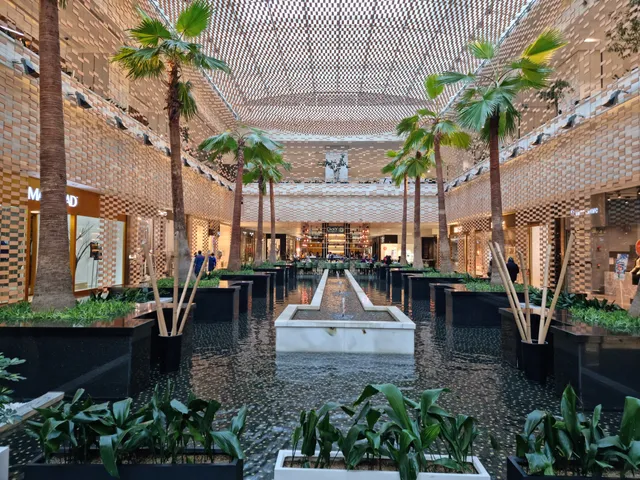
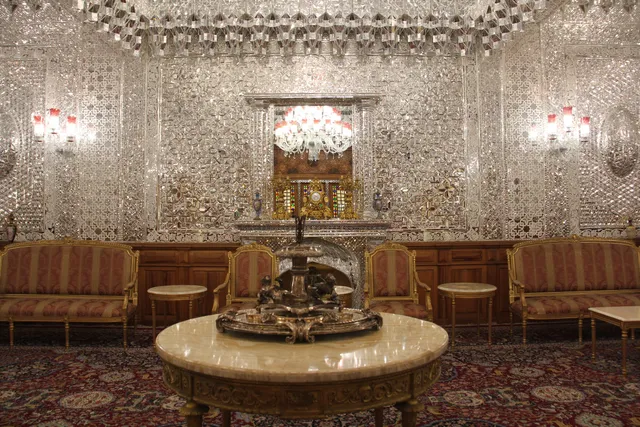
The Iran Mall (Persian: ایران مال) is the biggest shopping mall in the world in terms of area, and one of the largest commercials, cultural and social projects in the world, located in northwest Tehran, Iran, by Chitgar Lake. The multi-purpose complex was designed on land with an area of 317,000 square meters and seven floors. Its infrastructure area in the first phase is 1,350,000 square meters, which will be increased to 1,600,000 square meters when all the development phases are completed. The facility is owned by Ayandeh Bank. The original idea of building such a large complex came from the well-known Iranian entrepreneur, Ali Ansari, who has also been the chief executive of constructing the Iran Mall. According to the Guinness World Records, the longest continuous concrete pour has been completed in Iran Mall. This record was achieved between 1 and 6 March 2018. The traditional bazaar of Iran Mall is inspired by the markets of Tabriz, Isfahan, Shiraz, Qazvin, Qom, etc. The traditional bazaar of Iran Mall is a collection that has been designed and built based on historical patterns and methods of Iranian architecture about historical markets and related buildings. This complex with the Iranian-Islamic architecture is a venue for displaying and selling handicrafts, souvenirs and products from various parts of Iran. The centre of the bazaar is the Chahar Souq. Chahar Souq divides the bazaar into 4 sections, and each store's space is between 500 and 1000 meters. The traditional bazaar with an area of about 10,000 square meters is located in the west side of Iran Mall. Didar Garden Didar Garden's roof is 14 meters long; this roof is made of glass and it is decorated with fountains and palm trees. The design of Didar Garden, which has an area of 3,000 square meters, is inspired by the architectural brick designs of Iran's central regions, such as Yazd and Kashan. Mahan Garden Iran Mall's Mahan Garden Mahan Garden with a width of 50 meters and an approximate length of 170 meters and an area of about 16,000 square meters has been built on three floors of the first to second commercial parking on five levels. Another feature of this garden is the design of its roof structure. For the first time in Iran, membrane coatings (ETFE) have been used to cover the roof of this building. Iran Mall's Mirror Hall One of the most prominent parts of the traditional bazaar is the Mirror Hall, which is based on the design of the Hall of Mirrors of the Golestan Palace. More than 38 million pieces of mirror have been worked into it, and carpet from Neyshabouri carpet weavers covers 126 square meters. Traditional drink shop On the southeastern side of the traditional bazaar of Iran Mall, an area of 250 square meters is devoted to a traditional drink shop. The Library The Iran Mall offers a separate structure known as the Jondishapour Library, named after Jondishapur University. The library uses earthy tones and a warm wood in its interior design to convey a sense of genuine Middle Eastern hospitality and comfort, and is built on three floors. It's equipped with more than 45,000 volumes of books, manuscripts, and documents. Separate reading studios also welcome those interested in reading books in a more secluded, private area. The statues displayed at Jondishapour library are of three important figures in Persian history. They are Ibn Sina (Persian: ابن سینا; 980 – June 1037 CE), commonly known in the West as Avicenna, Abu Ali Hasan ibn Ali Tusi (April 10, 1018 – October 14, 1092), better known by his honorific title of Nizam al-Mulk (Persian: نظامالملک, 'Order of the Realm'), and Abu Rayhan Muhammad ibn Ahmad al-Biruni (973 – after 1050), commonly known as al-Biruni. The car showroom is located in the west of Iran Mall with the aim of showcasing the latest technology in the automotive industry. A café is located in the center of the...
Read moreIran mall complex is a huge construction project with several phases. There are a lot of amazing architectural spaces with different design. Although some of them don't have originality needed, there is an eye-catching place. Facilities provided for these building are considerabe. All in all it's worth seeing.
Iran-Mall is one of the world’s top 5 malls and the number one in the Middle-East. The founders of the project aimed to found an international mall that gathers together the domestic and international business owners. The building is located in the west of Chitgar park in Tehran with the total floor area of 1,700,000 square meters. The project took about 5 years to complete. Meanwhile, 20,000 professionals and workers were engaged in the project since 2014. 18% of the spaces are allocated to the cultural facilities, 31% to the public and recreational, 24% to the commercial, 19% to the parking and 5% to the hotel.
The primary goal of the project was to create an environment that covers all the component of the sustainable development, including the environmental, economic, and social components of sustainability. The following were the main objectives of the project:
Contributing to economic growth and development of the country
Attracting tourists and providing a platform to absorb investment for the private sector to create more jobs
Providing a healthy environment for all people, especially the younger generation
Familiarizing people with the Iranian-Islamic culture
Economic, cultural and social development
Assisting the local economy through increased trade transactions
In designing the project, the national, religious, historical, geographical and cultural beliefs were considered to achieve a modern Iranian-Islamic architecture. In this regard, designers used the concept of the traditional bazaar to resemble it in the building. The founders hope the mall will work as an international hub to increase the exported commodities of Iran by attracting Iranian manufacturers and traditional craftspersons from Isfahan, Tabriz, Qom, Kashan, Shiraz, and Qazvin.
Bagh-Didar or Didar Garden (Meeting Garden) is a garden in the mall that its concept originates from Mahan-Garden of Iran. The garden is one of the most exciting places to visit in the mall. Similar to Mahan Garden which is in the heart of the desert, Bagh-Didar is a green space inside the rigid architectural environment of Iran-Mall. It created a pleasurable environment for people to meet and have a casual conversation. Also, another garden named Book Garden or Bagh-Ketab is a garden designed to create a place that people can use to read books.
The project is one of the most ambitious projects of Iran’s contemporary architecture that was constructed by Iranian and international designers and engineers. Besides, many celebrities and public figures praised the mall for its design and achievements in the initial opening ceremony. It consists of different concepts and ideas that were originated from the traditional architecture of Iran. The project is now in its final phase and soon will be open...
Read moreThe Iran Mall is a vast shopping and entertainment complex in northwest Tehran. The first phase of the mall opened in 2018, at which point the mall became the largest in the world. And with the second phase still in progress, the Iran Mall will only continue to grow.
Prior to the construction of the Iran Mall, the largest shopping mall in the world was the South China Mall in Dongguan, China. With a gross leasable area (GLA) of 7.1 million square feet, it was‚—and still is—a real whopper of a mall.
But when the first stage of the Iran Mall was opened in 2018, it more than doubled the GLA of the South China Mall, becoming the uncontested king of commercial complexes. With a total area of 15 million square feet, the Iran Mall is about five times larger than the King of Prussia mall in Pennsylvania, currently the largest mall in the United States. Or, to use a non-mall comparison, the Iran Mall covers more than twice the area of the Pentagon.
So what exactly is going on at the Iran Mall to justify such a vast space? Well, in terms of zoning, 24 percent of the mall is occupied by commercial spaces, 18 percent is allocated to cultural facilities, 31 percent to public and recreational areas, 19 percent to parking, and 5 percent for the hotel.
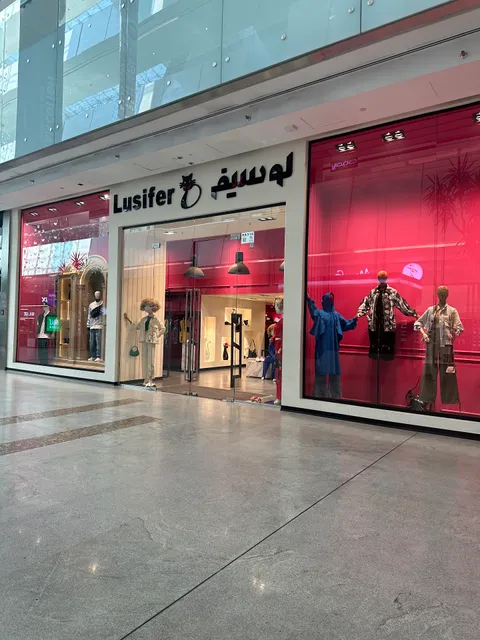
The first phase of the mall is home to a range of retail outlets that will have even the most world-weary of shopaholics drooling. Not all of the shops are open yet, but there is currently room for around 700 stores (set to expand to 1,000), selling everything from international designer brands to traditional Iranian-made products, and a 215,000-square-feet hypermarket. You’ll also find a vast car showroom.
For the style-conscious, meanwhile, there’s a fashion avenue, a diamond atrium, and a crystal atrium. And for the more cerebral shopper, there’s a book garden with several bookstores containing around 67,000 volumes, as well as an on-site museum, art galleries, and a state-of-the-art 2,000-seat theater.
Beyond the shopping, there’s also a cinema complex with 12 IMAX cinemas, an amusement park, a hotel, a conference hall, and a convention center. And to introduce a bit of healthiness into the mall, there’s a sports complex with cycling and hiking routes, numerous sports fields, swimming pools, tennis courts, and a large ice rink.
If all this sounds like a commercialized nightmare of Dawn of the Dead proportions, visitors can always run and hide in the Bagh-Didar, or Meeting Garden. Based on the Mahan Garden, a historical Persian garden in Iran, the Bagh-Didar is a cool green space located right in the heart of the mall, where people can escape from the incessant shopping.
As for phase two of the Iran Mall, that’s supposed to be completed in 2020. And once that’s finished, it will cover a total area of 20 million square feet. Which just...
Read more