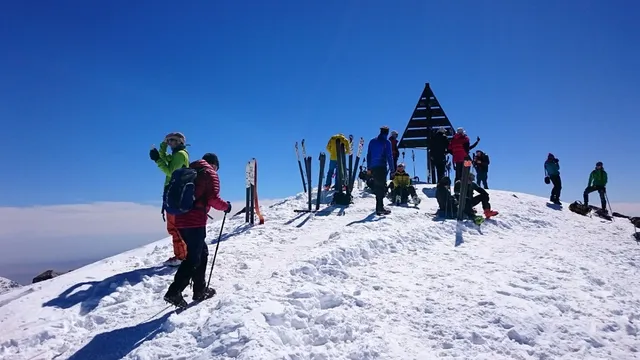
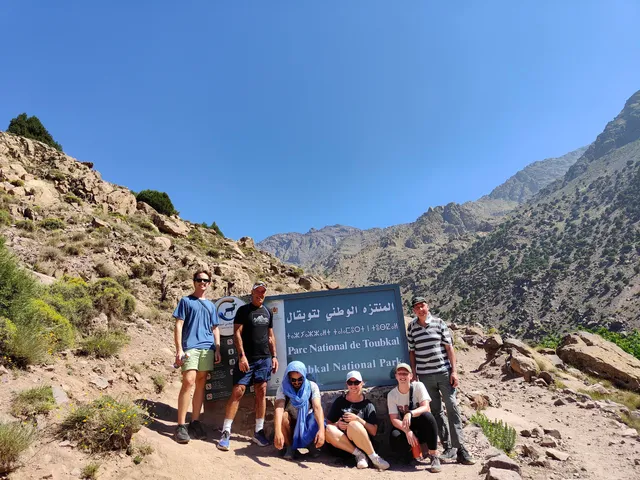
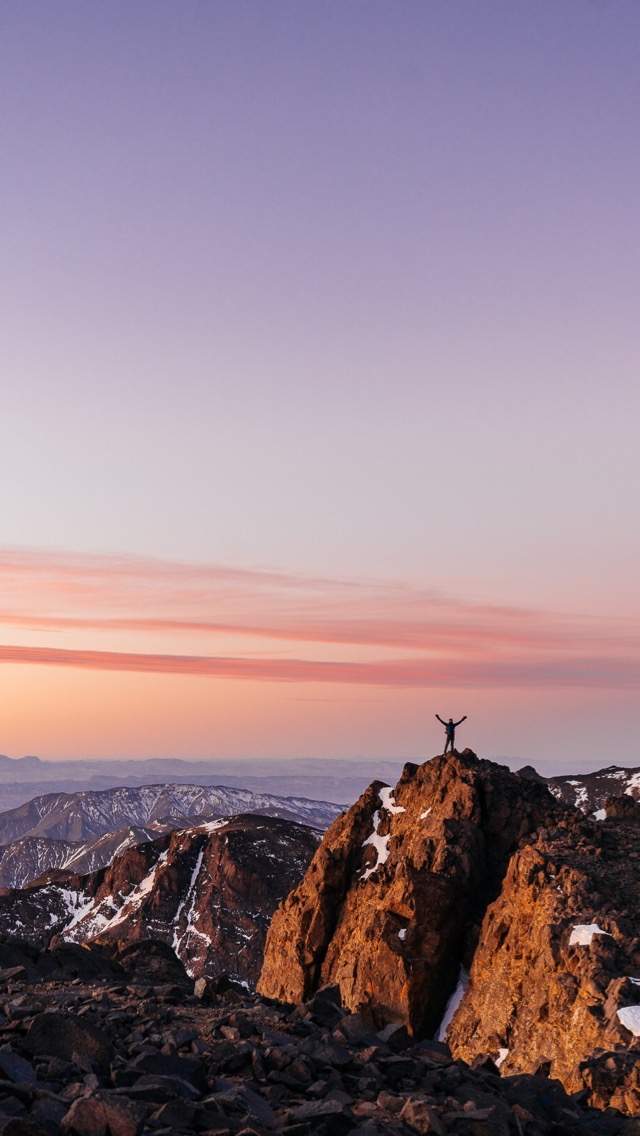
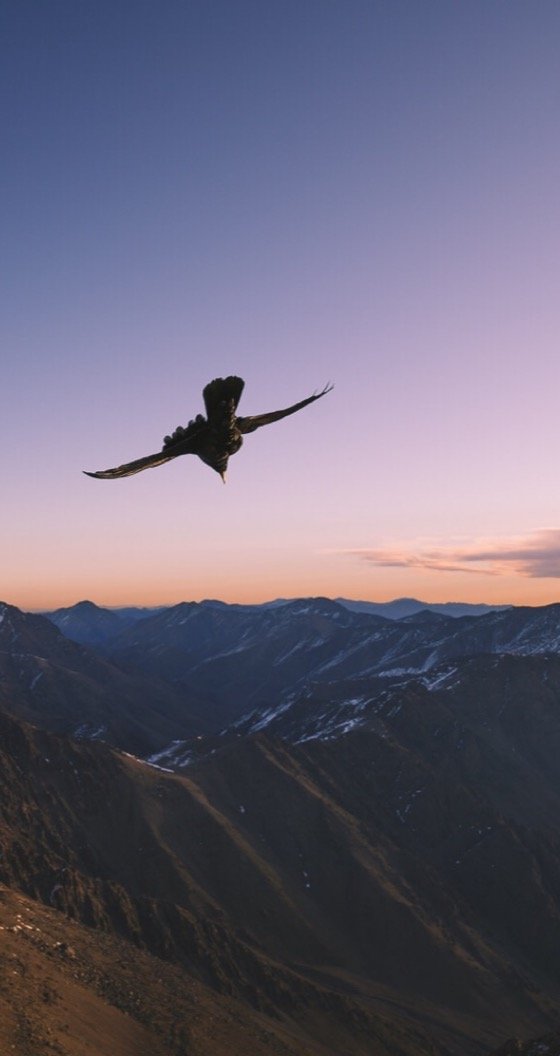
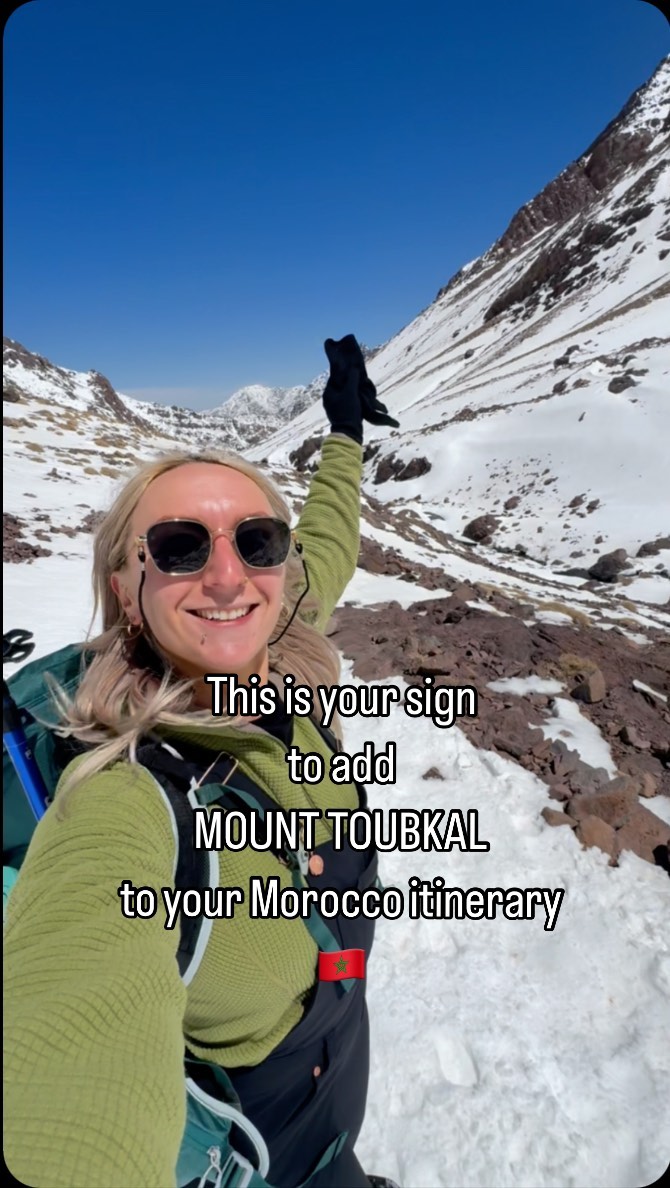
Toubkal or Tubkal (amazigh : ⵜⵓⴱⵇⴰⵍ Tugg kal; Arabic: توبقال Tūbqāl) is a mountain peak in southwestern Morocco, located in the Toubkal National Park. At 4,167 metres (13,671 ft), it is the highest peak in the Atlas Mountains, Morocco, North Africa and the Arab World. Located 63 km (39 mi) south of the city of Marrakesh, it is an ultra prominent peak, the highest for over 2,000 km (1,200 mi) and a popular destination for climbers. The first recorded ascent was on 12 June 1923 by the Marquis de Segonzac, Vincent Berger and Hubert Dolbeau, but the mountain may have been climbed before that date. Trekkers usually approach the mountain from the road-end village of Imlil. Qualified guides can be hired, as well as porters, to carry equipment and food supplies higher into the mountains. For experienced mountaineers, guides are not required for the normal route, as it is a moderate hike and orientation is not a problem. The normal route starts with an easy walk to the village of Aroumd . Past Aroumd a floodplain is crossed and the route follows the left slope of the valley southwards. The valley bends to the east to the tiny settlement of Sidi Chamharouch, which has grown around a Muslim shrine. At Sidi Chamharouch, the path leads over the stream and runs steeply uphill to the right side of the Isougouane valley, which leads to two stone-built refuges (old Neltner Refuge and new Refuge du Toubkal) that are often used as base camp at 3,207 m (10,522 ft). It is possible to buy good meals in the Refuge du Toubkal. Tents can be pitched near the refuges for a small charge. From that point a path crosses the stream, climbs a steep scree slope to the east and enters a valley (corrie), then climbs another steep slope to reach a col (Tizi'n'Toubkal at 3,940m). At the col the route turns left (northwards) to the summit ridge of Jbel Toubkal. The 4,167m summit is crowned with a curious pyramidal metal frame and views take in most of the Atlas and Little Atlas Mountains. The ascent during the summer (from May) is non-technical yet moderately difficult, only complicated by steep and slippery scree slopes and altitude sickness. Sturdy boots and proper (windproof) clothing are required, and trekking poles are helpful on the scree. An ice-axe may be needed on the remaining snowfields in the early summer. The ascent during the end of the winter and spring (February/March) is more difficult. Crampons are necessary to ascend through the snow and - in some cases - ice. It is possible to climb the mountain in two days - first day up to the refuge (around seven hours), second day to the summit (around five hours) and back to Imlil (up to five hours). In summer the mountains can be very dry, but are sometimes subject to storms. Although the temperature should remain above zero during the day, freezing conditions are possible over 3,500m. In winter the mountains are covered in snow and ice, and can be prone to avalanches. Skiing is possible as the snow can lie to considerable depth and cover many rocky slopes. Information about the state of the route can be obtained at Marrakech tourist offices or at Imlil. On 17 December, 2018, 2 tourists, one from Denmark and another from Norway were beheaded in a terror-related attack, their bodies were left near...
Read moreChallenging and wonderful hiking to Toubkal summit. We've done the three days and two nights trip to Toubkal summit with our guide Hassan. It requires a intermediate fitness level, and because of that we started an specific training about one and a half month ago. We started to do some resistance training and some cardio on the escalator at the gym to practice walk up. I advise you to do with a guide specially if are going to do the three days and two nights. I've seen people neglecting to do it with a guide, but they've done crucial mistakes that could have ruined their trip. The guides are sensitive to give you right directions and important instructions to do the hiking safely. I've seen a guy having an accident because he decided to walk without the guide. You could notice he was experienced, but he stayed close to the hilly part of the trail and the mule pushed him down and he had some injuries and twisted his ankle. You had better to do it with a guide to avoid anything unexpected. Also I've seen some naughty people on the base camp expecting to be in a hotel five stars with their friends. Guys, please be aware that this is a hiking that requires good concentration, self control, good capacity to cope with physical and psychological stress, and please bring the best of yourself with you. Share things with people and be ready to help and alternate things when needed. Those people were refusing to leave the table to give seats for other people to have dinner. Please, don't go to create a negative vibe and atmosphere and don't expect to have luxury on the base camp. Be aware that you are sharing a space with more 150 to 200 people on the base camp. You won't be in your grandmother's house with a nice bed and perfect hot shower. Also disrespectful people during the night with their lights in people's face. Please be more sensitive in moments like that because you are sharing a bedoom with other 20 people, and please try to respect a bit more the space of each other. Apart of that the hiking is amazing and the last bit of the ascent is the hardest one because there is a part quite narrow. For me that have fear of height, that was pretty challenging and the guide was crucial for me to transmit confidence and help me with instructions. The summit has breathtaking view and a nice feeling of achievement. There was a lack of organisation on the base camp in terms of registering the people who were hiking to the summit because there's some risk involved and it's important to make sure you confirm who is present on the base camp to walk up to the summit, just in case if something happens. Also I didn't see any preparation for a rescue situation, which is important occasions like Toubkal summit hiking. On the accident I saw the guide was a bit confuse about first aid procedures. He should have had a quicker action. It's totally worth it to do the Toubkal summit, however make sure that you are well prepared to do it in safe conditions to propose the best experience you can have. Take enough clothes and good equipment with you. Don't neglect a guide and start preparing your self in advance specifically to the hiking, and...
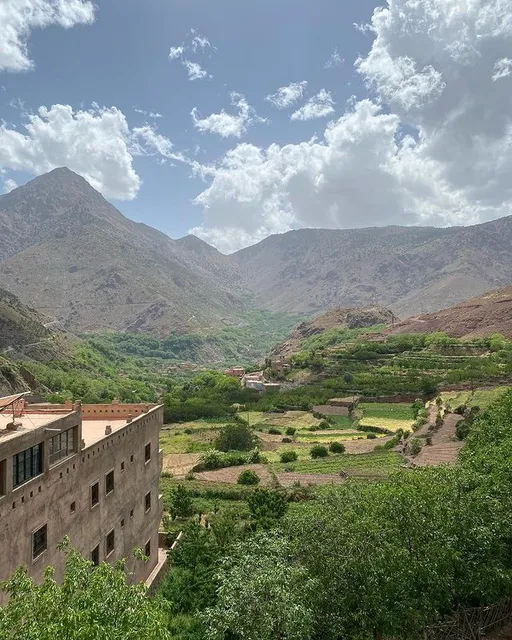
Read more🇲🇦 Morocco "Jbel Toubkal" is the highest mountain peak in Morocco, North Africa, and the Arab world. It's part of the High Atlas mountain range and is a popular destination for mountain climbers, nature lovers, and adventurers. Key Information About Jbel Toubkal Elevation: It stands at approximately 4,167 meters (13,671 feet) above sea level. Location: Toubkal is located in southwestern Morocco, within the Al Haouz province, about 60 to 82 kilometers south of Marrakech. The mountain is situated within the Toubkal National Park, which covers an area of 380 square kilometers. Name Origin: The name "Toubkal" is believed to be derived from the Amazigh language, possibly a corruption of "Tizi n Toug Akkal," meaning "the one that overlooks the land from above." It's also sometimes referred to as "Adrar n Deren," meaning "Mount of Oaks." Climate: The peaks experience a cold climate with snow falling for most of the year, making it an ideal destination for winter sports and ice climbing enthusiasts. Terrain: The Toubkal massif is composed of volcanic rocks, which have formed sharp mountain peaks and deep, narrow valleys. Climbing: Climbing Jbel Toubkal is a challenging yet rewarding adventure. It doesn't require technical climbing experience but does demand a good level of physical fitness and readiness to deal with altitude. The trek to the summit and back typically takes two days, with most journeys starting from the village of Imlil, a popular base camp. Touristic and Cultural Significance Tourist Destination: The mountain attracts adventure enthusiasts from all over the world, especially hikers, trekkers, and campers. Biodiversity: Toubkal National Park protects the high-mountain biodiversity, including animal species like Barbary sheep, golden eagles, and brown trout, as well as plants such as holm oak and juniper forests. Amazigh Heritage: Jbel Toubkal is a symbol of Amazigh culture in the region. It's surrounded by authentic Amazigh villages like Imlil, where visitors can interact with locals and learn about their heritage, customs, and traditional arts. Scenic Landscapes: The area around the mountain boasts breathtaking landscapes, including deep valleys, waterfalls, green ravines, and the beautiful Lake Ifni. Jbel Toubkal is not just a geographical landmark; it's also a place of deep cultural and historical value for the local inhabitants, with many tales and legends...
Read more