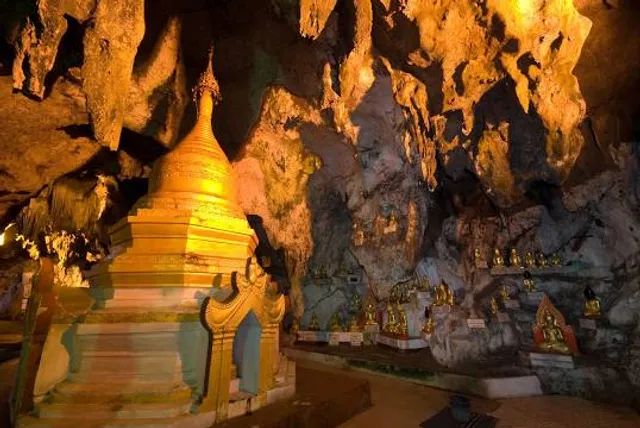
INSIDE A NATURAL CAVE IN Pindaya, Myanmar, thousands of golden Buddhas line the rocky shelfs and stalagmite altars attracting the faithful who are brave enough to get past the giant spider statue on the way up.
Containing over 8,000 depictions of the Buddha dating back as far as 1750, the Pindaya Cave is a constantly growing gallery of peaceful statuary. Among the immense collection are representations of the holy figure in almost every one of his traditional poses, including a few unique depictions, such as the Buddha with a single seed in his upturned palm which may be evidence that the cave was once used by a small Buddhist cult. The cave extends almost 500 feet into the hillside and is actually just one of three caves in the area, although the other two caves are not open to visitors and are believed to be quite shallow.
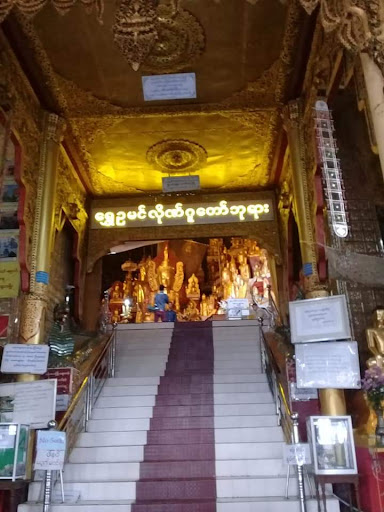
Before reaching the cave however visitors must pass through the Shwe U Min Pagoda, the entrance to which is guarded by a large spider statue. The massive bug is actually in reference to a local legend that gives the cave its name. The story goes that seven princesses were forced to take refuge in the cave, but were sealed in by a giant spider’s web. They were eventually saved by a prince who killed the spider, and shouted, “Pinku Ya-Pyi!” meaning, “I’ve got the spider!” This would be truncated and elided over the centuries to “Pindaya.” Now every worshipper has a chance to see the spider for themselves.
Cartoonish spider monsters and peaceful golden Buddhas might not seem to be much of a match, but Pindaya Cave brings them together nicely.
BUDDHISM INSECTS TEMPLES CAVES Community...
Read moreThe Pindaya cave is an important pilgrimage site for Burmese Buddhists and an attractive, unusual sights for tourists. The cave is set in a limestone hill in Central Burma not far from Inle Lake. The hill contains three caves, only one of which is open to the public. This cave that is about 150 meters long contains thousands of Buddha images in various styles and from different eras from the early Konbaung dynasty era to present day. Every small corner and nook of the cave is cramped with Buddha images up to the ceiling. Between the images are also a number of small pagodas as well as stalagmites and stalactites. During the course of several centuries thousands of Buddha images have been put inside the cave. Many statues bear the name of the person who donated it. The number of images is constantly growing since people are still adding more, by now there about 9,000. In front of the entrance is a sculpture of a giant spider and a Prince aiming his bow at it. Local legend tells that once a giant spider lived in the cave. One day the spider captured a local Princess and held her captive in the cave. According to the legend, the Prince armed with bow and arrow killed the spider, thus rescuing the Princess.The cave is open daily during daylight hours. Entrance fee is US$...
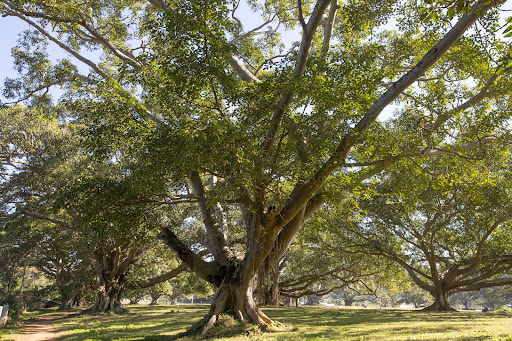
Read moreThe town of Pindaya sits in the south eastern corner of Shan state and is often bypassed by for the nearby, and better known, Inlay Lake. Having seen both I would say both places warrant looking at if you have time. If you are on a tight schedule I would wholeheartedly recommend foregoing Inlay, and spending a couple of days in Pindaya instead. My reasons for this recommendation are based primarily on the visual splendor of Pindaya Cave. If you add in the low numbers of travelers going there, the less commercialised feel of the town, the great scenery, the 350 year old Banyan trees lining the roads, and the exceptional Green Tea Restaurant, and its views across the lake, then Pindaya seems like a far better...
Read more