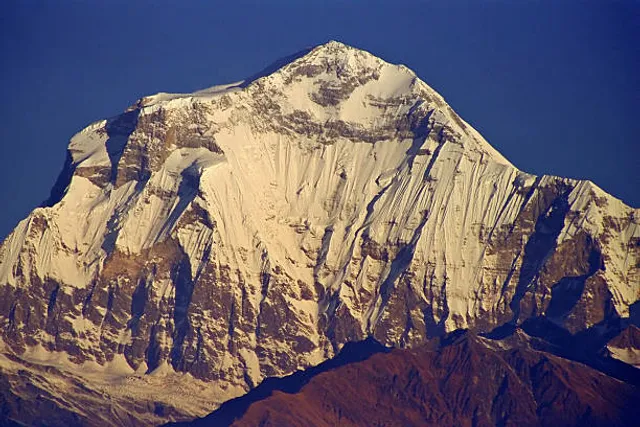
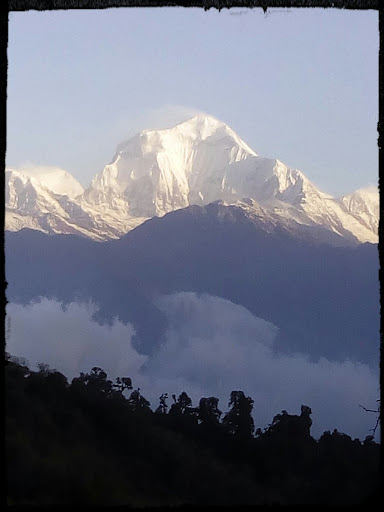
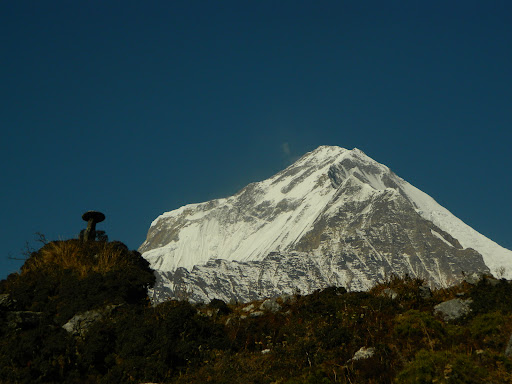
Dhaulagiri, located in Nepal, is the seventh highest mountain in the world at 8,167 metres (26,795 ft) above sea level, and the highest mountain within the borders of a single country. It was first climbed on 13 May 1960 by a Swiss-Austrian-Nepali expedition. Annapurna I (8,091 m (26,545 ft)) is 34 km (21 mi) east of Dhaulagiri. The Kali Gandaki River flows between the two in the Kaligandaki Gorge, said to be the world's deepest.citation needed] The town of Pokhara is south of the Annapurnas, an important regional center and the gateway for climbers and trekkers visiting both ranges as well as a tourist destination in its own right.
Toponymy
Dhaulagiri (धौलागिरी) is the Nepali name for the mountain which comes from Sanskrit where धवल (dhawala) means dazzling, white, beautiful[3] and गिरि (giri) means mountain.[4] Dhaulagiri I is also the highest point of the Gandaki river basin.
Geography
Looking north from the plains of India, most 8,000-metre peaks are obscured by nearer mountains, but in clear weather, Dhaulagiri is conspicuous from northern Bihar[5] and as far south as Gorakhpur in Uttar Pradesh. In 1808, survey computations showed it to be the highest mountain yet surveyed.[6 This lasted until 1838 when Kangchenjunga took its place, followed by Mount Everest in 1858.
Dhaulagiri I stands to the east of the range which bears its name. Its sudden rise from lower terrain is almost unequaled—it rises 7,000 m (22,970 ft) from the Kali Gandaki River 30 km to the southeast, while the South and West faces rise precipitously over 4,000 m (13,120 ft). Such is its vertical relief that despite being closer to Cho Oyu and Mount Everest, it is the only one of the Nepali eight-thousanders whose prominence parent is K2, over 1,031 km (640 mi) away. The south face of Gurja Himal in the titular massif is also notably immense.
The rock layers found at the summit of Dhaulagiri, as well as Everest, are made up of limestone and dolomite formed at the bottom of the ocean. The summits of the other Himalayan eight-thousanders are made up of granite that was formed deep underground.[8]
Climbing history
The unclimbed South Face of Dhaulagiri, seen from Poon Hill
Dhaulagiri I in October 2002. The northeast ridge is the left skyline.
Dhaulagiri was the penultimate eight-thousander to be summitted, and the final in Nepal. As its other routes are disproportionately dangerous, most ascents have followed the Northeast Ridge route of the first ascent, but climbs have been made from most directions. As of 2024, the two aspects which have repelled all attempts along their full length are the Northwest Ridge (though it has been climbed to the summit via the so-called "Pear" buttress) and the South Face. The latter is often regarded as one of the greatest remaining challenges in alpinism.
As of 2007, there had been 358 successful ascents and 58 fatalities, which is a summit to a fatality rate of 16.2%.[9] Between 1950 and 2006, 2.88% of 2,016 expedition members and staff going above base camp on Dhaulagiri I died. On all 8,000 metre peaks in Nepal the death rate was 1.63%, ranging from 0.65% on Cho Oyu to 4.04% on Annapurna I and 3.05% on Manaslu.[10]
Partial timeline
1950 – Dhaulagiri I reconnoitered by a French expedition led by Maurice Herzog. They do not see a feasible route and switch to Annapurna, where they make the first ascent of an 8000 m peak.[11]
1953–1958 – Five expeditions attempt the north face, or "Pear Buttress", route.
1959 – Austrian expedition led by Fritz Moravec makes the first attempt on the northeast ridge.[12]
1960 – Swiss-Austrian expedition led by Max Eiselin, successful ascent by Kurt Diemberger, Peter Diener, Ernst Forrer, Albin Schelbert, Nyima Dorje Sherpa, Nawang Dorje...
Read more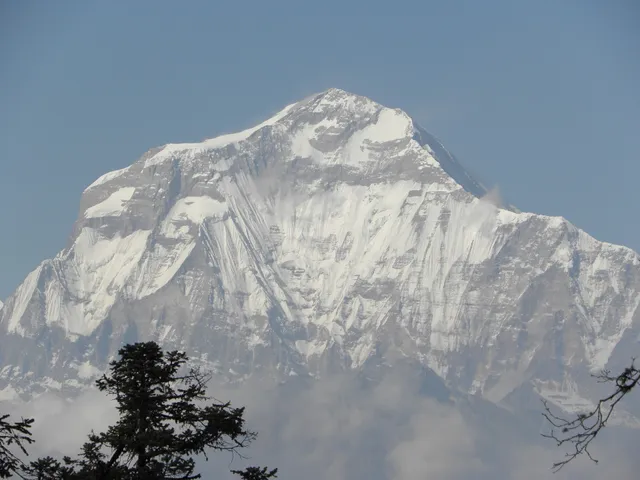
 Learn more insights from Wanderboat AI.