SUMMARY One word - INTENSE !
DETAILS First up, my jump partner :
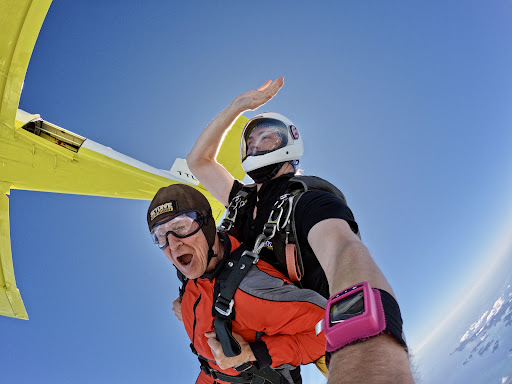
I got paired with Maurice, as Irish an Irishman as you will ever find! His rock solid legs took the landing for both our body weights even though i am slightly taller and much heavier than he is. He talked me through what to do and what was going to happen as we went up, and as he did the wrist video'ing. Definitely calmed my nerves, so thanks muchly, Maurice :)
Next, the experience :
Sticking your feet out the door and getting ready is the time your brain starts going into "why am i doing this" mode. But you are only on the edge for a few seconds (a good thing or else you'd probably change your mind) and then out you go without warning.
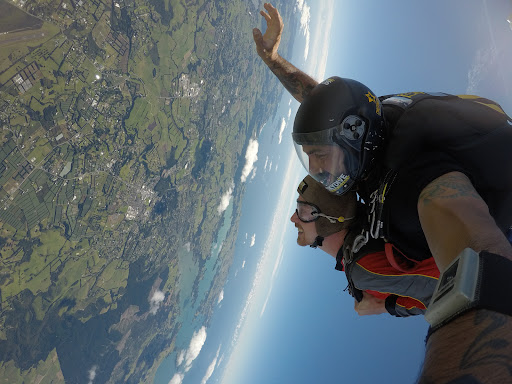
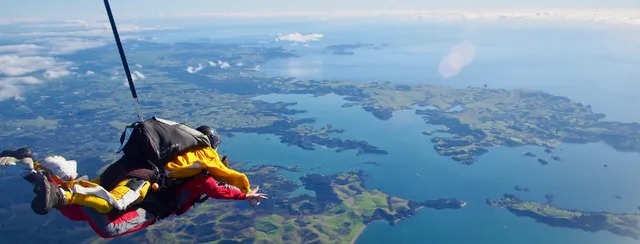
The first few seconds is where your brain does a self-reboot coz you have no idea which way is up as you tumble through the air. Then you straighten out horizontally, extend arms and legs to maximize air resistance and feel the wind whipping by your face as you fall from 16500 feet at 200+kph.
Can't scream, smile or open your mouth as any little opening in your lips gives you chipmunk cheeks coz of the air gushing in (and looks real bad on photos!)
Stretch out your arms and you start to feel like a bird in flight, then the air resistance starts to pull at your pecs. Just 20 seconds of that and i start to understand why they ask you pre-jump if you have any prior shoulder injuries.
Then the yank of the chute release and you decelerate from 200+ to 20+ kph in 5 seconds. It feels like someone grabbing your shoulders and yanking you backwards super hard for about 5 seconds. Legs and arms all go flying out!
Post-chute deployment is easily my favourite - enjoying the panoramic view of the beautiful NZ landscape during the slow descent, an awesome view you can get by very few other means.
Last, the landing :
Dont't try to be a hero and help take the impact with your legs. Follow what they say and stick 'em up as high as you can away from the ground during landing Let your jump partner expert take the ground impact (thanks again Maurice!). Some of it will be felt by your butt but it's very minor - kind of like sitting down hard on a wooden chair with no cushion. Nevertheless, skydiving DOES carry risks. If you do get hurt for whatever reason, well that's what buying travel insurance in advance that covers such accidents is supposed to be for.
I seriously hate looking down at the ground near the edge of tall buildings. But skydiving is a totally different feeling and i am really glad i got to do my...
Read moreFirst off, I did not dive, both of my adult children did after Christmas as part of their present. I have a 26 year old 70 kg daughter and a 28 year old 75 kg son. The company is very organized and both my children had a great experience until landing.
My one star is based on the response to the injury upon landing for my daughter. I'm sharing this as I saw several younger children set up to dive. Parents, very painful injuries occurred with my daughter and others. I was told that on very rare occasions turbulence occurs on landing and it hasn't happened in 8 years. Then I found a one star review from from 2 years ago with the same situation. You can find it by sorting on reviews from low to high.
Our daughter (Sab) was paired with a smaller women as her dive instructor. In watching the video, they didn't slow down like my son's team did. They came in so fast and didn't she didn't attempt to take any off the impact which was all left to Sab's tailbone. The manager later stated is saw what happened. I was shocked he didn't check on her at all at the time of the hard landing. She was in shock after landing and in tears. The dive instructor is just kept filming her and asking if she would do it again. She says, "not right away while holding back tears". She is a very tough young lady so only severe pain causes this reaction.
We got ice from the front desk and went to urgent care in New Zealand before she left. Were not able to be seen due to a long wait time and a flight schedule. The flight home was unbearable for her.
I understand skydiving has inherent risk. However, I don't appreciate being lied to about the last time this happened. The company seems to have a history of brushing off severe landings. I was also told my daughter would be contacted directly by the manager after she returned home and she never was. She is still feels the injury 2 months later. They did call her when she was still in New Zealand when I texted we were going to urgent care.
I just want future injuries to be handled better and hopefully no one gets undersized dive...
Read moreI did a skydive here on 02nd January 2022. The skydive itself was exhilarating. A lifelong dream and the first one I'd ever done. Everything went well until we came in to land. We seemed to be coming in faster than we should but as a complete novice, I had no point of reference.
We hit the ground very hard, landing directly on my backside. The pain was excruciating. The instructor, Maurice, said he tried to take the impact on his feet, but couldn't (I am significantly taller and heavier than him (I'm a 30's male - 185cm, 95kg)
I could barely stand up, but I was ushered away and told that this sort of thing happens now and again. Just put a bit of deep heat on it and I'll be fine in a couple of days!
I was in agony, so I went to a physio a couple of days later and got referred for an x-ray. I had a compression fracture (T11) in my spine and a broken tailbone. It heavily impacted my quality of life. I've gone through physiotherapy and have improved significantly, but I'm still in intermittent discomfort nearly 10 months later.
There was no record made of the accident and it was all brushed off. I returned to the site the next day to understand what went wrong. Maurice wasn't available so I spoke to one of his colleagues. I was told it was probably turbulence. It's unlucky and rare, but it happens. It didn't appear to be taken seriously.
I realise there are inherent risks with jumping out of an aeroplane, but I'm not happy with how it...
Read more