HTML SitemapExplore

Chaukhandi Tombs — Local services in Karachi Division

Name
Chaukhandi Tombs
Description
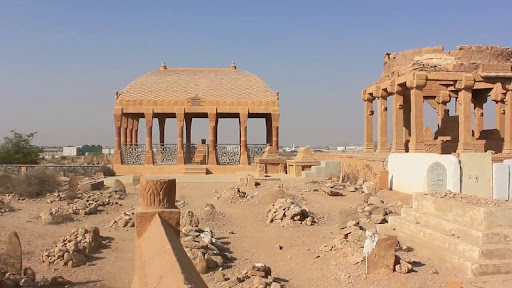
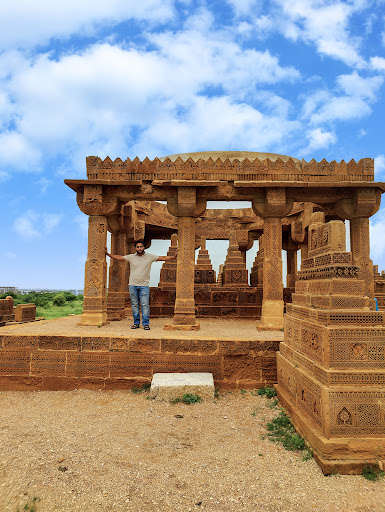
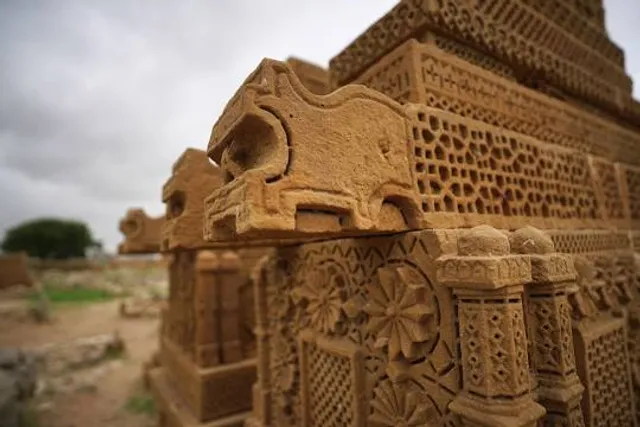
The Chaukhandi tombs form an early Islamic cemetery situated 29 km east of Karachi, Sindh province of Pakistan. The tombs are notable for their elaborate sandstone carvings.
Nearby attractions
Nearby restaurants
Nearby local services
Nearby hotels
Related posts
Keywords
Chaukhandi Tombs tourism.Chaukhandi Tombs hotels.Chaukhandi Tombs bed and breakfast. flights to Chaukhandi Tombs.Chaukhandi Tombs attractions.Chaukhandi Tombs restaurants.Chaukhandi Tombs local services.Chaukhandi Tombs travel.Chaukhandi Tombs travel guide.Chaukhandi Tombs travel blog.Chaukhandi Tombs pictures.Chaukhandi Tombs photos.Chaukhandi Tombs travel tips.Chaukhandi Tombs maps.Chaukhandi Tombs things to do.
Chaukhandi Tombs things to do, attractions, restaurants, events info and trip planning
Chaukhandi Tombs
PakistanSindhKarachi DivisionChaukhandi Tombs

Basic Info

Chaukhandi Tombs

N-5 Near, Landhi Town, Karachi, Pakistan
4.4(205)
Open until 7:00 PM
Save
spot

Ratings & Description

Info

The Chaukhandi tombs form an early Islamic cemetery situated 29 km east of Karachi, Sindh province of Pakistan. The tombs are notable for their elaborate sandstone carvings.

Cultural
Outdoor
Scenic
Off the beaten path
attractions: , restaurants: , local businesses:
logoLearn more insights from Wanderboat AI.
Website
sindhculture.gov.pk
Open hoursSee all hours
Tue7 AM - 7 PMOpen

Plan your stay

hotel
Pet-friendly Hotels in Karachi Division
Find a cozy hotel nearby and make it a full experience.
hotel
Affordable Hotels in Karachi Division
Find a cozy hotel nearby and make it a full experience.
hotel
The Coolest Hotels You Haven't Heard Of (Yet)
Find a cozy hotel nearby and make it a full experience.
hotel
Trending Stays Worth the Hype in Karachi Division
Find a cozy hotel nearby and make it a full experience.

Reviews

Get the Appoverlay
Get the AppOne tap to find yournext favorite spots!
Wanderboat LogoWanderboat

Your everyday Al companion for getaway ideas

CompanyAbout Us
InformationAI Trip PlannerSitemap
SocialXInstagramTiktokLinkedin
LegalTerms of ServicePrivacy Policy

Get the app

© 2025 Wanderboat. All rights reserved.

Posts

Aftab FarooqAftab Farooq
The Chaukhandi tombs form an early Islamic cemetery situated 29 km (18 mi) east of Karachi, in the Sindh province of Pakistan. The tombs are notable for their elaborate sandstone carvings. The tombs are similar in style to the elaborate tombs at the Makli Necropolis near Thatta, and are built in the funerary architectural style typical of lower Sindh. Generally, the tombs are attributed to the Jokhio (also spelt Jokhiya) and known as the family graveyard of the Jokhio tribe, although other, mainly Baloch, tribes have also been buried here. They were mainly built during Mughal rule sometime in the 15th and 18th centuries when Islam became dominant. Pakistani professor Mirza Mahad Baig visited Sindh at the end of the 20th century and examined some of the tombs. He pointed out to Rajput influences in the Chaukhandi necropolis. He mentioned that it is well known that many Munda warrior groups have family ties with the so-called Rajput tribes of Rajasthan and Gujarat. Some Rajput tribes, namely the Jokhio, the satlari, emigrated from Kutch (Gujarat) and Rajputana towards the Sindh and Makran regions during the Samma Dynasty. These tribes had close relations among each other, including matrimonial ties, both within their own group as well as with the Baloch tribe of the Kalmatis. His hypothesis suggested a tribal Rajput origin in the utilization not only of the monolithic slabs and pedestals in the step-shaped graves, but also in the naive decoration of some tombs, resembling a house facade, or a human face as if drawn by a child. The decoration of the tombs (mostly with geometric motifs) seems derived from wood sculpture. With a few exceptions human figures are avoided, in accordance with Islamic beliefs.
Shahzad AnsariShahzad Ansari
Even though Karachi is where I was born, there are still parts of the city I have yet to explore. Chaukhandi graveyard is one such location. You must be thinking that we should also go to the cemetery. Yes, if you enjoy traveling to historic sites. The Chaukhandi cemetery has an unusual location. The Chaukhandi Graveyard neighborhood in Bhais Colony, Karachi, is located behind the Razzaqabad Police Training Center. This cemetery is situated roughly 20 kilometers from my home in Jail Chowrangi, Karachi. There are burials of various Baloch tribes as well as those belonging to the Jokhi tribes in the Chaukhandi cemetery. The unique feature of this cemetery is the preservation of both male and female burials. While the women's graves are exquisitely ornamented, the men's graves have stunning helmet-like decorations along with swordsmanship, cavalry, and dagger motifs. It's simple to distinguish between the graves of males and women. It is amazing to observe how these multi-layered designs could have been built when there were no contemporary tools at all, and how these designs were made so expertly that the other layers of the tombs were not even slightly harmed. Multiple accomplished artisans must have worked on one burial for several days.
Shahzaib RehmanShahzaib Rehman
The Chaukhandi Tombs are an ancient Islamic cemetery located about 29 km east of Karachi, near the National Highway. These tombs date back to the 15th to 18th centuries and are primarily associated with the Jokhio tribe, as well as Baloch chieftains. The site is renowned for its sandstone architecture and intricately carved graves, which showcase a unique blend of Islamic, Rajput, and Mughal artistic influences. The tombs are built in a step-pyramid style, often in family enclosures, and feature detailed engravings of weapons, horses, jewelry, floral patterns, and geometric motifs — each symbol reflecting the status, profession, or achievements of the deceased. Although the graves follow Islamic burial customs, the artistry reflects a cross-cultural heritage, making the site both architecturally and historically significant. Recognized for its cultural value, the Chaukhandi Tombs have been placed on the UNESCO Tentative List, though the site remains under threat from weathering and neglect. This site stands as a silent yet powerful reminder of Sindh’s layered history and craftsmanship, echoing the stories of warriors, tribes, and the artistic soul of an era long gone.
See more posts
See more posts
hotel
Find your stay

Pet-friendly Hotels in Karachi Division

Find a cozy hotel nearby and make it a full experience.

The Chaukhandi tombs form an early Islamic cemetery situated 29 km (18 mi) east of Karachi, in the Sindh province of Pakistan. The tombs are notable for their elaborate sandstone carvings. The tombs are similar in style to the elaborate tombs at the Makli Necropolis near Thatta, and are built in the funerary architectural style typical of lower Sindh. Generally, the tombs are attributed to the Jokhio (also spelt Jokhiya) and known as the family graveyard of the Jokhio tribe, although other, mainly Baloch, tribes have also been buried here. They were mainly built during Mughal rule sometime in the 15th and 18th centuries when Islam became dominant. Pakistani professor Mirza Mahad Baig visited Sindh at the end of the 20th century and examined some of the tombs. He pointed out to Rajput influences in the Chaukhandi necropolis. He mentioned that it is well known that many Munda warrior groups have family ties with the so-called Rajput tribes of Rajasthan and Gujarat. Some Rajput tribes, namely the Jokhio, the satlari, emigrated from Kutch (Gujarat) and Rajputana towards the Sindh and Makran regions during the Samma Dynasty. These tribes had close relations among each other, including matrimonial ties, both within their own group as well as with the Baloch tribe of the Kalmatis. His hypothesis suggested a tribal Rajput origin in the utilization not only of the monolithic slabs and pedestals in the step-shaped graves, but also in the naive decoration of some tombs, resembling a house facade, or a human face as if drawn by a child. The decoration of the tombs (mostly with geometric motifs) seems derived from wood sculpture. With a few exceptions human figures are avoided, in accordance with Islamic beliefs.
Aftab Farooq

Aftab Farooq

hotel
Find your stay

Affordable Hotels in Karachi Division

Find a cozy hotel nearby and make it a full experience.

Get the Appoverlay
Get the AppOne tap to find yournext favorite spots!
Even though Karachi is where I was born, there are still parts of the city I have yet to explore. Chaukhandi graveyard is one such location. You must be thinking that we should also go to the cemetery. Yes, if you enjoy traveling to historic sites. The Chaukhandi cemetery has an unusual location. The Chaukhandi Graveyard neighborhood in Bhais Colony, Karachi, is located behind the Razzaqabad Police Training Center. This cemetery is situated roughly 20 kilometers from my home in Jail Chowrangi, Karachi. There are burials of various Baloch tribes as well as those belonging to the Jokhi tribes in the Chaukhandi cemetery. The unique feature of this cemetery is the preservation of both male and female burials. While the women's graves are exquisitely ornamented, the men's graves have stunning helmet-like decorations along with swordsmanship, cavalry, and dagger motifs. It's simple to distinguish between the graves of males and women. It is amazing to observe how these multi-layered designs could have been built when there were no contemporary tools at all, and how these designs were made so expertly that the other layers of the tombs were not even slightly harmed. Multiple accomplished artisans must have worked on one burial for several days.
Shahzad Ansari

Shahzad Ansari

hotel
Find your stay

The Coolest Hotels You Haven't Heard Of (Yet)

Find a cozy hotel nearby and make it a full experience.

hotel
Find your stay

Trending Stays Worth the Hype in Karachi Division

Find a cozy hotel nearby and make it a full experience.

The Chaukhandi Tombs are an ancient Islamic cemetery located about 29 km east of Karachi, near the National Highway. These tombs date back to the 15th to 18th centuries and are primarily associated with the Jokhio tribe, as well as Baloch chieftains. The site is renowned for its sandstone architecture and intricately carved graves, which showcase a unique blend of Islamic, Rajput, and Mughal artistic influences. The tombs are built in a step-pyramid style, often in family enclosures, and feature detailed engravings of weapons, horses, jewelry, floral patterns, and geometric motifs — each symbol reflecting the status, profession, or achievements of the deceased. Although the graves follow Islamic burial customs, the artistry reflects a cross-cultural heritage, making the site both architecturally and historically significant. Recognized for its cultural value, the Chaukhandi Tombs have been placed on the UNESCO Tentative List, though the site remains under threat from weathering and neglect. This site stands as a silent yet powerful reminder of Sindh’s layered history and craftsmanship, echoing the stories of warriors, tribes, and the artistic soul of an era long gone.
Shahzaib Rehman

Shahzaib Rehman

See more posts
See more posts

Reviews of Chaukhandi Tombs

4.4
(205)
avatar
3.0
8y

KARACHI: The path leading to the Chowkandi graveyard is enough to deter would-be enthusiasts. The beaten down road that runs for miles, riddled with potholes, chock-a-block traffic and just general lawlessness, amidst rampant illegal construction, prepares us for a disappointing visit to one of the few historical places the city can boast of.

In the midst of the barren landscape is a place known for centuries’ worth of history, stripped of its allure and its distinctly carved yellow sand stones, cruelly dismembered for its glory by art enthusiasts, antique thieves, smugglers and the land mafia. These forces have individually and collectively, bit by bit, stolen gravestones, leaving gaps in the already floundering historical narrative of Sindh.

Attributed to the Jokhio and Baloch tribes and built between the 15th and 18th centuries, the intricate geometrical designs on weathered stones however remain intact despite the vagaries of time. Proud and regal in outlook, each narrates a distinct tale, of a life lived and a life lost. But these tales have become far and few in between.

The graveyard has no distinct entrance, and no defined boundary. This unfortunate absence has been time and again attributed as the reason behind the unchecked pilferage of the gravestones. Cruelly smashed into smaller, easier to manage pieces, the more attractive ones have been plucked away, leaving behind the broken remains of stones carved and adorned for a loved one’s grave.

This lack of security at open-air historical sites encourages relic thieves to take their pick of what is being offered. The time we were at Chowkandi, no watchman was present and young men, in packs or alone, entered the vicinity of the graveyard and lingered suspiciously without any check and balance.

The unkept grounds are dotted with shards of broken glass, plastic wrappers and stubbed cigarettes. Gravestones have been vandalised by being broken from their original place and rearranged on newly dug graves. The original inhabitants of the graveyard are outnumbered by the newly deceased, whose graves are now covered with the intricately carved stones, some with a bright blue paint smeared all over. These are clearly visible within newly built make-shift tombs, with low whitewashed walls. Pieces broken from original graves have been put together with the help of cement that has rendered further damage to the stones.

With a never-ending fascination and respect that funerary architecture is given in Islam, this thievery is appalling.

The small lane leading to the graveyard entrance has hastily constructed shops whose legitimacy can be questioned. The smoking factory at the far end of the graveyard, along with several constructed buildings, and even a residential housing scheme that will no doubt encroach on the graveyard land, are all a testament to the ignorance (or negligence) of the government that is allowing these structures to be slowly wiped out from existence.

The tombs are usually pyramid shaped, but plundering has rendered them disproportionate in size and shape. The ones embellished with geometrical designs are numerous but the ones that comprised floral motifs, and human and pictorial representations such as hunting scenes, and of jewellery and arms, allowing the viewer to decipher whether the grave belonged to a warrior or a craftsman, are distinctly missing.

What has let down Chowkandi most is the apathy exhibited by the state in preserving this site. This irreparable damage to the overall authenticity of the historical graveyard must be halted before it is lost...

   Read more

avatar
5.0
7y

Tombs at Chaukundi Graveyard- Karachi Chaukundi tombs are situated at a distance of 29 km (18 miles) in the east on N-5 National Highway near Landhi Town, Karachi. The Chaukhandi tombs are remarkable for the elaboration and exquisite stone carving. The style of graves architecture is typical, which only exists in Sindh. That style is found no where else in the Islamic countries. That type of construction of graveyard is unique due to its orientation from south to north. The graves are constructed in buff sandstone. The carved decoration' presents exquisite craftsmanship. Those graves are constructed either as single graves or in a group. More or less a number of eight graves had been raised on a single common platform. Structurally, primary sarcophagus has six vertical slabs, with two long slabs standing on each side of the grave covering the length of the body and the remaining two vertical slabs covering the head and foot side. All of those six slabs are covered by a second sarcophagus consisting of six more vertical slabs similarly. But, in size, it gives the grave a pyramid shape. The upper (second sarcophagus) is further covered with four or five horizontal slabs and the topmost (third) sarcophagus is set vertically with its northern end carved into a knob known as a 'crown' or turban. The tombs are embellished besides geometrical designs and motifs, with figural representations such as mounted horsemen, hunting scenes, arms, jewellery etc. There are various opinions as to the meaning of the word Chaukhandi. Some scholars believed that Chaukhandi is the name of a place. Others take it to be an architectural term. On the type site of 'Chaukhandi', there is the tomb of Jam Murid bin Hail, which contains the word 'Chaukhandi', after the name of the deceased, which provides sufficient witness of that place. Banerji visited the Chaukhandi graveyard in 1920. He referred it as "the little village Chaukhandi". According to Sindhi language, 'Chaow' means 'four' and 'Kundi' means 'corner'. Chaukhandi thus refers to the four corners (angles) construction, supporting the umbrella shaped dome over the tomb and would apply to all tombs having the same construction. However, all the tombs covered with umbrella shaped domes or with a rectangular pavilion at Chaukhandi have more than four pillars or columns - an angular building construction. In year 1922, the Chowkundi tombs near Landhi were brought with the pale of the Ancient Monuments...

   Read more
avatar
5.0
1y

Chukandi Qabristan, located in Karachi, Pakistan, is a significant historical cemetery that offers a unique glimpse into the region's cultural and architectural heritage. This review explores the site's historical importance, architectural features, and accessibility.

The Chukandi Qabristan is notable for its distinct graves, which are characterized by their unique sandstone slabs and angular shapes. These graves, dating back several centuries, represent a blend of local and foreign influences, reflecting the diverse cultural history of the area.

The cemetery's architectural style is a testament to the craftsmanship of the local artisans. The sandstone slabs, intricately carved with geometric patterns and motifs, showcase the artistic abilities prevalent during that era. Each grave tells a story through its design, offering a window into the traditions and beliefs of the communities that once inhabited this region.

Visiting Chukandi Qabristan is a truly immersive experience. The tranquil atmosphere of the cemetery invites reflection and contemplation. As you walk among the graves, you can't help but admire the skill and creativity that went into creating these timeless monuments.

Accessibility to Chukandi Qabristan can be a bit challenging. The cemetery is located in a rural area, and reaching it requires navigating through narrow lanes and unpaved roads. However, the journey is well worth it for those interested in history and architecture.

For tourists and historians alike, Chukandi Qabristan offers a fascinating glimpse into Karachi's rich cultural tapestry. The cemetery serves as a reminder of the diverse communities that have shaped the city's identity over the centuries.

In conclusion, Chukandi Qabristan is a hidden gem waiting to be discovered by those with a passion for history and architecture. Its unique graves and tranquil ambiance make it a must-visit destination for anyone exploring Karachi's cultural heritage. However, potential visitors should be prepared for the journey to this...

   Read more
Page 1 of 7
Previous
Next