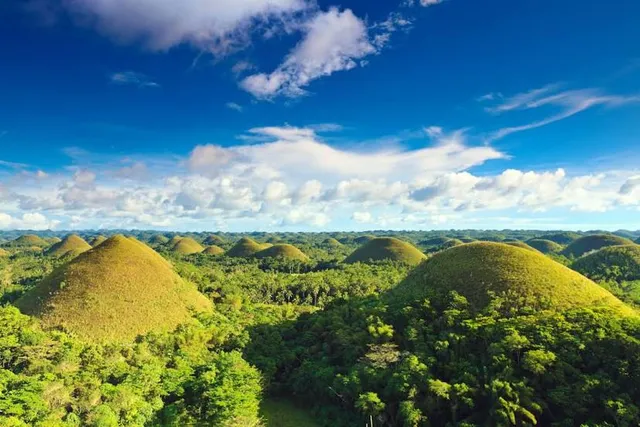
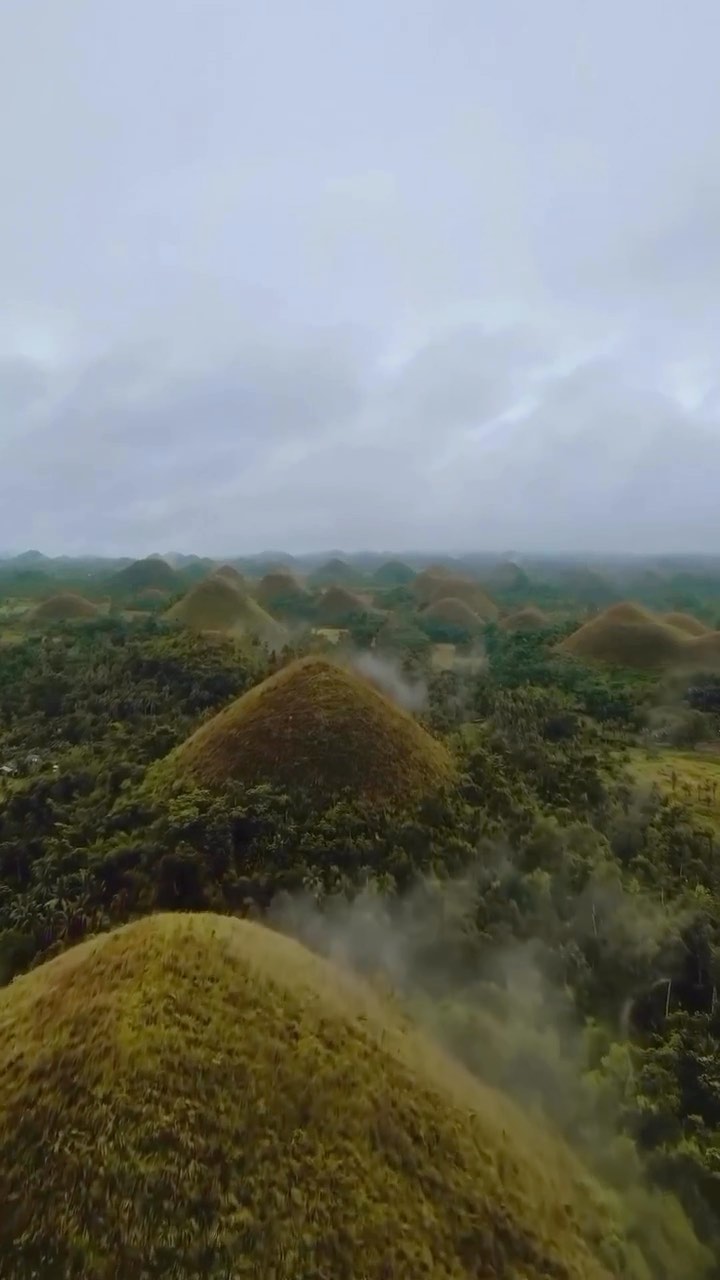
The Chocolate Hills are conical karst hills similar to those seen in the limestone regions of Slovenia, Croatia, northern Puerto Rico, and Pinar del RĂo Province, Cuba. These hills consist of Late Pliocene to Early Pleistocene, thin to medium bedded, sandy to rubbly marine limestones. These limestones contain the abundant fossils of shallow marine foraminifera, coral, mollusks, and algae.
These conical hills are geomorphological features called cockpit karst, which were created by a combination of the dissolution of limestone by rainfall, surface water, and groundwater, and their subaerial erosion by rivers and streams after they had been uplifted above sea level and fractured by tectonic processes. These hills are separated by well developed flat plains and contain numerous caves and springs. The Chocolate Hills are considered to be a remarkable example of conical karst topography.
The origin for the conical karst of the Chocolate Hills is described in popular terms on the bronze plaque at the viewing deck in Carmen, Bohol. This plaque states that they are eroded formations of a type of marine limestone that sits on top of hardened clay.
The plaque reads: The unique land form known as the Chocolate Hills of Bohol was formed ages ago by the uplift of coral deposits and the action of rain water and erosion. The plaque also makes reference to a fanciful explanation of the origin of the Chocolate Hills that is unsupported by any published scientific research, i.e. either Hillmer or Travaglia and others, when it states: the grassy hills were once coral reefs that erupted from the sea in a massive geologic shift. Wind and water put on the finishing touches over hundreds of thousands of years.
Self-published, popular web pages present a variety of fanciful and less credible explanations about how these hills formed. They include sub-oceanic volcanism; limestone covered blocks created by the destruction of an active volcano in a cataclysmic eruption; coral reefs that were raised from the sea as the result of a massive geologic shift; and tidal movements. The lack of any exposed or associated volcanic rocks anywhere in the Chocolate Hills refutes the popular theories involving volcanic eruptions. These theories involving either a sudden, massive geologic shift, coral reefs being erupted from the sea, or tidal movements lack any corroborating evidence and support...
   Read moreChocolate Hills in Bohol is a natural wonder with incredible views and well-developed tourist facilities. However, visitors should consider the seasonal appearance, potential crowds, and limited interaction options when planning their visit.
Pros of Chocolate Hills in Bohol:
Natural Wonder: Chocolate Hills is a unique geological formation, comprising thousands of cone-shaped hills that turn brown during the dry season, creating a stunning and iconic landscape.
Panoramic Views: Visitors can enjoy breathtaking panoramic views of the Chocolate Hills from several viewpoints, including the Chocolate Hills Complex, providing fantastic photo opportunities.
Tourist Facilities: The area around Chocolate Hills is well-developed for tourism, with amenities such as viewing decks, souvenir shops, and restaurants, ensuring a comfortable visit.
Adventure Opportunities: In addition to sightseeing, visitors can explore nearby attractions, such as adventure parks and wildlife sanctuaries, offering a range of outdoor activities.
Cons of Chocolate Hills in Bohol:
Weather-Dependent Appearance: The brown color of the hills is most prominent during the dry season, so visitors who come during the wet season may not see the characteristic "chocolate" hue.
Crowds: Chocolate Hills is a popular tourist destination, and it can get quite crowded, especially during peak travel times, potentially affecting the tranquility of the experience.
Limited Interaction: While the hills are a stunning natural attraction, there may be limited activities beyond sightseeing, which could be a drawback for those seeking more interactive experiences.
Accessibility: Getting to Chocolate Hills may require a bit of travel within Bohol, and visitors should be prepared for potentially challenging roads or transportation...
   Read moreChocolate Hills Review: A Bit Underwhelming but Still Worth a Visit
I visited the Chocolate Hills with high expectations, but I was a bit disappointedâmainly because the weather was cloudy, which made the view less impressive. I also expected to see countless hills like in the photos, but in reality, only a few are clearly visible from the main viewing deck.
Entrance Fee & Transport to the Viewpoint:
To access the hills, you need to pay an entrance fee of â±100 per person. After paying, a vehicle will bring you up to the viewpoint and pick you up afterward, which is convenient since it's a bit of a walk uphill.
How to Get There from Tagbilaran City:
If you're traveling by public transport, head to DAO Integrated Terminal in Tagbilaran City:
Take a Southern Bus going to Carmen
Ask the driver to stop at Chocolate Hills
The bus is non-air-conditioned and often crowded, with people standing
Fare: â±115 per person
Travel time: Around 2 hours
For a more comfortable option, take a UV Express (shuttle van) from the same terminal:
Air-conditioned and more comfortable
Fare: â±120 per person
Travel time: About 1 hour and 15 minutes
Getting Back to Tagbilaran City:
After your visit, wait for a return ride near the entrance, next to the police station. You can hop on any passing bus or mini bus going back to Tagbilaran.
Important: The last buses leave around 6 PM, so donât miss them!
While the experience didnât fully meet my expectations, the trip was still interesting and worth it if youâre already in Boholâjust check the weather and manage your expectations...
   Read more