На русском языке читать вторую половину отзыва.
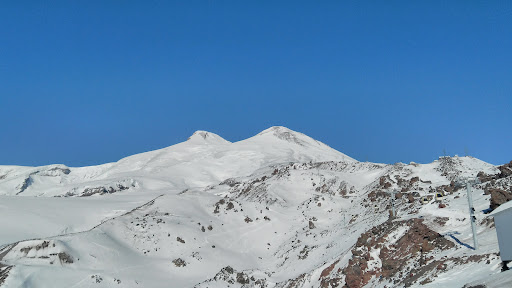
A delightful place. It breathes easily and freely. Stunning views. It amazes the imagination.
It is not recommended to climb for people with diseases of the cardiovascular system. The difference in heights and pressure is very serious. At the lower station of the cableway, the altitude is 2400m above sea level, at the upper 3850m. Atmospheric pressure at Gara-Bashi station is only 550 mm Hg. at a rate of 760. Therefore, on the first day, it is better to acclimatize, take a walk down in the Azau glade, go to a narzan glade, otherwise "mountain sickness" may occur - headache, nausea, even vomiting.
Elbrus lift 2 cable cars. New Austrian and old, from the USSR. New has 3 lines and with two transfers raises to a height of 3850 meters. On the old 2 lines and lifts up to 3000m. 1 lift costs 1300r. on the new and 500r. on old. Then you can climb on a snowmobile or a snowcat, up to the Pastukhov rocks, to a height of 4850m. From here, if you go down on skis, the distance will be 11.5 km. The longest continuous track in Russia!
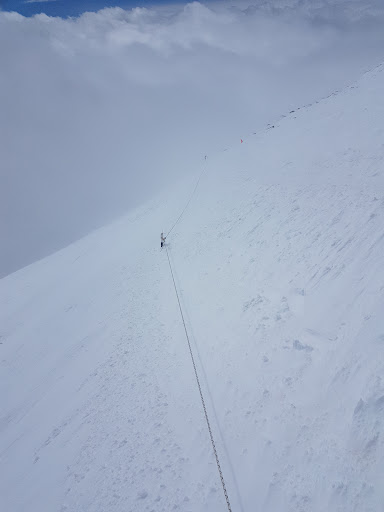
Above 3500m there is a glacier that never melts. Ice thickness in some places reaches 300m. Therefore, there is snow all year round and you can ski until the end of June. It is possible and later, but uncomfortable, because the summer sun melts the snow surface during the day, and at night it freezes and an ice crust forms. The most comfortable time for skiing is from January to March. But in November sometimes a lot of snow falls, and in May.
The weather can change in 10 minutes. No predictions help. The best forecast is to watch webcams. Sunglasses and warm things are required to take, very bright sun, blinding white snow, even in summer there can be sub-zero temperatures above.
Восхитительное место. Здесь дышится легко и свободно. Потрясающие виды. Поражает воображение.
Не рекомендуется подниматься для людей с заболеваниями сердечно-сосудистой системы. Перепад высот и давления очень серьезный. На нижней станции канатной дороги высота 2400м над уровнем моря, на верхней 3850м. Атмосферное давление на станции Гара-Баши всего 550мм.рт.ст. при норме 760. Поэтому в первый день лучше акклиматизироваться, погулять внизу, на поляне Азау, съездить на нарзанную поляну, иначе может проявиться "горная болезнь" - болит голова, тошнота, даже рвота.
На Эльбрус поднимают 2 канатных дороги. Новая австрийская и старая, из СССР. Новая имеет 3 линии и с двумя пересадками поднимает на высоту 3850 метров. На старой 2 линии и поднимает до 3000м. 1 подъем стоит 1300р. на новой и 500р. на старой. Дальше можно подняться на снегоходе или ратраке, максимально до скал Пастухова, на высоту 4850м. Отсюда, если спуститься вниз на лыжах, выйдет расстояние 11,5км. Самая длинная непрерывная трасса в России!
Выше отметки 3500м находится ледник, который никогда не тает. Толщина льда местами достигает 300м. Поэтому здесь круглый год лежит снег и можно кататься на лыжах до конца июня. Можно и позже, но некомфортно, тк за день летнее солнце растапливает поверхность снега, а ночью он замерзает и образуется ледовая корка. Самое комфортнее время для катания с января по март. Но и в ноябре иногда выпадает много снега, и в мае.
Погода может поменяться за 10мин. Никакие прогнозы не помогают. Лучший прогноз это посмотреть веб-камеры. Солнечные очки и теплые вещи брать обязательно, очень яркое солнце, слепящий белый снег, даже летом наверху может быть минусовая...
Read more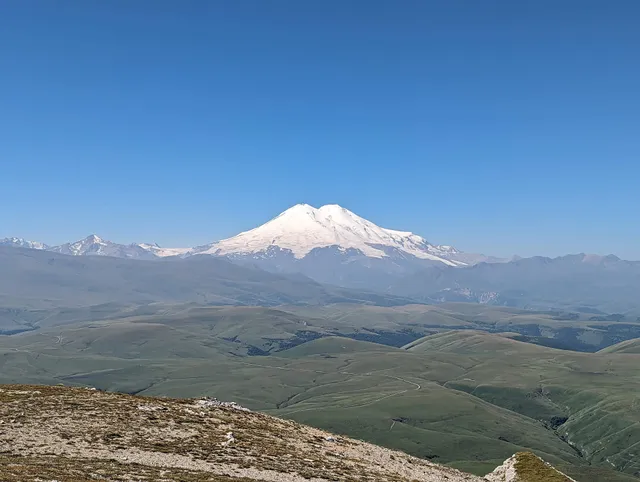
 Learn more insights from Wanderboat AI.