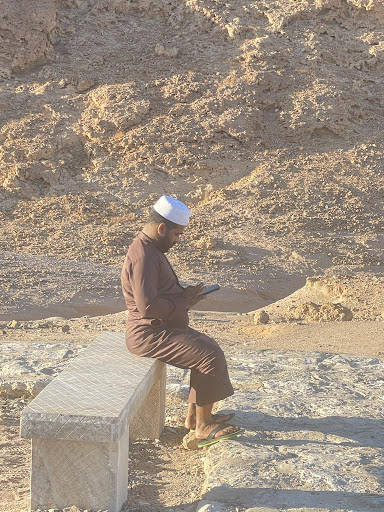
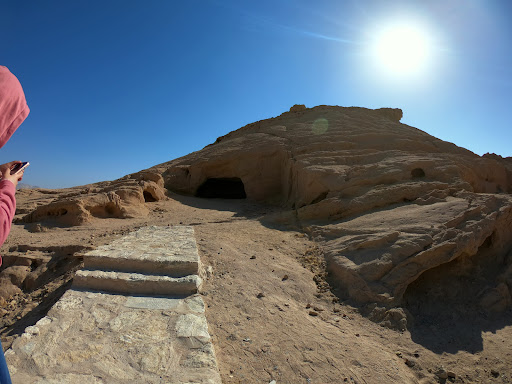
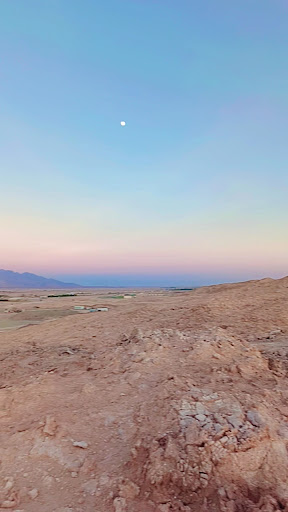
Last month, I had the extraordinary opportunity to visit Madyan in Saudi Arabia, a place steeped in historical and spiritual significance. Madyan is known for its connection to Prophet Shu’aib (peace be upon him) and is home to ancient rock-cut structures that speak volumes about the region’s rich past.
Upon arriving in Madyan, I was immediately struck by the timeless beauty of the landscape. The ancient rock houses, carved meticulously into the cliffs, were a testament to the architectural ingenuity of the past. These structures, though weathered by time, stood as enduring symbols of the people who once inhabited them. Walking among these ancient dwellings, I felt a profound connection to history, imagining the lives of those who lived there millennia ago.
The site’s historical significance is deeply rooted in its association with Prophet Shu’aib. According to Islamic tradition, Madyan is where he preached and guided his people. Standing in this place, I was reminded of the Prophet’s messages of honesty, justice, and faith. It was a deeply spiritual experience, reflecting on the enduring relevance of his teachings.
The serenity of Madyan was palpable. The quiet, unspoiled surroundings provided a perfect backdrop for reflection and prayer. The natural beauty of the area, combined with its historical and spiritual importance, made this visit exceptionally memorable.
Visiting Madyan was not just a journey through a historical site but a spiritual voyage that deepened my appreciation for the rich tapestry of Islamic history. It was a reminder of the timeless messages of the Prophets and the enduring legacy of the ancient civilizations that once thrived in this region. I left Madyan with a renewed sense of faith and a deeper connection...
Read moreThe road leading to Maghair Shuaib, graves carved in rocks in Saudi Arabia, Maghair Shuaib located in the Tabuk region in the north of Saudi Arabia, the beauty of the ancient cities of Al-Nabi Shuaib, tourism in Saudi Arabia, Maghair Shuaib in Al-Bidaa .
Madain Shuʿayb A Wonder of the World
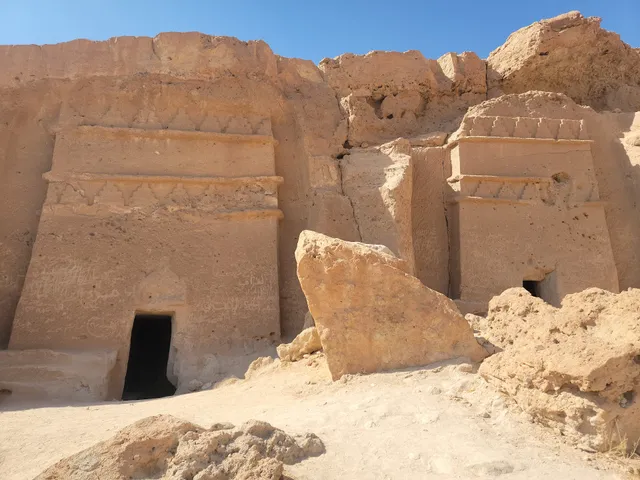
Madain Shu'ayb, or Maghair Shu'ayb, which translates to cities of Shu'ayb, is located in the governorate of Al-Bida', one of the governorates of the Tabuk province. Madain Shu'ayb, which is an icon of rock-cut architecture, is situated between the governorates of Haql and Maqna, towards the northwest side of the city of Tabuk. Once inhabited by the Nabataeans, this place was a fertile oasis full of water springs and orchards.
This area, dates back to 100 years BC, is also known as Madian, and contains houses carved into the mountains, similar to Madain Saleh. The Arab historian Hamad Al-Jassir says that Al-Bida' or Maghair Shu'ayb is an ancient oasis in which Allah sent his prophet Shu'ayb to Madian people. He adds that the most famous monuments landmarks are the Lihyanite and the Nabatean texts and inscriptions carved on the rocks. And there is also a site for an ancient city from the early Islamic times known as al-Malqta
Madain Shu'ayb was visited by many explorers and orientalists, including Georg August Wallin, Edward Roble who wrote on Madain in 1829, the British Richard Francis Burton, the Lady Anne Blunt, and others.
The area boasts some other famous monuments, including the rock-carved As-Saee'dni water well and many pools and water streams. It is believed that this water well is the same one from which the prophet Moses, peace be upon him, drank from it, so someone called it the water...
Read moreOne of the ancient city of Nabataean people living here in this part of Saudi Arabia long time ago. The Nabataeans were one of several nomadic Bedouin tribes that roamed the Arabian Desert in search of pasture and water for their herds. They emerged as a distinct civilization and political entity between the 4th and 2nd centuries BCE, with their kingdom centered around a loosely controlled trading network that brought considerable wealth and influence across the ancient world. Wikipedia. As a visitor in this place, its nice to see that this place is still intact and being preserve. But some of the sites has been vandalized with people's names and etc. But still I'm very humbled to experience and see this place in person, because I can imagine the past of Saudi Arabia and how it develop. I also discovered that this ancient Arabs are sophisticated people even pre islamic era. This part of Nabataean kingdon is smaller compared to Al ula or in Petra city in Jordan but still its significant is big. Because it will gave us an idea about the reach of the Nabataean kingdom and how they manage their civilization. We visited this place on last days of December 2020 at 12noon it is still hot around 24 degrees centigrade. I advice you to visit this place on the Middle to last week of January or 1st week of February, it might be cold obmn that time. This place is accessible to the road and there is parking and a museum in the front were you'll find all the discoveries in this place. Dont missed this historical place and make as part of your itinerary when visiting Tabuk...
Read more