Neelagiri Maha Thero hiding in the middle of the Maha ...
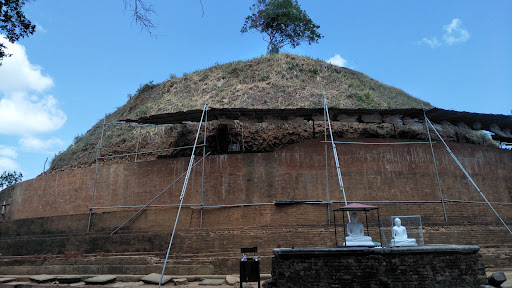
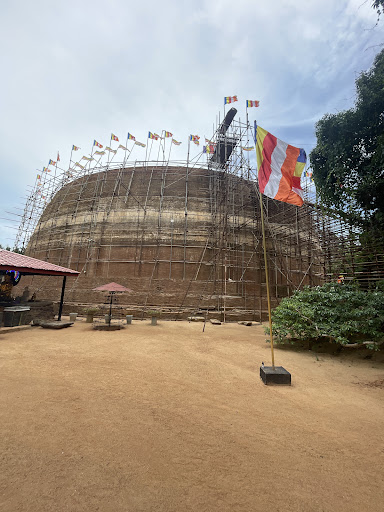
Recently the name Neelagiri Maha Seya was heard in the media. The reason is that archaeological excavations have begun. From Lahugala in the middle of the A-4 road from Siyambalanduwa to Pottuvil, turn right. 4.2km to cross over Hada Oya 1.8km through the jungle. It has a circumference of 1200 feet.
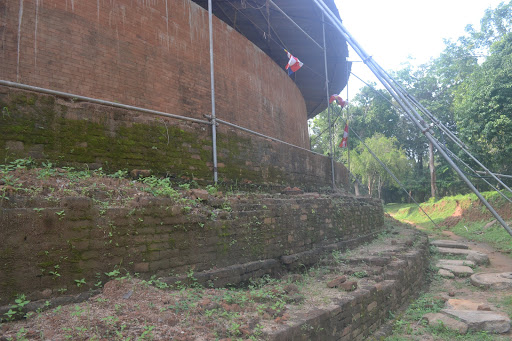
Located in the middle of the jungle, only a few elderly people knew Lahugala. In 1972, the brick wall was rebuilt to a height of 20 feet and 100 feet without any archaeological excavation and the acquisition of the land by the Department of Archeology and without preparation of estimates. No details are known about this.
Back in 2004, a group called Karunaratne of the Eastern Buddhist Renaissance and a group of Buddhist monks of the Lahugala Magul Maha Vihara, Ven. It was a journey of study and exploration. Then, with the assistance of the STF, searches were carried out for 7-8 km. It appeared that there was a city with temples and palaces like Anuradhapura.
The history of the Neelagiri Saya dates back to the pre-Christian era and the complex ruins of the surrounding temples suggest that it was a sacred place for the Maha Sangha.
During the excavation, Professor Raj Somadeva of the Postgraduate Institute of Archeology at the University of Kelaniya and two others uncovered two unwritten inscriptions. According to a inscription inscribed in the Western Brahmi script, Maharajini who had been hiding so far in history has revealed that there was a queen named Chula Sewali Devi-samila and that the Chaitya now known as Neela Giri was the Uththara Sewali Pabbatha.
Prior to the birth of the concept of the Three Sinhalese, the river from the Mahaweli river was known as the Rajarata of the North, the Ruhunu (South of the South) and the mountains as the Malaya Rata. The Neelagiri Hela and Neelagiri Chaitya located in Lahugala in the present-day Ampara district of the central Ruhuna country are widely spoken of by scholars as the largest Chaitya in the Eastern Province of Sri Lanka.
Excavations of a Buddhist shrine spanning 36 hectares (89 acres) have been uncovered from the circumference of the stupa, 355 meters to the north, 268 meters to the south, 348 meters to the east and 198 meters to the west.
Prof. Somadeva says that this Vihara complex is a complete monastery complex consisting of a Uposathagara, Bhikkhu Ahava, Statues and Houses. The temple complex has a natural water body in the north and a natural rock in the south. The construction of the rock temple in Talawa was done using simple technology.
A large number of sacred stones have been found from the ground where the stupa is located.
Lahugala is an ancient city near the capital city of the Magam kingdom in Ruhuna, Ruhuna. Prof. Raj Somadeva, who says that this historic place and the city is protected by nature, should be protected in the future by nature.
In the case of the Neelagiri Seya, the stone quarry known as the pillow masonry is unique. This is because it contains the only inscription found in the history of the Neelagiri Saya.
According to archaeologists, when was the Neelagiri Stupa built and who was the King who built it? The details have not yet been revealed. Nevertheless, a stone inscription in Brahmi script, about 200 m away from the pillow, provides strong evidence. It is said that Chula Shiva Devi, the queen of King Bhatibhabaya Tissa (22 BC - 07 BC), made a sacrifice to the 'Uththara Sewali Pabbatha Vihara' and paid tax to the temple. . Dr. Nimal Perera says that this means that Neelagiri Seya was in existence during the reign of King Bhatikabhaya Tissa. According to archaeological officials, the name of the Neelagiri Stupa is the Sivali Pabbatha Vihara in Uttara. According to history, Bhatikabhaya Tissa was a king who had many foreign relations. Exotic artefacts such as 'Kannelian beads' have been found in the Neelagiri Seya. Was Neelagiri Stupa originally made by King Mahanaga, or was Bhatikabhaya a King Tissa? It's a curious thing to go.
In the...
Read more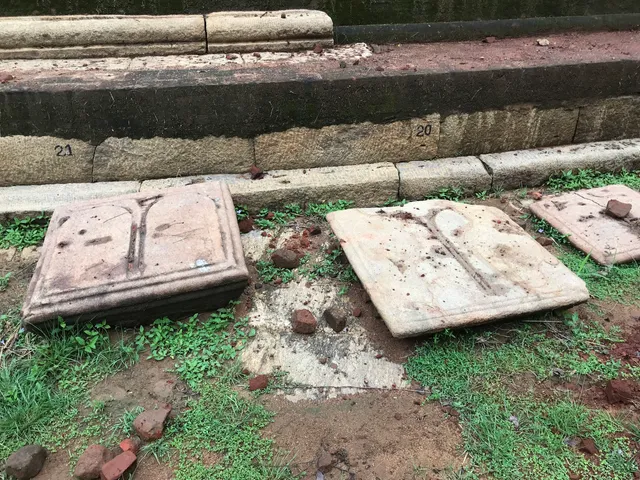
 Learn more insights from Wanderboat AI.