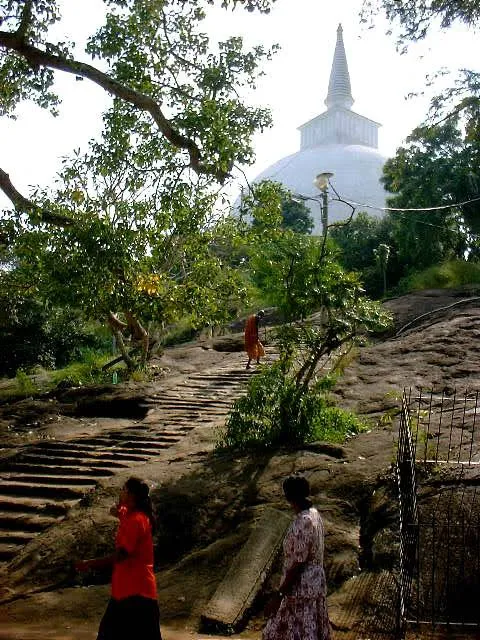
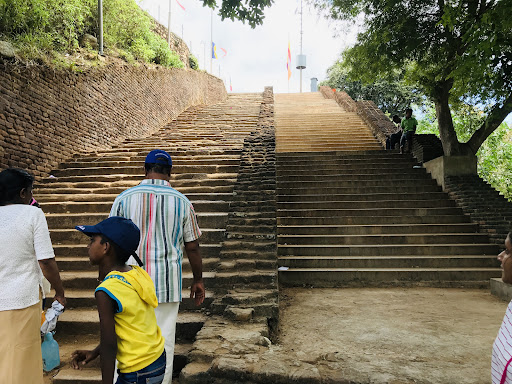
Mihintale Mountain, with the arrival of Buddhism in Sri Lanka, began to serve as a residential area for the venerable monks headed by Arahath Mahinda Mahathera. But soon, with the royal patronage, the sanctuary housed a multitude of with monastic buildings-stupas, uposathgharas, bodhigharas- to serve the monks. Sixty eight cave dwellings provided the monks shade and shelter. Mihintale, the sanctuary for many thousands of laymen as well as holy men, had all the facilities and amenities for basic living.
Vedahala – the Hospital at the foot of the mountain at Mihintale
With the growth of the community of monks and the pious laymen, there arose the inevitable need of a hospital. The first hospital at Mihintale was founded by King Sena the second (853-887 AC) at Mihintale. The identification was based on a tenth century inscription found at the site.
About half a kilometer from Indikatusaya along the gravel road and on the turning to the left is located Rajagirilena Kanda. On the low hill with a height of about of 100 feet, among the boulders at the summit are caves once occupied by the monks. Fairly roomy cells were formed by brick and clay walls that divide the interior sheltered by an overhanging rock roof. Rajagirilena Kanda with its airy caverns in a pleasant setting is believed to be first dwellings of the Buddhist monks at Mihintale.
Kaludiya Pokuna, the Black Water Pool at Mihintale
A short path of about fifty meters through the boulders at Rajagirilena Kanda leads to Kaludiya Pokuna, the central attraction of the hill named Porodini in the Mihintale Tablets of King Mahinda the 4th. Kaludiya Pokuna, the largest pool at Mihintale measures 200 feet in length and 70 feet in width. Around the pool are the ruins of meditation halls, bathing houses and walled caves. The name Black Water Pool was a result of the dark shadows left upon the waters by the rock boulders and shady trees...
Read moreI'm merely a VietNamese on-map-visitor , "travelling" regularly to Buddhist Temples in India & SriLanka . To designate the 8 Wonders of the world , we must select :
1 _ LUMBINI GARDEN , Bangalore , Nepal .
2 _MAHABODHI TEMPLE , BodhGaya ,Bihar , India .
3_ DHAMEKH STUPA, Sarnath, India .
4_PARINIBBANA STUPA ,55 Kushinagar ,Uttar Pradesh,lndia.
5_KELANIYA RAJA MAHA VIHARIYA , Peliyagoda 13000 , Colombo, SriLanka.
6_SRI DALADA MALIGAWA. Temple of the Sacred Tooth Relic , Kandy 20.000 SriLanka.
*7_MIHINTALE ,Anuradhapura, SriLanka.
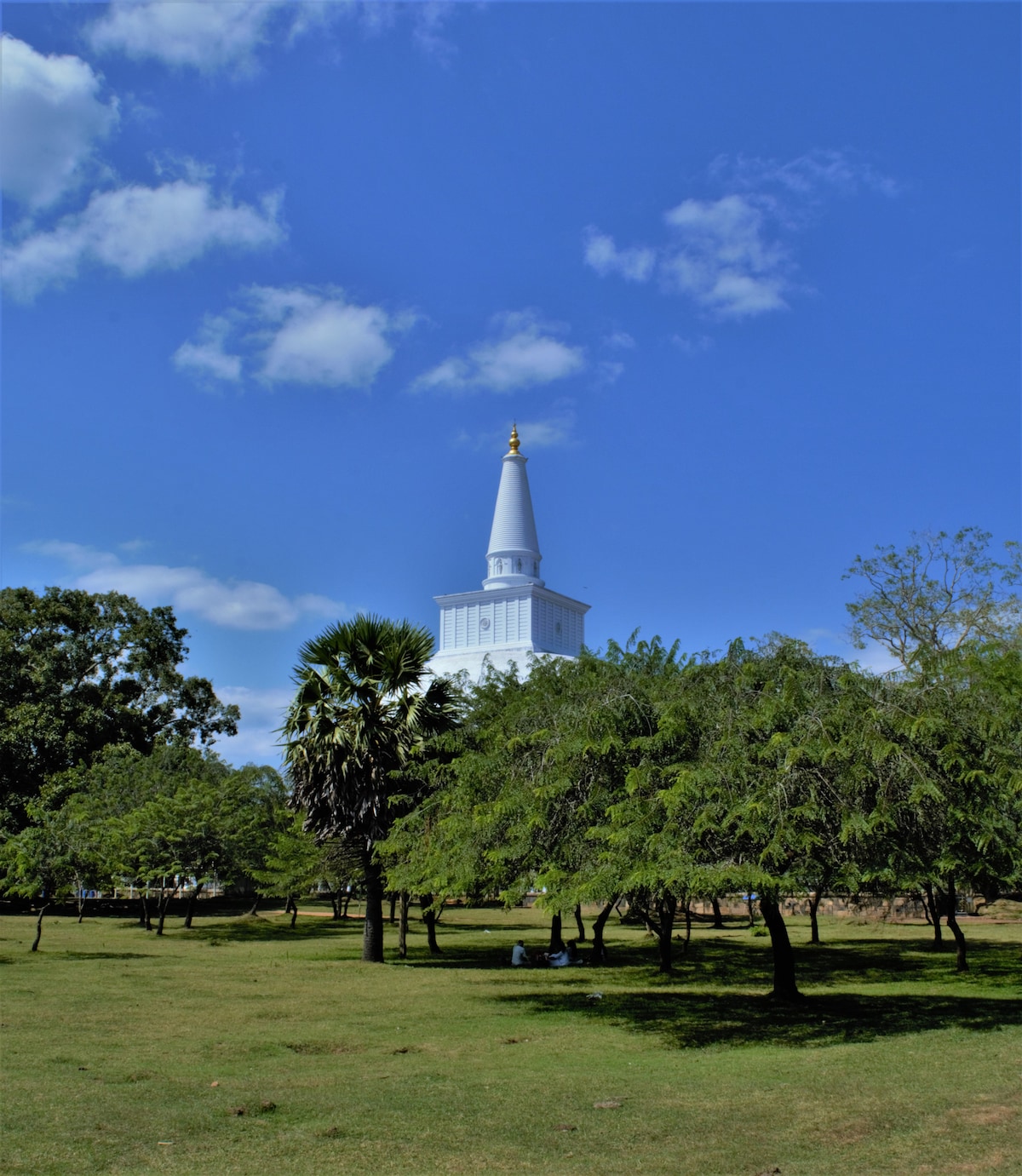
8 _RUWANWELI MAHA SEYA , in Anuradhapura ,SriLanka.
The Buddha's Teachings being the best & the only Explanation for the eternal question " Who we' re , What's our Past & Future " , and the SammaSambuddhassa’ s pointed out the highest Kingdom for Living Beings ei Nibbana , the End of All Errors & Sorrows , along w. the Way leading Thereunto , namely The Noble Eightfold Path . Those Buddhist Wonders are just the sacred places where the Buddha had resided , or bequeathed His Relics , or where an event had come for the establishment of or bringing back an improvement for the Buddhist Three Jewells . See for more , my comments completed at the sacred temple "Kelaniya Râja Maha Viharaya" & the huge “Ruwalweli Maha Seya “ I’Ve just...
Read moreMihintale is revered as the birthplace of Buddhism in Sri Lanka, but, regardless of your beliefs, it is unforgettable: a sequence of beautiful shrines, stupas and caves strung out across wooded hills, usually busy with crowds of devout, white-robed pilgrims.According to legend, it was at Mihintale – literally “Mahinda’s Hill” – that the Indian missionary Mahinda, met and converted King Devanampiyatissa in 247 BC, establishing Buddhism as the island’s state religion. Mahinda was the son of the great Mauryan emperor Asoka, sent by his father to bring word of the Buddha’s teachings to Sri Lanka. Buddhism was immediately embraced with fervour by the Sinhalese people and soon became firmly established in the island – unlike in India, its birthplace, where it would subsequently fall into terminal decline.All over the world, high places are given religious significance, with the result that devotees are always climbing steps. Sometimes on their knees. Mihintale is one such place, its various shrines connected by a total of some 1,840 steps that ultimately lead to the summit – steep enough to require deep breaths and a meditative pace. They were built in the reign of Bhathika Abhaya (22 BC–AD 7), although a later paved road provides a short cut up to the...
Read more