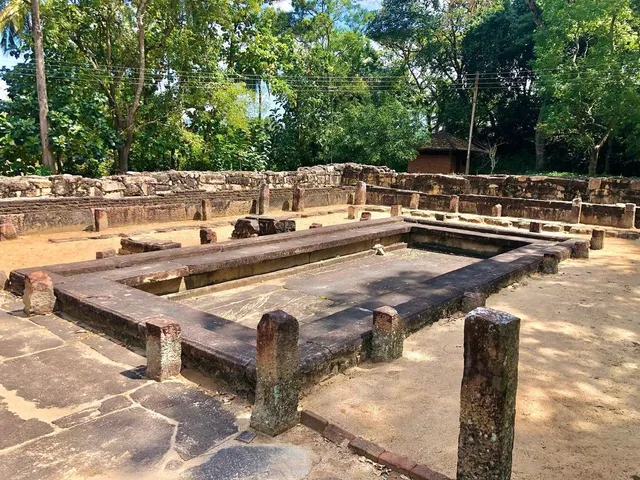
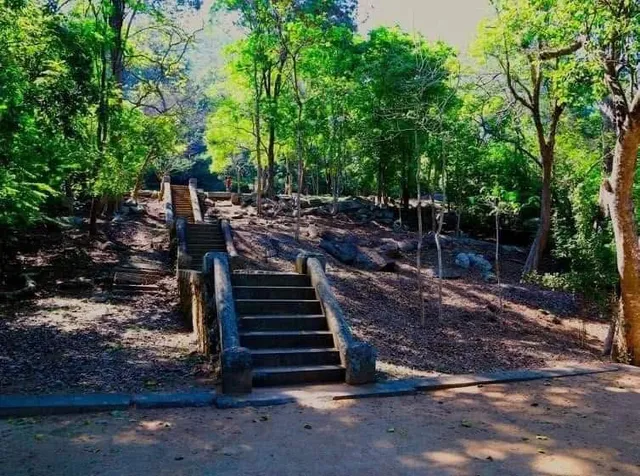
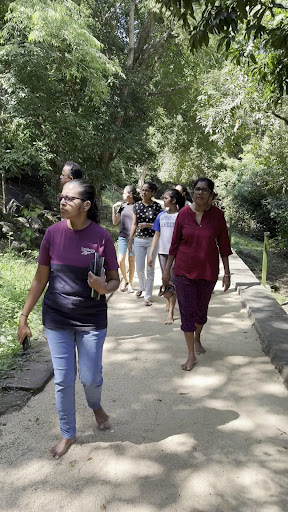
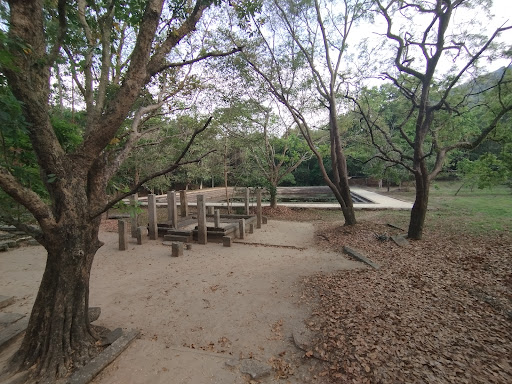
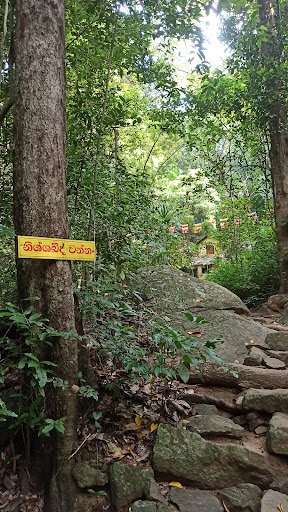
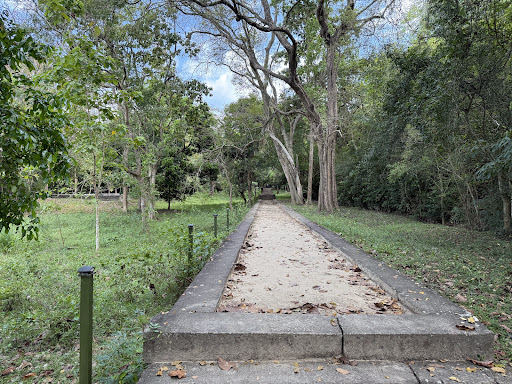
Haven of Peace and Silence A group of 18 of us travelling with “Flamingo Lanka Travels” visited the ruins of Arankele Monastery, the austere abode of a sect of recluse monks who dwelt here in ancient times. Our guide from the Department of Archaeology, Sunil, led us through the scattered ruins of this haven of peace and silence. Whilst writing this, I vividly remember the two km long pathway, protected with dressed stone kerbstones, used by meditating monks. Ancient trees and creepers overhang these pathways providing shade and kept us comfortable allowing only a little sunlight to filter through. We also enjoyed the songs of a wide variety of constantly chirping birds. These pathways used by the monks for their meditation slope gently punctuated with small flights of steps, made of dressed stone, to accommodate the natural terrain. Along the pathway is a beautifully built circular round-about probably to allow walking monks to rest. Ruins of a hospital complex (Jantagara) for monks lies at the entrance. Ruins of the many columns indicate that it had been roofed. A grinding stone used to grind various herbs lies on a side. The central sunken area had been large herbal bath. You can imagine sick monks being treated here by the ayurvedic doctors of ancient times. Scattered in the area had been many apartments (Patanagara) presumably used for meditation and other rituals including receiving devotees and educating them in Buddhist way of living. These are twin double-platform buildings, linked with a stone bridge built on a rock outcrop. The raised platforms are held by retaining walls of large dressed stone and are surrounded by troughs of water, believed to keep the interior free. We visited two large ponds made of dressed stone used by bathing monks. There had also been a roofed chamber with a promenade for walking meditation. At this walking path for meditation site is a toilet used by monks. At the end of the walk through the site you come to a little cave, plastered inside, with three rooms said to be used by a venerated priest called Maliyadeva as his dwelling and meditation chamber. None of the buildings are decorated. There is no stupa, no image house with a Buddha statues nor a bo-tree signifying the simplicity and the philosophy of the monks who dwelt here. It is said that the robes worn by these monks were made from rags and clothes found at the graves. There is no entrance fee charged. However, one has to observe the decorum when entering a place of worship or veneration. We felt calm, tranquil and peaceful at the end of the walk through a friendly environmental area having gone through the historic past for...
Read moreThe ancient monastery of Arankele which is acclaimed to be the premier Forest Hemitage of Sri Lanka was constructed in the past for the use of Bhikkhus engaged in meditation. It is located in the Ganewatta Divisional Secretariat Division of the Kurunegala District.
There are two schools of thought regarding the origin of its name. One such thought is the combination of the word “aran” derived from Arahat and “kele” being forest hermitage where the Arahants took shelter. The other being the adaptation of the two words “Arama” meaning monastery and “kele” meaning forest to form the word Arankele which had further evolved to sound Arankele.
This Bhikkhu monastery which is in a natural habitat has mountain slopes and plataues dotted with hundreds of buildings such as padhanagharas, Jantagharas (hot water bathing houses), Bodhigharas (parapet encrcling Bo trees), ponds, promenades, caves etc.
Of the buildings in the sacred area, the presence of a Jantaghara for the aged and the sick Bhikkhus is of special significance. In the Jantaghara, places are set aside for hot baths, saunas and medicinal baths. In this building the hearths used for boiling water and grinding stones for the making of medicinal pastes from herbs are found as well.
The Cankamanaghara found in the complex is a sheltered promenade. Sanitary utilities comprising of the triade-urinals, toilets and wash rooms are located in the vicinity of the building.
In addition to ponds brimming with warter, long promenades, residences for the monks, buildings, Bodhigharas, Padhanagharas for the use of monks engaged in meditation are well placed in the...
Read moreArankele Monastery is forest monastery, dates back to 6th Century. Arankale forest which is situated 117 Km away from Colombo, is located at the district of Kurunegala. The densely wooded terrain crowded with substantial hardwood trees.
The significance of the Arankale forest is its tranquility and how the natural formations of caves have been used for the hermit lifestyle of the monks. Furthermore, it was evident in the existence of meditation halls, stone-faced double platform structures. These platforms aligned in the east-west axis consist of the entrance porch to the east bridged by a giant monolith.
As you enter the Arankale Forest monastery, irrespective of the faith, you will get lost in the wilderness and find peace under the dense trees and streams of water. It is more like an outdoor park which was designed for the monks to develop their spiritual wellbeing.
The long walking paths to engage in sakmanbhavanawa (walking meditation), hot water ponds and vesting grinding stone for the Aryuvedic purposes, were evidence that this was a monastery which did not intend on having any ties with the outside world, as it was designed to be self-sufficient.
There is a strange thing here, because of a wish of one powerful monk, there are no crows...
Read more