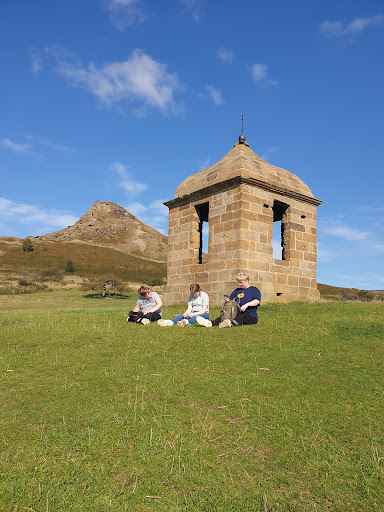
The Roseberry area has been inhabited for thousands of years and the hill has long attracted attention for its distinctive shape. A Bronze Age hoard was discovered on the slopes of the hill and is now in the Sheffield City Museum. It was occupied during the Iron Age; walled enclosures and the remains of huts dating from the period are still visible in the hill's vicinity. During this period Jet may have been mined in the area around the hill.[7]
The hill was perhaps held in special regard by the Vikings, who settled in Cleveland during the early medieval period and gave the area many of its place names. They gave Roseberry Topping its present name; first attested in 1119 as "Othenesberg", its second element is accepted to derive from Old Norse bjarg (rock); the first element must be an Old Norse personal name, Authunn or Óthinn, giving 'Authunn's/Óthinn's rock'. If the latter, Roseberry Topping is one of only a handful of known pagan names in England, being named after the Norse god Odin and paralleled by the Old English name Wodnesberg, found for example in Woodnesborough.[8] The name changed successively to Othensberg, Ohenseberg, Ounsberry and Ouesberry before finally settling on Roseberry. "Topping" is a Yorkshire dialectal derivation of Old English topp, top (of a hill).[9] The naming of the hill may thus fit a well-established pattern in Continental Europe of hills and mountains being named after Odin or the Germanic equivalent, Wodan. Aelfric of Eynsham, writing in the 10th century, recorded how "the heathens made him into a celebrated god and made offerings to him at crossroads and brought oblations to high hills for him. This god was honoured among all heathens and he is called ... Othon in Danish."[10]
In 1736, explorer James Cook's family moved to Airey Holme Farm at nearby Great Ayton. When he had time off from working on the farm with his father, young James took himself off up Roseberry Topping, which gave him his first taste for adventure and exploration, which was to stay with him for life.
Roseberry Topping can be seen from many miles away and was long used by sailors and farmers as an indicator of impending bad weather. An old rhyme commemorates this usage:
When Roseberry Topping wears a cap, let Cleveland then beware of a clap![11]
The hill was private property for many years, formerly being part of a game estate owned by the Cressy family. In the early 18th century, Dorothea Cressy married Archibald Primrose, who was later made Earl of Rosebery. Roseberry Topping is now managed by the National Trust and is open to the public. It is just within the North York Moors National Park whose border runs along the A173 road below it.[citation needed]
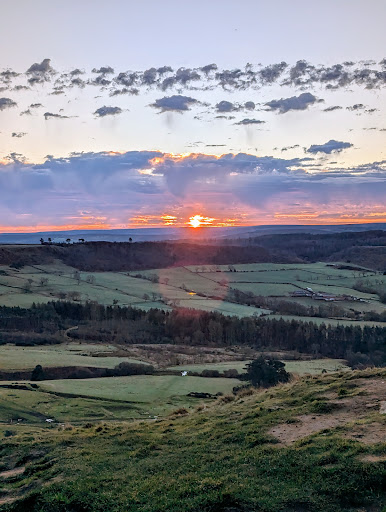
A spur of the Cleveland Way National Trail runs up to the summit. The path has been a sight-seeing excursion route for centuries due to the views of the Cleveland area from the summit; as early as 1700, travellers were recommended to visit the peak to see "the most delightful prospect upon the valleys below to the hills above."[12]
The site was notified as a geological Site of Special Scientific Interest in 1954, with a boundary extension in 1986 bringing the designated area to 10.86 hectares. The site is listed as being of national importance in the Geological Conservation Review.[13]
During the Napoleonic Wars, the Wensleydale volunteers responded to a false alarm when the beacon on Penhill in North Yorkshire was lit in response to a supposed lit beacon on Roseberry Topping, 40 miles distant. This turned out to be burning...
Read more
 Learn more insights from Wanderboat AI.