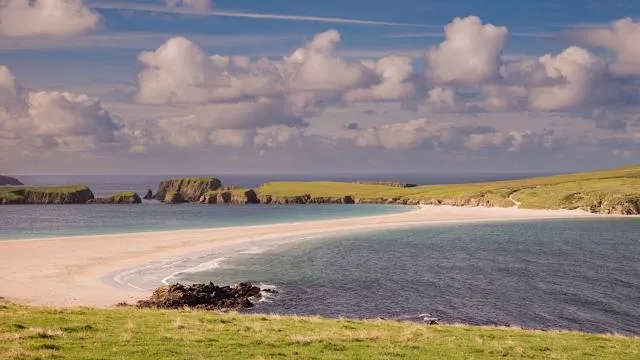
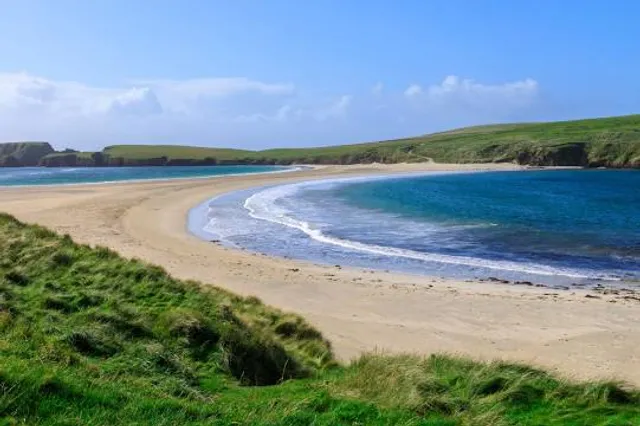
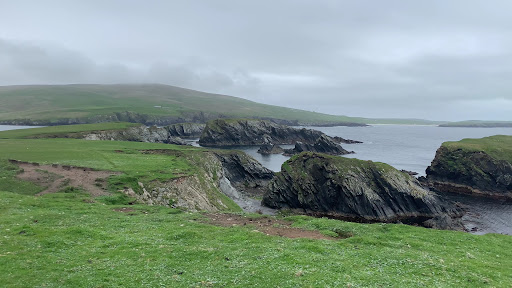
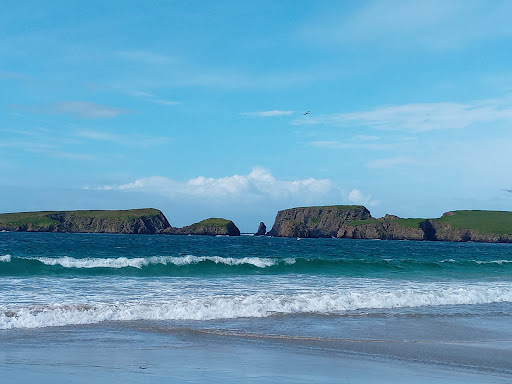
Last month we walked along the largest tombolo of the UK to reach the small tied island of St. Ninian in Shetland. It was a particularly misty evening, which gave our hike a fantastic atmosphere.
After glacial times, much of Shetland became a flooded landscape as the lower ends of its valleys drowned beneath the rising waters. Numerous sea inlets - the 'voes' now characteristic of Shetland - were formed. In addition, rising sea levels reworked sediments to produce stunning sandy or shingle beaches, bars and tombolos like St. Ninian's.
The chapel on St. Ninian's Isle is famous for its "treasure": 28 Pictish silver objects and the jaw bone of a porpoise which were buried under a cross-marked slab close to the altar.
The "treasure" was of several different styles and was thought to be the collection of a family rather than ecclesiastical and includes bowls, weaponry and jewellery.
People believed that the Church would not be violated and that it was therefore a good place in which to hide things for safekeeping. Whilst tragedy may have overtaken the owners, the treasure was indeed safe until 1958 when a Shetland schoolboy working on the excavation discovered it.
The silver is in the National Museum of Scotland, but replicas can be seen in the Shetland Museum.
The treasure may have been buried at the end of the 8th or beginning of the 9th century AD, when Viking raids on Scotland first began. Alternatively, as the objects show signs of significant use, they may have been hidden centuries later.
The site was excavated in the late 1950s and in 2000/2001 and the graveyard demonstrates a continuity of pre Christian and Christian burial. The earliest burials were in long cists, stone boxes which were aligned north-south. The bodies were laid on their sides with their knees drawn up to their chests. A group of babies, aligned east-west and with tiny crosses at their heads were buried under empty cists and may represent the point at which Christian practices were being introduced, with pre Christian tradition...
   Read moreOne of the most recognised landmarks in Sheltland. It's a public place with a good size car park. If you have spare 2 hours please take a walk across the tombola on to the isle and walk right around. You will be amazed with breathtaking clifs on the other side, torquoise sea and cuts in the rock. There's also round of old kirk. If your lucky enough you may see killer whales looking for dinner around that area. Wonderful place to visit regardless of the weather or...
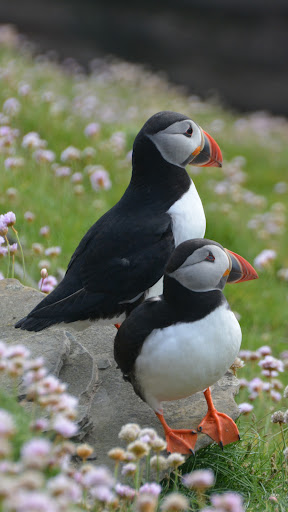
   Read moreA wonderful place to visit. With the largest tombolo in the UK. Enjoy a nice walk around the isle, and if you're lucky like us, you'll get to see some puffins at the right time of day and year. Allow yourself a few hours and take some lunch. There are some amazing views from the cliffs where you can sit and enjoy the birdlife. There's also the ruins of an old 12th church to explore. Remember to only...
   Read more