Have You Ever Been to South Dakota?
Have you ever stood beneath the skies of South Dakota?
For my wife and me, this was our second journey to that vast and stirring land — a place that calls you back with its silent majesty. Once again, we set our course for Yellowstone National Park, weaving through the heartland, stopping at every roadside gem that caught our eye or stirred our spirit.
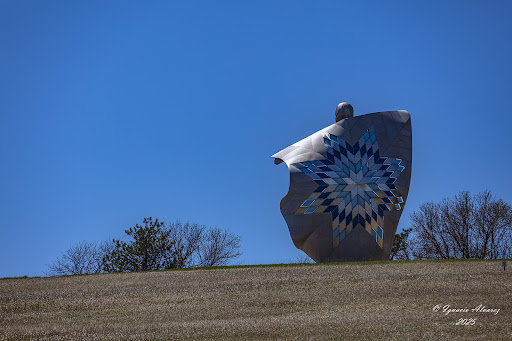
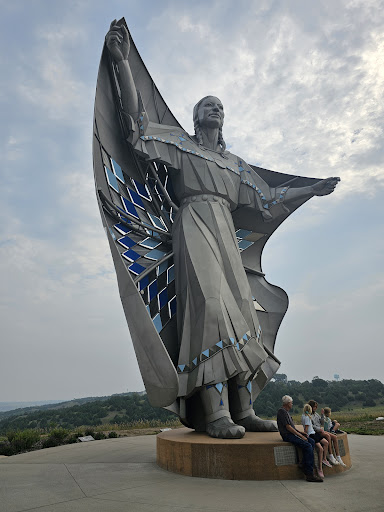
Years ago, on our return to Illinois from Yellowstone, we glimpsed a lone statue perched on a hill — a silent sentinel watching over the highway. Back then, it stood alone, surrounded by wind and sky, without shelter or sign. This time, things were different. A resting place had been built, complete with rich stories and truths carved into panels — an homage to the tribes of the region.
It is a place worth stopping for.
No — it is a place that demands a pause.
The statue, the centerpiece of it all, is stunning — not just in form, but in presence. A breathtaking work of art, radiant and solemn, urging every traveler to stop, to look, to feel.
It honors the Lakota — the Teton Sioux — one of the three great branches of the Sioux Nation. Their history runs deep in the soil of South Dakota. They are not a single people, but seven distinct bands:
Oglala, Hunkpapa, Brulé, Minneconjou, Itazipco (Sans Arc), Sihasapa (Blackfoot), and Iháŋktȟuŋwaŋna (Two Kettle).
They live primarily on the reservations scattered across the western plains: Pine Ridge, Rosebud, Cheyenne River, Standing Rock.
They did not choose these boundaries.
They were given them — with the heavy hand of history and the sharper blade of broken promises.
The Lakota are a part of the Oceti Sakowin — the Seven Council Fires — along with their Dakota and Nakota kin. They are a people of fire, of ceremony, of stories passed through generations in spoken word, sacred song, and the beat of the drum.
Fierce in spirit, they once resisted the tide of westward expansion — from Wounded Knee to the Battle of Little Bighorn, their name etched into the story of resistance and resilience.
Yet history has not dimmed them.
It has tempered them — like steel in flame.
Despite the tragedies they’ve endured, the Lakota remain: speaking their language, painting their truths, honoring their ancestors, gathering in circles of healing and remembrance.
They are not relics of the past.
They are the living heart of it — still beating.
And perhaps one day, as with other civilizations who’ve walked through fire, the Lakota will be free again.
Free not just in body, but in land, in spirit, in future.
Not confined to borders that shrink their birthright — not consigned to what some still dare call "reservations," but what history should name for what they are:
concentration camps of a different kind.
The Lakota endure.
And that endurance is a kind of freedom.
A freedom the wind in South Dakota seems to understand.
So if you ever find yourself on that highway, and see that statue rising against the sky —
Stop.
Step out.
And listen.
The land is...
Read more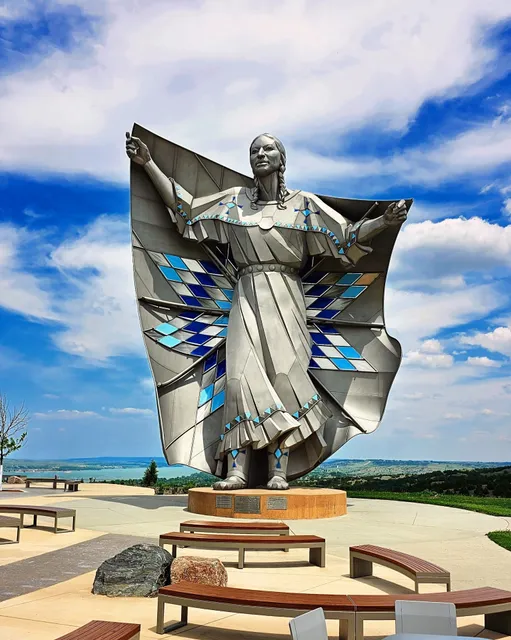
 Learn more insights from Wanderboat AI.