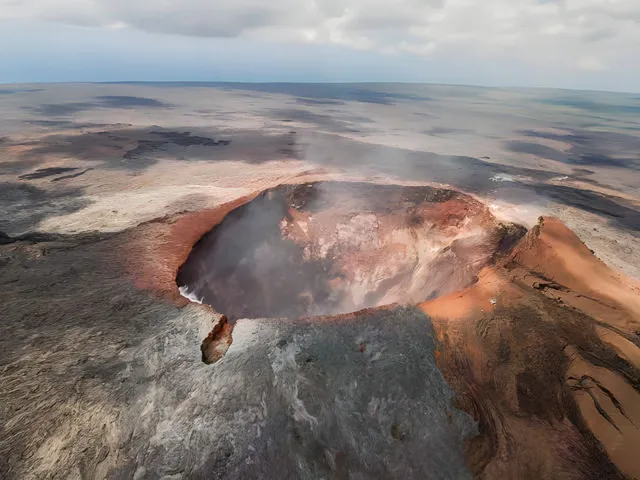
As of 7:00 a.m. today, December 15, webcams only captured residual incandescence and no lava movement in the F3 vent. The channels below the vent appear drained of lava and no longer feed the main flow front. The inactive main flow front remains stalled about 1.7 mi (2.8 km) from the Daniel K. Inouye Highway (Saddle Road) when last measured on the morning of December 10. The inactive main flow front still glows at a few spots at night and may inch northward very slowly as it continues to settle. Sulfur dioxide (SO2) emission rates are at background levels; on December 10, the emission rate was approximately 2,000 tonnes per day (t/d). The Hawaii Interagency Vog Information Tremor (a signal associated with subsurface fluid movement) is no longer detectable; summit and Northeast Rift Zone inflation is slowing. The significance of the continuing inflation while the flow field is inactive is not yet clear; it is common for eruptions to wax and wane or pause completely, but none of the eight recorded eruptions from Mauna Loa’s Northeast Rift Zone returned to high eruption rates after those rates decreased significantly. Nevertheless, the Hawaiian Volcano Observatory continues to closely monitor the current activity. There is no active lava within Moku'āweoweo caldera nor in either rift zone. Satellite imagery shows the entire 2022 flow field cooling and no...
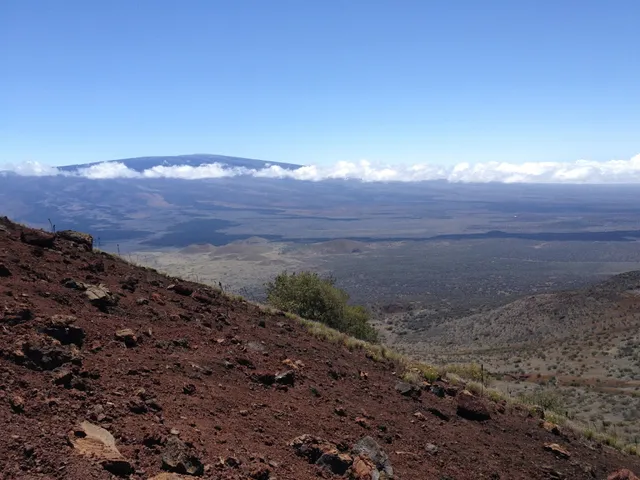
Read moreDriving up to the summit of Muana Loa is a fun and exciting drive. Please keep in mind the condition of your car and style of driving. If you have a small car and it is fully loaded, it is not the greatest idea to try and make the drive. My wife and I had a compact car and it was struggling to get to the summit. During our trip up, 3 people were trying to get a ride to the top and we had to decline because our car certainly would have overheated. Also, on the way down.... downshift. Try to save your brakes by shifting the vehicle into a low gear so you do not need to brake as much. If you do brake a ton, make a handful of stops on the way down at pull-offs to allow the brakes to cool down...
Read moreMauna Loa (/ˌmɔːnə ˈloʊ.ə, ˌmaʊnə -/, Hawaiian: [ˈmɐwnə ˈlowə]; lit. 'Long Mountain'[1]) is one of five volcanoes that form the Island of Hawaii in the U.S. state of Hawaii in the Pacific Ocean. Mauna Loa is Earth's largest active volcano[1] by both mass and volume. It was historically considered to be the largest volcano on Earth until Tamu Massif was discovered to be larger.[4] Mauna Loa is a shield volcano with relatively gentle slopes, and a volume estimated at 18,000 cubic miles (75,000 km3),[5] although its peak is about 125 feet (38 m) lower than that of its neighbor, Mauna Kea.[6] Lava eruptions from Mauna Loa are silica-poor and very fluid, and tend to...
Read more