Let me first start by stating that the Pecan Pi is a really good DAC. Not just for its price, but compared to DACs at double, triple or quadruple the Pecan Pi's modest asking price. The Pecan Pi has a number of strengths and only a few subjective weaknesses, none of which detract significantly from it's excellent overall performance.
In my listening tests, I compared the Pecan Pi to a Chord 2 Qute (US$1500 - discontinued, now replaced by the Chord Qutest US$1900) and a Kinki Studio DAC-1 (US$2000). An unfair comparison, perhaps, but I wanted to hear whether the Pecan Pi could go toe-to-toe with DACs in the next class up (price-wise at least). Could this new light-weight contender slug it out some the with best established middleweights? The Chord and Kinki have excellent reviews and as an owner of both, I was very familiar with their particular sonic attributes, strengths and weaknesses.
One of the first things I noticed about the Pecan Pi is its wonderful sense of pace and timing and significant dynamic prowess, which is comparable to the Chord 2 Qute and superior to the Kinki DAC-1. The Pecan Pi is no shrinking violet and brings a real joie de vivre and foot-tapping boogie factor to musical proceedings.
The mid-range of the Pecan Pi is lifelike and full-bodied, with performers and instruments existing in their own clearly defined space, yet remaining connected as part of the overall fabric of the performance. It is more sophisticated than the mid-range of the 2Qute , if not quite up to the standard of the DAC-1. Treble is clean and extended with only the faintest wisp of sibilance present, once again a step up from the 2Qute, although falling slightly short of the silky smooth treble of the DAC-1.
On balance and in absolute terms (with cost removed from the equation) the Kinki DAC-1 is still by go-to mid-priced DAC. The areas (as I hear them) where the Pecan Pi falls just short of the Kinki are in soundstage depth, centre image focus, treble sophistication and harmonic decay. The soundstage via the Kinki DAC starts at the plane of the speakers and extends many feet to the rear. By comparison, the soundstage on the Pecan Pi is slightly foreshortened, extending a little in front of the speakers and a little behind. Or put another way, the Pecan Pi's perspective has you sitting in the front few rows of a concert rather than in the middle or rear of the hall. With the Pecan Pi there is also a sense of a slight smearing of the centre image and the merest hint of a silvery sheen in the treble region. Likewise, the Kinki provided a greater sense of harmonic decay as notes trailed off - through the Pecan Pi they seemed ever so slightly truncated.
If that sounds a little harsh, on the positive side, the Pecan Pi made the Kinki DAC sound a little soft, slow and small. Everything seemed energised and supercharged via the Pecan Pi, which made for a thoroughly immersive and engrossing listening experience. Overall the Pecan Pi reminded me an awful lot of the musical presentation of the Chord 2Qute, but with some noticeable improvements in the mid-range and treble. By comparison, the 2Qute sounds a little coarse and rough about the edges - like a rowdy party animal compared to the more sophisticated Pecan Pi.
So there you have it - the Pecan Pi is absolutely capable of stepping up a weight class and slugging it out with several highly-regarded DACs in the US$1500 - $2000 range. It's a wonderful all-rounder and strikes a beautiful balance between dynamism and natural tonality and will rarely leave you wanting for more. If it lacks the nth degree of treble purity, image focus and harmonic complexity, that is only noticeable in comparison to a DAC that is four times the Pecan Pi's asking price. I preferred the Pecan Pi to the Chord 2Qute which for several years was one of the critics favourite in the under $2k DAC category - yes, the Pecan Pi is that good and for its asking price is an absolute steal and a massive sonic...
   Read morePrevious Setup:
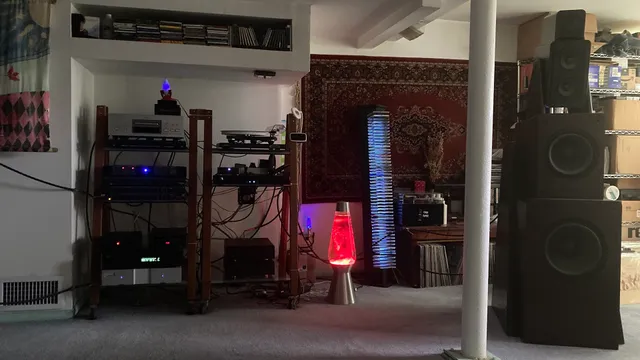
Allo DigiOne Signature Player Allo Shanti Dual Linear Ultra Low Noise PSU Sony STR-DN1080 Amplifier Sony SS-MF600H speakers
Current Setup:
Orchard Audio PecanPi Leaf Audio PW-05 Linear Power Supply Sony STR-DN10880 Amplifier Sony SS-MF600H speakers. Sony MDR-7506 headphones
I honestly didn’t know what to expect. I had an Allo DigiOne Signature Player as my only reference amongst other RasberryPi + HAT setups. I really liked the Allo DigiOne Signature setup, however I didn’t like the overall investment it took so I decided to ultimately sell it.
Along comes the opportunity to play with an Orchard Audio PecanPi. I don’t understand all the graphs, charts, and testing breakdowns.. .so will just go with my subjective review.
Songs tested:
Sonic Youth – Schizophrenia 16bit/44.1khz Joni Mitchell – All I Want 24bit/192khz Bob Dylan – Tangled Up in Blue 24bit/192khz
My initial setup was with my Sony MDR-7506 headphones. I had always thought that perhaps I bought the wrong headphones when using it with my previous allo setup because it just sounded quite unremarkable..nice…but just not inviting me to get into what I was listening. I knew I had a nice setup so just blamed the headphones.
This time around I got to connect the sony heaphones directly into the PecanPi… I was so wrong. I had good headphones.. I just didn’t have a DAC that had balanced outputs. My first impression was “wow, wow, wow…” It took time for me to appreciate my Allo DigiOne Signature Player…. PecanPi had me impressed withing seconds into the music. I chose Joni Mitchell and Bob Dylan because I wanted to hear clarity in the instruments. I was very impressed with the separation of instruments and clarity of vocals. PecanPi makes you want to actively enjoy the music, get involved in the details. Both these songs are easy to distinguish all the instruments in play…. Now imagine there is a more defined fidelity and clarity unlike you’ve heard before.
I chose Sonic Youth because it’s just…noisy. Beautiful songs if you are into the marriage of euphony and cacophony. Sonic Youth’s Schizophrenia had always been this wall of dissonant sound. The overwhelming sum of not so clear parts. PecanPi magically gave it clarity and separation… it was like experiencing something you heard so many times, however instead of going insane from predictability… all of a sudden you have been released from the cave and experience reality for the first time. I love this song ever since the first time I heard it back in 1992… all of a sudden, it’s a whole new listening experience with the PecanPi.
I am currently enjoying music again hours at a time with this PecanPi. I had no intention of buying it.. but the geek in me wanted to tinker with it and just thought nothing could surpass the Allo DigiOne Signature that I found respectable over time. The PecanPi grabs your attention from the get go..no break in...
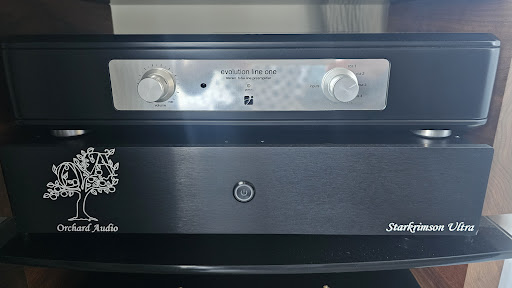
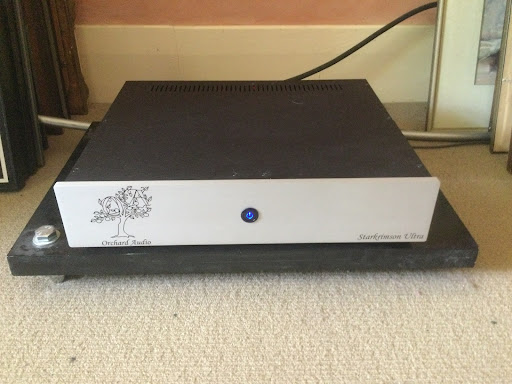
   Read morePart 2 of review: Starkrimson Ultra Sound: After break-in and speaker position adjustment, sound staging of both amps was excellent (realistic) with similar placement of instruments between speakers and in depth. The Starkrimson sounded ruler flat in frequency response while the BHK 250 sounded just slightly warmer making it sound like it had slightly more punch (more on this later). Both amps were quick, but the Starkrimson sounded quicker getting it closer to the live performance. The Starkrimson stunned me by the clarity and detail with which the music was presented. This was especially apparent at the frequency extremes on percussion instruments, cymbals, and bells. Every note of every instrument played sounded more accurate in volume and tone and more distinct from other instruments’ notes even when all were playing at the same time allowing each instrument to have its own space sounding more like a live event. In comparison, the BHK 250 sounded a little less clear obscuring some of the finer details of the notes played and less distinct. With the overall cleaner presentation by the Starkrimson, very soft notes could now be heard that I didn’t remember hearing with the BHK 250. At first, I thought the BHK 250 had a bit more punch (feeling the strike on a bass drum on your chest) like at Esteban’s live concert in a restaurant that I attended recently). When I looked at Esteban’s live album cover, I realized that the CD version was recorded in a much bigger venue. You are not going to get the same force of a bass drum strike when sitting 10 feet away from the drum versus 100 feet or more at similar volumes. Considering this and the slightly warmer presentation of the BHK 250, I concluded that the amount of punch the Starkrimson had (it did have punch) was more accurate although it would be interesting to see what doubling or tripling the size of the power supply does to the sound. Conclusion: The Starkrimson Ultra is not leaving my system. It is easy to move, economical (power-wise), and sounds much closer to the live performance than any amp I have owned including the BHK 250. Even my wife commented on how much more realistic the music sounded. Adding cost to the evaluation, it’s a “no-brainer”. The Starkrimson Ultra is sonically very competitive (and probably beats) with most $5K to $10K amps and may be competitive with even higher priced amps. Leo should have named the amp “David” because it really is a giant amp killer. At a $2.5K list price, it is a bargain. The application of Gallium Nitride transistors to audio amplification (and a talented amp designer) has produced a significant step forward in reproducing a live musical event at home and should place GaNi class D amps in the mainstream of...
   Read more