
Daily Share | No.4 🇫🇷 National Museum of Natural History
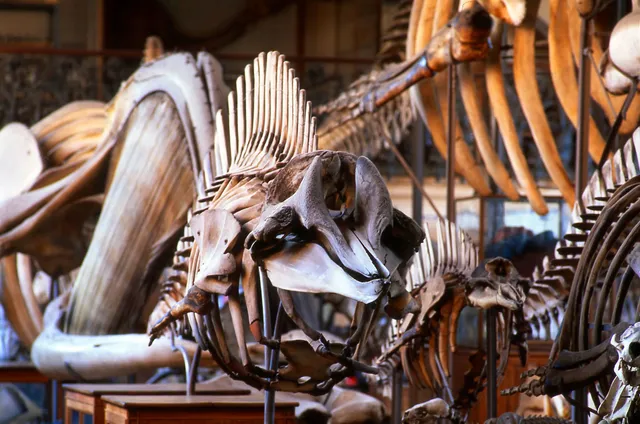
GALERIE DE PALÉONTOLOGIE ET D’ANATOMIE COMPARÉE Paleontology and Comparative Anatomy Gallery Purchase method: Offline on-site Online - Official website (It’s highly recommended to book in advance as this gallery is quite popular and can get crowded) Full ticket 🎫: 12 € Reduced ticket 🎫: 9 € Open time: 10am-6pm Closed on Tuesdays Address: 57 Rue Cuvier, 75005 Paris I first heard about this museum when I watched a French movie - “Les aventures extraordinaires d’Adele Blanc-Sec” (The Extraordinary Adventures of Adèle Blanc-Sec). 🎬 When the movie was released back in 2010, I was still in high school, and I remember it vividly even now because the plot was just so fantastic! It featured the scenery of early 20th-century Paris, an archaeological adventure, and a beautiful, intelligent, and fearless female protagonist. She went to great lengths to save her sister, who was in a deep coma, by awakening the mummy of an ancient Egyptian doctor. Meanwhile, something strange happened in this very gallery (the Paris Natural History Museum) - a dinosaur egg over 100 million years old suddenly hatched into a pterosaur! 🦖 The predecessor of this museum was the Royal Medicinal Plant Garden. 🌿 The first floor is the Comparative Anatomy Gallery, which mainly compares existing vertebrates with extinct animals to illustrate their similarities and differences. The gallery displays about 650 skeletons, covering fish, amphibians, reptiles, birds, and mammals. Important exhibits include the okapi, narwhal, Steller’s sea cow, and the Tasmanian tiger. 🦒🦓 The second floor is the Paleontology Gallery, which is arranged in chronological order. It showcases the evolutionary history of life on Earth over the past 540 million years, from the terrifying fish of the Paleozoic Era to the giant crocodiles and dinosaurs of the Mesozoic Era, such as the brontosaurus, iguanodon, and triceratops, and then to the early horses, brontotheres, and Egyptian primates of the Cenozoic Era. 🦕 The third floor displays invertebrates and plants that have existed on Earth for nearly 3.5 billion years. 🌿 #NationalMuseumofNaturalHistory#ExtinctAnimals #Dissection