
Osaka Travel Summary 12 - Yasaka Shrine (1)🌿
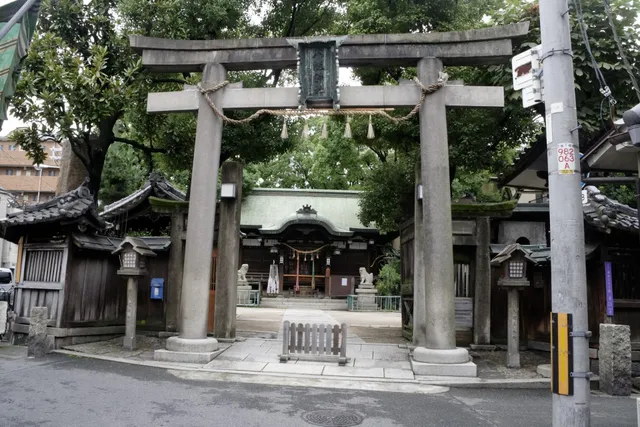
Yasaka Shrine enshrines deities such as Susano'o no Mikoto, Kushinada-hime no Mikoto, and the Yao-koto Myojin. 🎢🌟 In Japanese mythology, Susano'o no Mikoto defeated the Yamata no Orochi (the eight-headed serpent representing all disasters) and saved Kushinada-hime no Mikoto. 🍃🌺 He also brought fortune to the people and is considered a truly great god. 🌟 There are various theories about the origin of the shrine. 🎢🌟 One is that during the Yamato period, the descendants of the Korean envoy, Iri, the Yabuki clan, moved the Ushiwakamaru (enshrined on Mount Ushiwakamaru in Korea) to Japan, which became the origin of Yasaka Shrine. Another theory is that the Yabuki clan, who naturalized in Japan, originated from their ancestral god, Kanshin-in. 🎢🌟 However, since ancient times, Yasaka Shrine has indeed enshrined Ushiwakamaru (said to be a guardian deity in Buddhism), and in Japan, it is believed that Ushiwakamaru is the same as Susano'o no Mikoto. 🌿 🍃🌺 The West Tower Gate (Figure 1) is said to never have spider webs and does not leave water stains when it rains. 🕸️ Climbing the stone steps and passing through the West Tower Gate, you first purify your hands and mouth at the hand-washing pavilion (temizuya) on the left (Figure 2). 🎢🌟 After purification, you proceed to worship. Facing the front of the West Tower Gate, there is the Eki Shrine. 🍃🌺As its name suggests, it is a shrine that can expel diseases (Figure 3). 🌿 Moving forward along the worship path extending to the right from the Eki Shrine, you pass by Ota Shrine, Hiruko Shrine, and Okuninushi Shrine. 🎢🌟 After passing in front of the shrine office, you can reach the Main Hall (Figure 4), which is considered an important cultural property of the nation. 🏛️ #Osaka 🌺