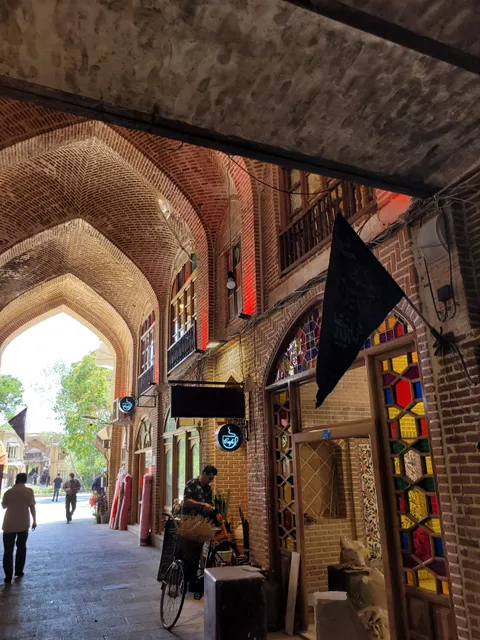

Tabriz Grand Bazaar: The World's Largest Covered Marketplace
The term "Bazaar" originates from the ancient Persian word "بازار" (Bāzār), meaning "marketplace." This concept spread across Central Asia, the Middle East, and the Islamic world, eventually reaching Xinjiang via the Silk Road, where it became central to Uyghur culture. As the 16th-century capital of Persia, Tabriz in northwestern Iran is home to the world's largest bazaar—a labyrinth of commerce and history. 🏛️ Architectural Marvel • Spanning 7 square kilometers, the bazaar comprises 24 caravanserais and 22 domed halls, all interconnected in a maze-like structure. • Its design blends Persian traditional architecture with Islamic geometric aesthetics, featuring ingenious dome skylights still in use today. ⏳ Historical Timeline 3rd Century BCE (Sassanid Era): The bazaar's earliest form emerged as a key Silk Road trading hub. 7th Century (Arab Conquest): Tabriz became a military stronghold, with its marketplace evolving under Islamic influence. 13th Century (Mongol Ilkhanate): As the Silk Road flourished, the bazaar attracted Genoese merchants, Jewish moneylenders, and even hosted a "Chinatown" of Chinese artisans. Stone vaults and specialized quarters (silk, spices, jewelry) were established. 16th Century (Safavid Dynasty): As Persia’s capital, Tabriz expanded its bazaar into an economic powerhouse, with dedicated zones like Amir Market (gold) and Mozaffarieh (carpets). 🏆 Modern Recognition • 2010: Designated a UNESCO World Heritage Site as the "Silk Road’s most intact commercial system." • 2013: Won the Aga Khan Award for Architecture after a community-driven restoration. 🌍 A Living Legacy Today, wandering through Tabriz Bazaar is like stepping into a time capsule of Persian civilization. From the scent of saffron to the glint of handwoven carpets, it remains a vibrant testament to Eurasian-African trade history. One grand bazaar, a millennium of merchants. #SilkRoad #IranTravel #WorldHeritage #CulturalCrossroad