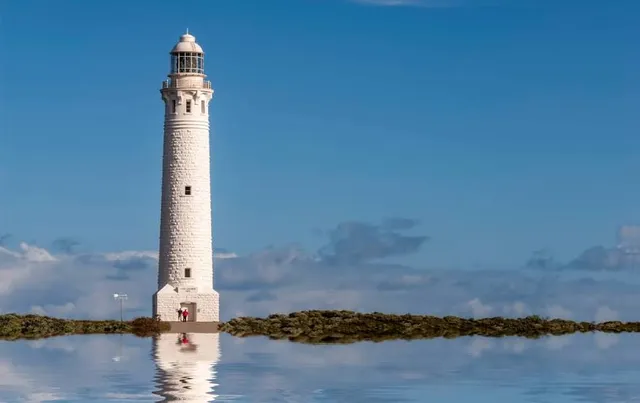
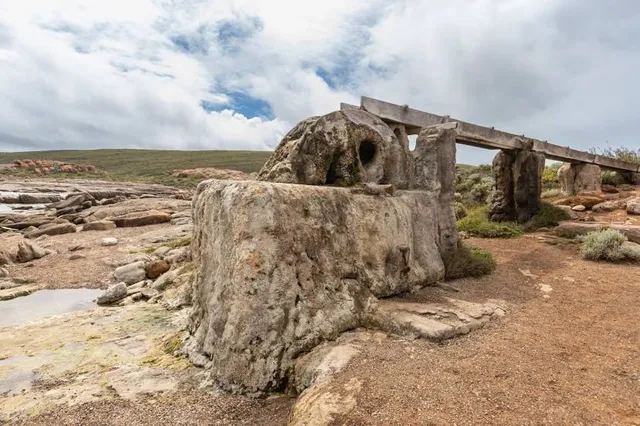
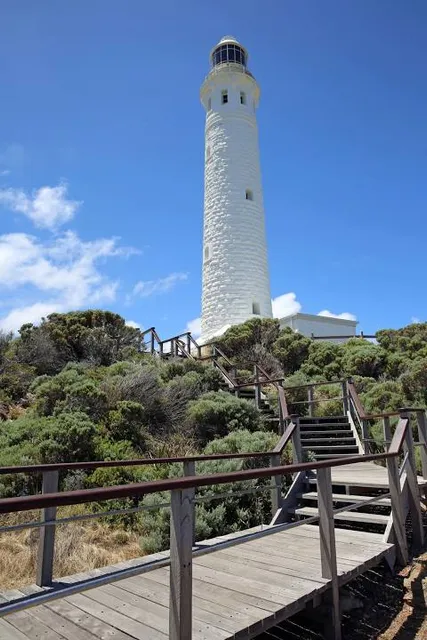
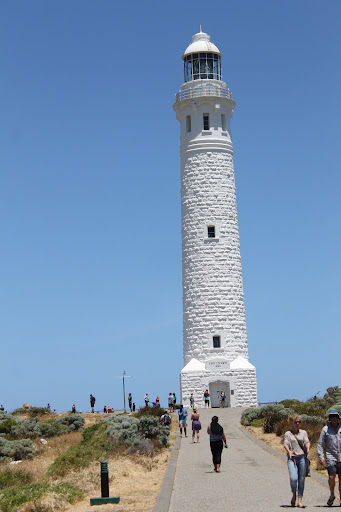
he Cape Leeuwin Lighthouse is a lighthouse located on the headland of Cape Leeuwin, the most south-westerly point on the mainland of the Australian Continent, in the state of Western Australia.
Cape Leeuwin Lighthouse was constructed by a company led by M. C. Davies, with George Temple Poole supervising the construction of the light and designing the keepers' quarters.The light tower which is built of local stone was originally designed to show two lights – a higher white light and a lower red light. Although the foundations were completed, the lower light was never installed.It was opened with great ceremony in 1895 by John Forrest, the Premier of Western Australia. Until June 1982 the lens was rotated by a counter weight driving clockwork mechanism, and the beacon was a pressure kerosene mantle type. A radio navigation beacon was commissioned in 1955 and operated until 1992.The lighthouse was automated in 1982.The lighthouse, besides being a navigational aid, serves as an important automatic weather station. The lighthouse's buildings and grounds are now vested in the local tourism body and the single (1960s) and double (1980s) communications towers that were north-west of the lighthouse, seen in older photographs of Cape Leeuwin, have been removed.
The nearest functioning lighthouse north of Cape Leeuwin is the much smaller Cape Hamelin lighthouse, just south of the Hamelin Bay camping area.
The young Felix von Luckner, later a German World War I war hero, noted for his long voyage on the Seeadler during which he captured 14 enemy ships, was briefly assistant lighthouse keeper. He abandoned the job when discovered with his hotel-keeper's daughter by her father.
International Lighthouse Day was celebrated at Cape Leeuwin lighthouse for the first time in 2004.The climb to the viewing deck consists...
   Read moreCape Leeuwin Lighthouse – A Historic Maritime Landmark The Cape Leeuwin Lighthouse is a historic lighthouse located at the southernmost point of Western Australia, where the Indian Ocean meets the Southern Ocean. It is situated in Leeuwin-Naturaliste National Park and is one of the most iconic landmarks in the region. The lighthouse was built in 1895 to guide ships safely through the treacherous waters of the Southern Ocean, a region known for its strong currents and unpredictable weather conditions.
Standing 56 meters tall, the Cape Leeuwin Lighthouse is the tallest in Western Australia and offers breathtaking panoramic views of the surrounding coastline. Visitors can climb to the top of the lighthouse for a spectacular vista of the rugged cliffs, pristine beaches, and the confluence of the two oceans. The lighthouse is still operational today, continuing to serve as an important beacon for maritime navigation.
In addition to its functional role, the Cape Leeuwin Lighthouse is also a popular tourist attraction. The surrounding area includes a visitor center with informative exhibits about the lighthouse’s history, the maritime heritage of the region, and the flora and fauna of the nearby parklands. The lighthouse is a must-visit destination for those exploring the beauty of Western Australia’s coastline, offering both natural beauty and historical...
   Read moreThis charming white lighthouse stands at the meeting point of the Indian and Southern Oceans. Entry is just AUD 7.50—a great value! Inside, you'll find a delightful café serving delicious pastries and sausage rolls, as well as a fantastic souvenir shop.
Must-see highlights with your AUD 7.50 ticket:
👉 Immersive Movie Experience – Step into the keeper’s cottage and feel the desperation of a sailor battling a storm, struggling to reach the lighthouse.
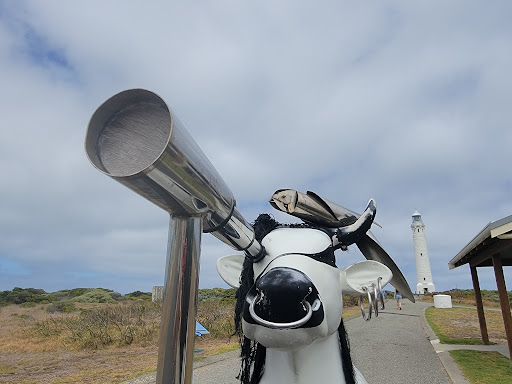
👉 Cow Parade Tribute – Spot the quirky cow with binoculars, a nod to the famous Cow Parade featuring 85 cows in Margaret River. Just remember—climb the lighthouse, not the cow!
👉 Two Oceans Selfie Spot – Capture the perfect photo in front of the sign marking the exact confluence of the two mighty oceans.
👉 The Flying Cat – Hear the incredible tale of a lighthouse keeper’s cat that was swept off the 32-meter-high tower by strong winds—only to land safely in a bush!
👉 Ferocious Winds – Discover how the winds here are so powerful that they once blew away the official measuring gauge.
👉 A Whale with an Attitude – Learn about the ill-fated schooner that, in 1882, collided with a sperm whale, causing it to sink. Some sailors had to row for 22 exhausting hours to reach Leeuwin...
   Read more