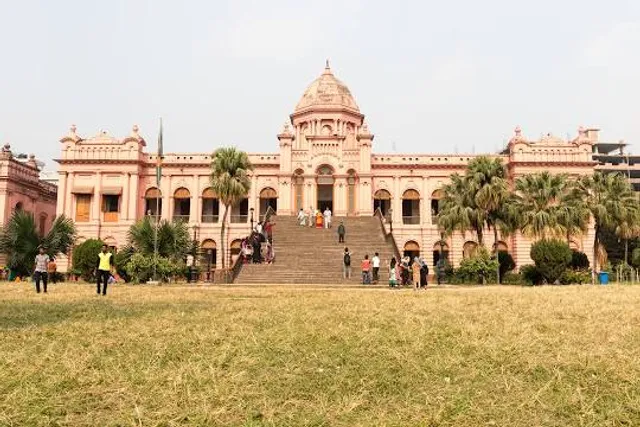
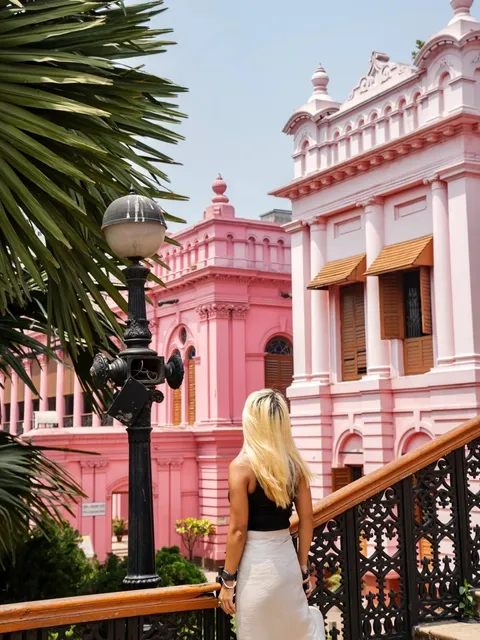
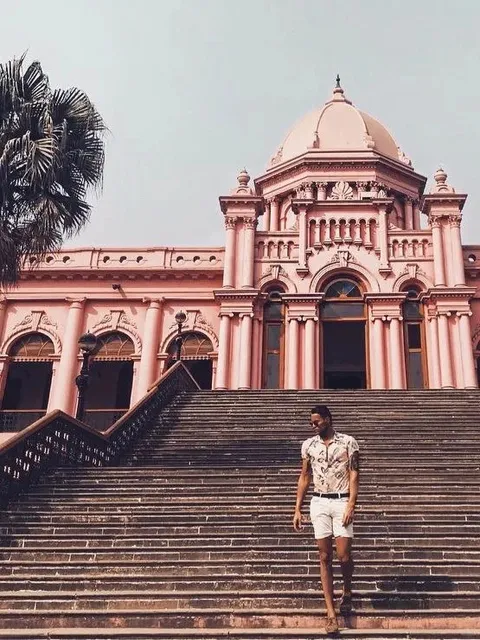
Ahsan Manzil Is The One Most Beautiful and old architectural style of the landlord's residential palace which is located in the poran Dhaka ,Kumartoli area beside Buriganga River of Dhaka, Bangladesh.This is a Historical Place. Ahsan Manzil is associated with the centuries-old history of Dhaka. Ahsan Manzil is considered one of the best old structures in Dhaka. This palace, which is full of memories of the Nawab family, is currently being run as a museum. "Ahsan Manzil" is a rich repository of Bengal's glorious history and Nawabi heritage. In the middle of the 18th century, the landlord Sheikh Inayet Ullah built a palace called Rang Mahal on the present site of Ahsan Manzil. Later, his son Sheikh Matiullah sold Rang Mahal to French merchants. In 1830, Khwaja Alimullah, father of Nawab Abdul Ghani, bought it. In 1859, Nawab Abdul Ghani started building a palace there. It took 13 long years to build the palace. He named it ‘Ahsan Manzil’ after his beloved son Khwaja Ahsanullah. Once upon a time, the highest dome in Dhaka was the beautiful dome on the roof of the Ahsan Manzil Palace. The veranda and floor of this two-storey building are made of marble. Inside the palace there is a dining room, library, water tank, court hall and billiard room. And on the second floor of the palace there are guest rooms, a drawing room, a dance hall, a library and some other living rooms. There are car verandas on the north and south sides of the palace, one story high. On the south side, an open staircase goes down from the veranda of the second floor to the front garden. Just in front of the palace is a beautiful flower garden and a green field. Ahsan Manzil is considered to be the first brick and stone architectural monument in the city of Dhaka. And the first electric light was lit in this building by the Nawabs of that time. The architectural style of Ahsan Manzil attracted the West equally, there is evidence that Lord Curzon actually stayed in this building when he was in Dhaka. This palace was a major political center of Bengal from the mid-19th century for about 100 years. In 1906, a meeting held here decided to establish the Muslim League. Architectural style There is a beautiful dome on the roof of this palace. At one time, the top of this dome was the highest in Dhaka city. The three-arched entrance outside the main building is also beautiful to look at. Similarly, the stairs leading up to it also attract everyone's attention. There are two beautiful arches on the east and west ends, which are the most beautiful. There are two parts inside Ahsan Manzil. There is a sitting room and a library in the east part. There is a dance hall and other residential rooms in the west part. There is a courtroom and a dining room on the ground floor. The two-story palace building, built on a 1-meter-high altar, measures 125.4 meters and 28.75 meters. The height from floor to ceiling on the ground floor is 5 meters and 5.8 meters on the second floor. There are car balconies on the north and south sides of the palace, which are the same height as one floor. A large open staircase leads down from the second-story balcony through the front garden to the riverbank. In front of the staircase was a fountain in the garden, which does not exist today. There are wide balconies with semicircular arches on the north and south sides of both floors of the palace. The floors of the balconies and rooms are decorated with marble. To build the dome of Ahsan Manzil, first the four corners of the square room on the ground floor were filled with bricks and given a round shape. Above this, a similar round room built on the second floor was made octagonal near the roof by squinching the upper part. This octagonal room became the barrel of the dome on the roof. Finally, the pointed heads of the octagonal arms are gradually tilted towards the center and the dome in the shape of a lotus has been created. The height of the dome top from the ground is 27.13 meters. In 1992, the tourist attraction was renovated and converted into a museum (Ahsan...
Read moreAhsan Manzil, an architectural treasure, witnessed many historical events of Bangladesh. From the last part of the 19th century to the initial years of Pakistan, the Muslim leadership of East Bengal emerged from this palace. The nawabs of Dhaka used to conduct their court affairs here as chief of the panchayet (village council) everyday. Many anti-Congress meetings were held here under the initiative of Nawab Ahsanullah, a staunch believer in Muslim separate identity. Almost all the Viceroys, Governors and Lieutenant Governors of British India who visited Dhaka spent some time at the Ahsan Manzil.
In 1874, Lord northbrook, Governor General of India attended an evening function here in the palace when he came to lay the foundation of a water works installed by Nawab Abdul Ghani. In 1888, Lord dufferin also accepted the hospitality offered at Ahsan Manzil. In 1904 Lord curzon, on a visit to East Bengal, stayed in this palace on 18 and 19 February to win public support for the proposed Partition of Bengal.
Almost all political activities of Nawab Khwaja salimullah centred round this palace. Ahsan Manzil was the cradle of the All India Muslim League. With the decline of the nawabs of Dhaka, Ahsan Manzil also started to decline. When in 1952 the Dhaka Nawab State was acquired under the East Bengal Estate Acquisition Act, it became impossible for the successors of the nawabs to maintain the palace due to financial constraints. Nawab Khwaja habibullah shifted his residence to Paribag Green House soon after the acquisition of the zamindari. The palace was on the verge of collapse in no time as successors rented out rooms without considering its dignity. Over the years illegal occupants turned the place into a filthy slum.
Recognising the historical and architectural importance of the Ahsan Manzil, the government of Bangladesh took the initiative to renovate it. In 1985 Ahsan Manzil and its surroundings were acquired. After the completion of the renovation work in 1992 under the supervision of the Directorate of Public Works and Architecture, it was brought under the control of bangladesh national museum (20 September 1992), and it was turned into a Museum.
Ahsan Manzil situated at Kumartoli of Dhaka on the bank of the Buriganga, was the residential palace and the kachari of the nawabs of dhaka. It has been turned into a museum recently. It was said to be the Rang Mahal of Sheikh Enayetullah, a zamindar of Jamalpur pargana (Barisal) during the time of the Mughals. Having purchased it from his son Matiullah, the french made it their trading centre. Khwaja alimullah bought it from the French in 1830 and converted it into his residence, effecting necessary reconstruction and renovations. Nawab Khwaja abdul ghani engaged Martin and Company, a European construction and engineering firm, to make a master plan for their residence.
The construction of the palace was begun in 1859 and completed in 1872. Abdul Ghani named it Ahsan Manzil after his son Khwaja ahsanullah. At that time the newly built palace was known as Rang Mahal and the earlier one was called Andar Mahal. Ahsan Manzil was pertly damage by a terrible tornado On April 7, 1888, particularly the Andar Mahal of the palace. Nawab Ahsanullah rebuilt the Andar Mahal and repaired the Rang Mahal using good quality bricks that were brought from Raniganj. The exquisite dome of the present Rang Mahal was interposed. Ahsan Manzil was badly damaged again by the earthquake of 12 June 1897. However, Nawab Ahsanullah had it repaired again.
Source...
Read moreAhsan Manzil (আহসান মঞ্জিল) is a famous palace in Old Dhaka, located at Kumartuli beside the Buriganga River.
Originally, the land had been owned by various people, including French traders. Later, in 1830, Khwaja Alimullah bought the property and converted it into a residence.
The palace you see now was built largely under Khwaja Abdul Ghani, and it was named Ahsan Manzil in honor of his son, Khwaja Ahsanullah. Construction spanned from about 1859 to 1872.
Over time, the palace suffered damage by natural disasters — in particular a tornado in 1888 and an earthquake in 1897. It was renovated and expanded after those events.
Architecture & Layout
The palace is built in Indo-Saracenic Revival style, which is a mix of Mughal, Islamic, and European architectural elements.
It’s raised on a platform about 1 meter high, and its footprint is roughly 125.4 m × 28.75 m.
Entrance porticos on the north and south, verandas & terraces, large stairways facing the Buriganga — all designed to give both grandeur and river-views.
The palace is divided into two broad wings:
Rangmahal (Eastern side) — including state rooms, drawing room, guest rooms, card room, library, etc.
Andarmahal (Western side) — more private/residential: dining halls, assembly hall, music room, bedrooms etc.
The central dome is one of its most striking features; designed with architectural elements (like squinches) to transition from square to octagonal plan beneath the dome, culminating in a form likened to a lotus bud. It rises about 27.13 meters above ground.
Cultural & Historical Significance
Ahsan Manzil was the official residence of the Nawabs of Dhaka — a major local elite family during the British period. It was not just a home but also a centre of political, social, and cultural affairs.
Important events took place there: meetings of the elite, political gatherings, hosting of high officials. It’s said that the All India Muslim League had connections to it (e.g. through events and leadership in the Nawab family).
Museum & Restoration
Over time, after the decline of the Nawab’s fortunes and subsequent neglect, the palace deteriorated.
The Government of Bangladesh acquired Ahsan Manzil in 1985 under a martial law act, with approximately 5.65 acres (some parts of the original palace complex remained outside acquisition).
The restoration was done carefully, preserving as much as possible, and in 1992 it was opened to the public as a museum under the Bangladesh National Museum.
Visiting / Practical Information
Ahsan Manzil is now a heritage museum; visitors can see many original rooms, artifacts, furniture, portraits, etc.
It has become one of Dhaka’s most popular tourist destinations — for architecture lovers, history buffs, as well as...
Read more