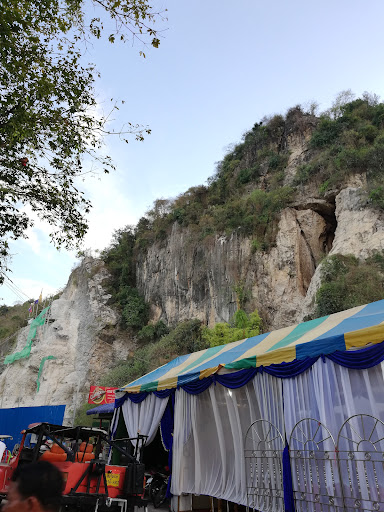
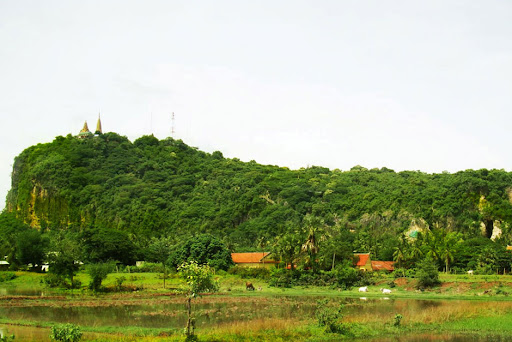
Phnom Sampov is a natural site located along National Road 57 in Sampeou Commune, Battambang district, about 12Kilometers of Battambang city. Atop a 100-meter-high mountain stands a pagoda and threee natural caves: Pkasla, Lakhaon and Aksopheak. Pkasla cave is full of uprooted stones and is considered important because it is where Phnom Sampeou residents come to celebrate after a marriage. Next to Phnom Sampeou are several important mountain clusters, including Phnom Kdaong, Phnom Krapeu(The Crocodile Mountain), Phnom Trung Moan, Phnom Trung Teat and Phnom Neang Romsay Sok. All are related to the Khmer Folktale titled Reachkol Neang Romsay Sok.
Phnom Sampeou means 'Ship mountain' because its peculiar shape reminds of a ship. This legendary 100 metres high mountain, topped by Wat Sampeou, contains 3 natural caves, lined with Buddhist shrines and statues: Pkasla, Lakhaon and Aksopheak. Pkasla cave is full of uprooted stones and is considered important because Sampeou inhabitants go there to celebrate after a marriage. Some caves were used by the Khmer Rouges as killing caves. Skeletons of their victims still remain in the caves. The wat is approached by a flight of 700 stairs. It is not exceptional but the view is spectacular. Next to Phnom Sampeou are several important mountain clusters.
Phnom Sampeou rises from the rice paddys of Southwestern Cambodia to a height of only 2500 feet, by my very generous estimate. So why should it have a page here? A few reasons:First, Cambodia does not have a single mountain currently listed on Summitpost, despite the fact that Cambodia actually has some perfectly respectable mountains (including Phnom Aural, at 5,948 feet) set in some of the most ecologically unique settings on the planet. Maybe Phnom Sampeou is not the most interesting mountain in Cambodia, but it is a good start.
Located approximately 15 kilometers outside of Cambodia's second largest city , Battambang, Phnom Sampeou rests on the Northern end of the D?mrei Mountains (literally "Elephant Mountains"), which fall into the Gulf of Thailand to the South and connect to the Kr?vanh Mountains (literally "Cardamom Mountains") to the East. Phnom Sampeou is composed of limestone and dotted with caves, and was an important setting for battles between the Khmer Rouge and military forces in the 1980s. This legacy still marks the mountain in two ways: first is the aging anti-aircraft guns staged near the top, and second is the presence of human remains--a product of the Khmer Rouge's genodical campaigns--that can still be found in the caves in Phnom Sampeou. Not for the light-hearted, exactly, but memorable and important. Phnom Sampeou also houses two important Buddhist wats.
Phnom Sampeou is riddled with far more caves than you can possibly access without putting yourself in serious danger (see "red tape"). This becomes apparent at dusk, when millions--literally, millions--of small bats come bursting out of the mountain in several directions. They form a steady stream toward the countryside, where they spend the evening stuffing themselves with insects. In case this isn't obvious, you might want to leave the caves before dusk.The bats are far from the scariest thing in the caves, however. The Khmer rouge executed thousands of people on Phnom Sampeou, and many were thrown through the roof of one of the caves and left to die in the cold and dark. One example of this can be found near the summit (any of the monks can show you, although the might want a donation). Some of the bones left in the cave can be found in a cage, others are piled near the walkway. Yikes.
Phnom Sampeou is one of the most popular visitor attractions in the whole of Cambodia ? and looking at it, it is not hard to see why! This attraction can be found 12 kilometres southwest of the city of Battambang and is steeped in...
Read more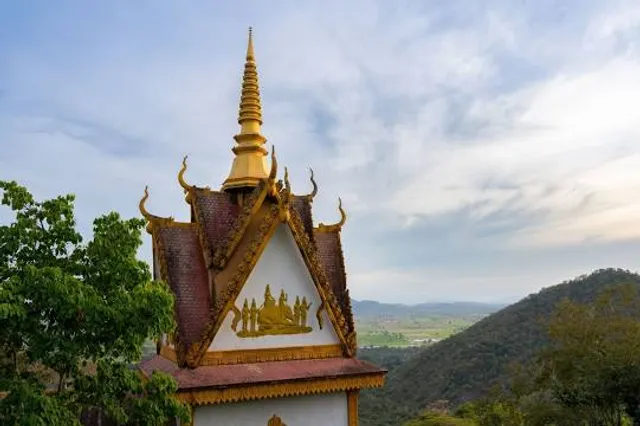
 Learn more insights from Wanderboat AI.