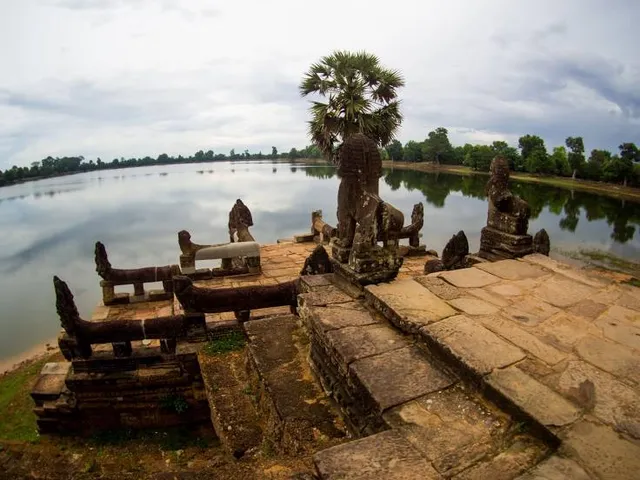
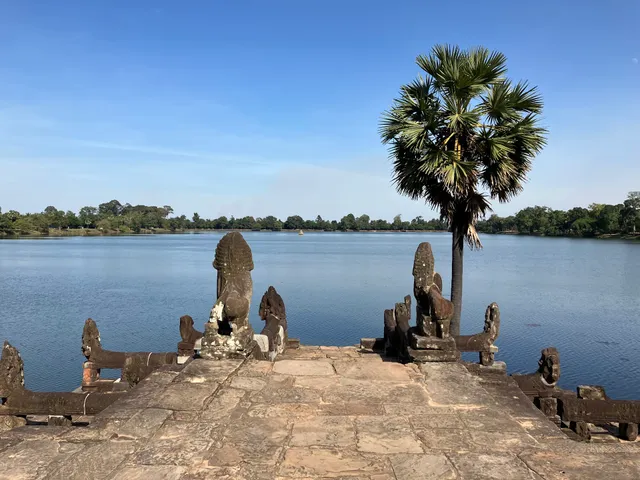
The name Banteay Kdei originates from an earlier name, Kuti, which is mentioned in the Sdok Kak Thom. This stele describes the arrival of Jayavarman II to the area, "When they arrived at the eastern district, the king bestowed an estate and a village called Kuti upon the family of the royal chaplain." This royal chaplain was the Brahman scholar Sivakaivalya, his chief priest for the Devaraja cult. The Khmer Empire lasted from 802 to 1431, initially under Hindu religious beliefs up to the end of the 12th century and later under Buddhist religious practices. It was a time when temples of grandeur came to be built and reached a crescendo during the reign of Suryavarman II until 1191, and later in the 12th–13th centuries, under Jayavarman VII. Many Buddhist temples were built, including the Banteay Kdei, from middle of the 12th century to early 13th century. Though Jayavarman VII was credited with building many temples, he was also accused of squandering money on extravagant temple building projects at the expense of society and other duties. He built Buddhist temples in which BodhisattvaAvalokitesvara was the main deity. This temple built, conforming to the style of the Ta Prohm and Preah Khan temples in the vicinity during the same period by Jayavarman VII, but of a smaller size, was built as a Buddhist monastic complex on the site of a 10th-century temple built by Rajendravarman. Some small inscriptions attest to the building of this temple by Jayavarman VII and the royal architect, Kavindrarimathana. Jayavarman VII had come to power at the age of 55 after defeating Chams who had invaded Angkor and subjected it to devastation. His "prodigious activity" resulted in the restoration of Cambodia from its ruins. He was chiefly the architect of the rebuilt capital at Angkor Thom and was called a "Great Builder". He was responsible for building many temples, which apart from Banteay Kdei, included the central temple of the Bayon, Prah Khan, Ta Prohm and many others, and also many rest houses for pilgrims. The reasons for building this temple at its present site is not known. However, it is established that the temple is a contemporary of the Angkor Wat as many similarities have been identified between the two, and also with Phimai temple in Thailand. It is reported to be the first temple built by Jayavarman VII in 1181 AD, opposite to the Srah Srang reservoir. In the 13th century, most of the temples built by Jayavarman were vandalised. However, some of the Mahayana Buddhist frontons and lintels are still seen in good condition. It is also the view of some archaeologists that the temple was built by Jayavarman II in honour of his religious teacher. The temple, which for several centuries after the Khmer reign ended, remained neglected and covered with vegetation. It was exposed after clearing the surrounding overgrowth of vegetation in 1920–1922. This work was carried out under the guidance of Henri Marchal (then Conservator of Angkor) and Ch. Battuer, by adopting a conservation principle which was known as "the principle of anastylosis, which was being employed very effectively by the Dutchauthorities in Indonesia". It was partially occupied by Buddhist monks till the 1960s. For ten years till March 2002, Sophia UniversityMission or the Sophia Mission of Japan carried out several Archaeological research at the Banteay Kdei temple. During these investigations, a cache of fragments of 274 Buddhist statues made in sandstone, along with a few metal art pieces, were unearthed, in 2001. Plans to build a storage room to house the statues was...
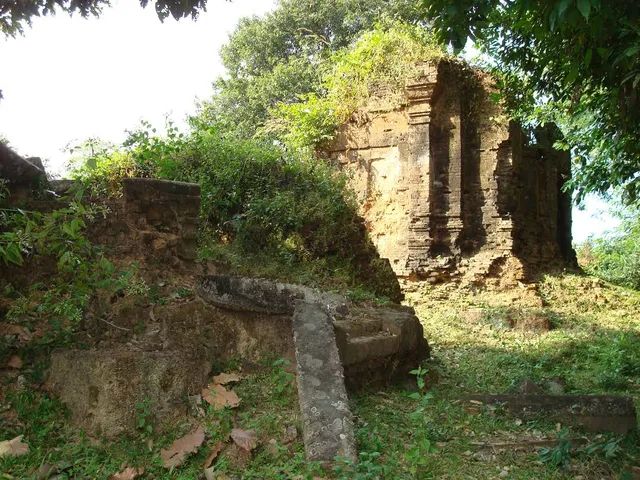
Read moreThe citadel of the cells. In the ruin and confusion of Banteay Kdei the carvings take one's interest. They are piquant, exquisite, not too frequent... they seem meant.. to make adorable a human habitation. Banteay Kdei is located south of Ta Prohm. A enter the monument from the west and leave at the west or vice versa, either way, also visit Srah Srang. It was built in middle of the 12th century to the beginning of the 13th century by king Jayavarman II in Mahaya Buddhism with following at least two different art periods Angkor Wat and Bayon are discernible at Banteay Kdei. BACKGROUND Banteay Kdei has not been restored and allows the visitor to experience what it may have looked like originally. Changes and additions account for is unbalanced layout. Banteay Kdei was built of soft sandstone and many of the galleries and porches have collapsed. The wall enclosing the temple was built of reused stones. LAYOUT The temple is built on the ground level use as a Buddhist monastery. The elements of the original design of Banteay Kdei seem to have been a Central Sanctuary, a surrounding gallery and a passageway connected to another gallery. A moat enclosed the original features of the temple. Another enclosure and two libraries were among the additions in the Bayon period. The outer enclosure (700 by 500 meters 2,297 by 1,640feet) is made of laterite and has four entry towers. A rectangular courtyard to the east is known as 'the hall of the dancing girls', a name derived from the decoration which includes dancers The entry tower of the second enclosure (3) is in the shape of a cross with three passages; the two on either end are connected to the literate wall of the enclosure (4) 320 by 200 scrolls of figures and large female divinities in niches. In the interior court there is a frieze of Buddha. A causeway of a later date, bordered with serpents, leads to the entry tower of the third enclosure. It comprises a laetrile wall includes a gallery with a double row of sandstone pillars that open onto a courtyard. Tip Parts of this area have been walled in and passage is limited. Vestiges of the wooden ceiling can still be seen in the central Sanctuary. The galleries and halls, which join it in a cross to the four entry towers, are probably additions. Two libraries open to the west in the courtyards on the left and right of...
Read moreIn the lush embrace of Siem Reap’s sprawling forest lies Banteay Kdei, a temple where time seems to pause and the bustling world fades away. Unlike the grandiosity of Angkor Wat, Banteay Kdei offers a personal, almost whispered invitation to explore its hidden mysteries—an experience that was profoundly memorable for our family.
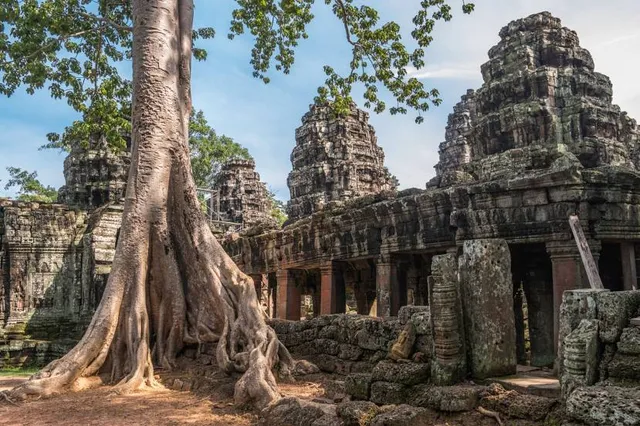
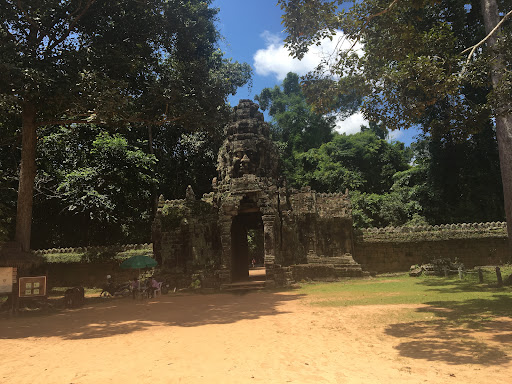
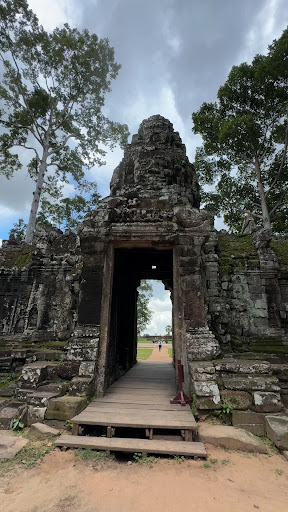
Approaching the temple, we were met with a sense of solitude that felt rare in a place so steeped in history. The dense foliage created an almost enchanted atmosphere, with dappled sunlight filtering through the trees and casting a soft glow over moss-covered stones. Walking through the entrance, we were immediately struck by the worn yet intricate carvings that seemed to tell their own ancient stories, inviting us to lean in and listen.
Our children, wide-eyed with curiosity, were delighted by the narrow passageways and hidden courtyards that seemed straight out of an adventure tale. They explored as if uncovering long-lost secrets, while we savored the quiet beauty around us. The stone faces gazing down from the temple’s towers felt both wise and watchful, their expressions softening as if to welcome us as honored guests.
One of the most enchanting moments was standing in the Hall of Dancers, surrounded by intricately carved apsaras. It was as though the stone figures had come alive, their frozen movements mirroring the grace of Banteay Kdei itself—a place that dances with time, untouched by the rush of modern life. The artistry here felt almost ethereal, as if we had stepped into another world.
Unlike the larger temples, Banteay Kdei was refreshingly accessible and uncrowded, making it perfect for families who wish to explore at their own pace. There was an underlying serenity that made each corner feel like a private discovery, giving us space to reflect and bond together in an environment that felt truly magical.
Banteay Kdei is more than a historical site; it is a journey through time, a gentle reminder of the beauty of impermanence, and a space where families can share in the wonder of Cambodia’s ancient legacy. For those seeking a destination that invites both contemplation and awe, Banteay Kdei is a hidden gem waiting to be discovered, and we’re grateful to have shared in its quiet majesty...
Read more