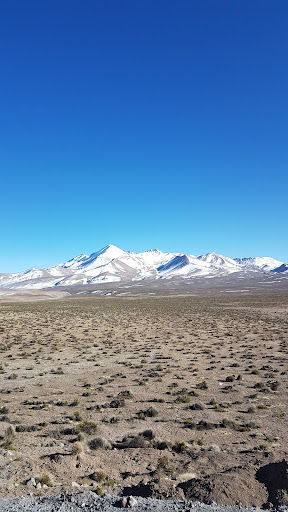
We drove in a 4x4 pickup (Toyota Hilux) from Colchane to Putre through PN Vulcan Isluga and Reserva National Las Vicuñas. The road south of the Salar de Surire is difficult in places and needs a high clearance vehicle to deal with a ford and some deeply rutted roads. We also used 4x4 in places to cope with loose road surface on steep inclines. The road north of Salar de Surire is in good condition as it is used by the mining trucks (of which there were many on the road; we treated them respectfully and they were helpful in indicating when we could pass). NOTE: when we contacted the local police they told us the north section of the road was not passable; we were not convinced they actually knew and had fortunately received information locally that the road was passable (from Hostal Altus: great place to stay, and from Antiplano travel). Conaf Tarapaca were responsive by email and had confirmed the state of the southern roads (passable with high clearance vehicle, 4x4 recommended). Conaf Arica did not reply to our emails. The route through the parks is highly recommended; really amazing scenery and good wildlife (we saw flamingo, fox, vizcacha and other birds, many many vicuñas...
Read moreEl Parque Nacional Lauca (en aimara: lawq'a, ‘pasto acuático’)? fue creado en Chile en 1965 como reserva forestal y adquirió su actual estatus en 1970 en parque nacional. Su superficie alcanza las 137 883 hectáreas. Comprende la precordillera y el altiplano andino, en altitudes entre los 3200 a 6342 msnm, en el extremo este de la región de Arica y Parinacota, comuna de Putre, provincia de Parinacota, encontrándose al norte de la reserva nacional Las Vicuñas. A su extremo poniente limita con el Río Lluta y al oriente con la frontera de Bolivia. Su nombre lo comparte con el río Lauca.
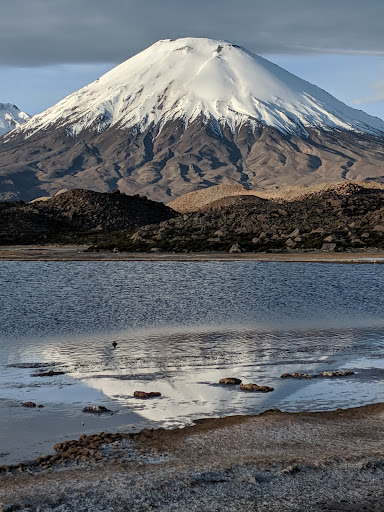
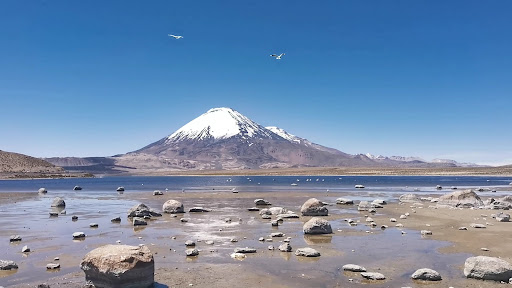
Este parque nacional representa no solo al altiplano, sino que tiene parte de su superficie en la estepa desértica prealtiplánica, ubicada en la precordillera. Presenta lluvias en verano y nieve en el invierno; el clima es seco con 280 mm. de precipitación media anual y una temperatura promedio que oscila entre 12 y 20 °C durante el día y -3 a –10 °C en la noche. El relieve del parque es, en general, irregular. Se destacan los volcanes Parinacota, de 6342 msnm; Pomerape, de 6282 msnm; Guallatiri, de 6060 msnm, y Acotango, de 6050 msnm.
En 1981, el parque pasó a ser parte de la lista mundial de reservas de la biosfera de la Unesco. El gobierno chileno estudia la desafectación de parte de este parque nacional para permitir la explotación minera por Codelco, Anglo American, BHP y Río Tinto
Como llegar? Se accede al parque por la vía internacional Arica- La Paz, Ruta 11-CH. Se encuentra a 14 km de la localidad de Putre y a 187 km de la ciudad de Arica.[2] La ciudad de Arica se encuentra a 30 metros sobre el nivel del mar y la localidad de Putre a 3.550 metros...
Read moreWhat an amazing place. It's like nowhere else! The high altitude lake and bird life are very special. Views of snow topped volcanoes, caves to climb up to, the boardwalk across the wetlands, llamas, alpacas and vicuñas, craggy mountains and thermal springs to soak in, all make this a unique part of the world. And a visit to the tiny Andean village of Parinacota is an absolute must with its adobe church from the 17th century and the tiny school with...
Read more